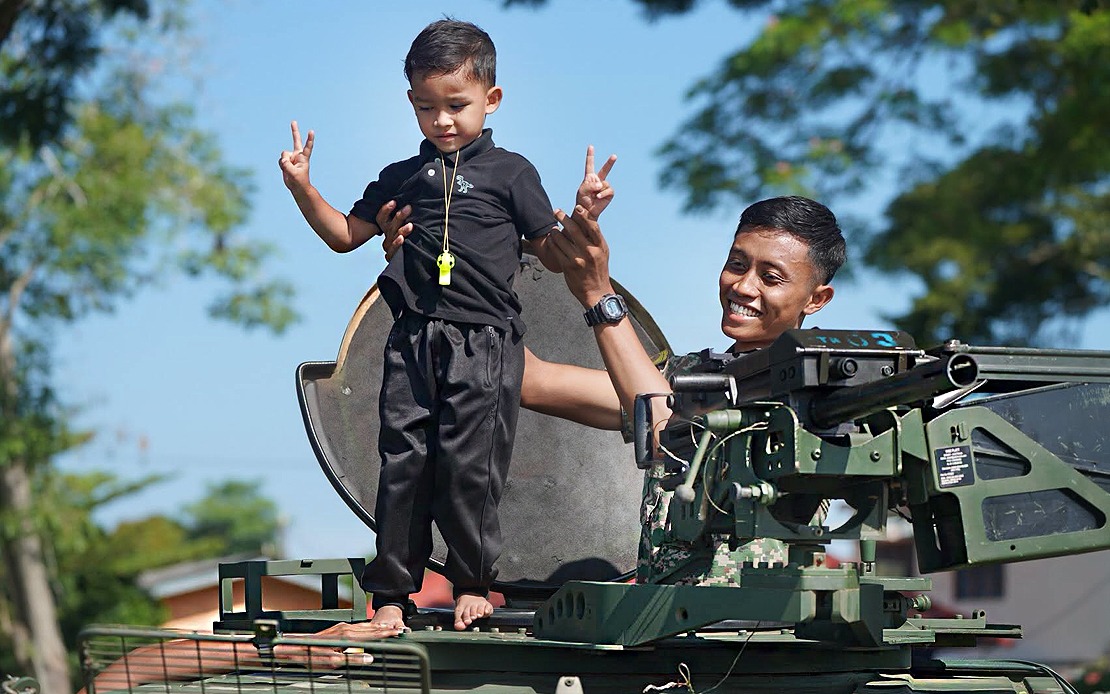
The Ministry of Defence has moved to deepen its engagement with communities across Malaysia through a multi-faceted approach combining infrastructure development, social services, and spiritual activities in the Alor Gajah district. The 'Program Jiwa Murni MADANI' initiative, rolled out at Padang Awam Kampung Gadek, represents a strategic effort to position the Malaysian Armed Forces as active participants in local development rather than distant institutions. This community-oriented strategy reflects a broader shift in defence thinking, where civilian welfare and military presence are increasingly intertwined to build trust and social cohesion at the grassroots level.
The flagship programme delivered a comprehensive range of services directly addressing immediate community needs. Free medical screenings provided by defence personnel created accessible healthcare touchpoints for residents who might otherwise struggle to reach such services. Entrepreneurship workshops and career exhibitions signalled the armed forces' role in economic development conversations, while RAHMAH Sales initiatives—part of the government's cost-of-living assistance programme—demonstrated how defence resources can be mobilised for economic relief. Sports competitions and mobile government counters further illustrated the breadth of activities designed to make defence institutions tangible and relevant to everyday civilian concerns, particularly in smaller towns where such integrated service delivery remains uncommon.
The infrastructure dimension of the initiative carries particular significance for understanding MINDEF's strategic approach. The 9th Squadron of the Royal Engineers Regiment undertook five substantial community projects valued at RM179,200, addressing infrastructure gaps that had likely accumulated over years. Repairs to the Multi-Purpose Hall playground in Kampung Baru and the futsal court in Taman Seri Kelemak directly enhanced recreational spaces for young people. The restoration work on religious buildings—the Madrasah Seri Kemuning and Surau Madrasah Khairiah—acknowledged the central role of spiritual institutions in rural Malaysian communities. Similarly, the fence repairs at Sekolah Jenis Kebangsaan (Tamil) Durian Tunggal represented recognition of educational infrastructure needs across diverse communities. These projects demonstrated how engineering capability within the armed forces could be deployed for civilian benefit rather than remaining exclusively military-focused.
Deputy Defence Minister Adly Zahari's presentation of RM133,000 in grants through the Service Centre Initiative expanded the reach of MINDEF's commitment across eight recipients representing diverse faith communities and organisational structures. The distribution across Suraus, temples, shrines, and schools reflected a deliberate approach to avoiding sectarian bias and ensuring that defence ministry support benefited all demographic groups within the district. The grants to Surau Kampung Ulu Batang Melaka, Surau Al Mubarakah in Taman Dimensi, the Chee Sen Ting Temple Association, and similar organisations demonstrated how government defence resources could support the infrastructure and operational needs of community spiritual centres. The inclusion of SJKT Batang Melaka for a GreenLab project indicated MINDEF's engagement with environmental education and sustainability concerns increasingly important to younger Malaysians.
The distribution of 500 RAHMAH baskets to MAF veterans' associations and local residents carried dual significance beyond simple welfare provision. For veterans, the initiative acknowledged their continued integration within civilian society and ensured they remained part of defence ministry support structures even after service concluded. For general residents, the gesture reinforced the government's positioning on cost-of-living pressures—a dominant concern for Malaysian voters. The visible presence of armed forces personnel distributing goods created human connections that abstract policy announcements cannot replicate, building what security theorists term 'soft power' through direct social engagement.
Complementing the main programme, the Religious Corps of the Malaysian Armed Forces organised the 'Program Ilmu dan Muafakat MADANI' at Masjid Kelemak, which integrated spiritual observance with community dialogue. The organisation of Maghrib and Isyak congregational prayers, followed by lectures and charity contributions, positioned the armed forces as participants in the Islamic religious calendar and community worship. This approach differs markedly from secular or purely functional engagement models, recognising that in Malaysian context, spiritual and social dimensions cannot be cleanly separated. The mosque setting provided a familiar venue where civilians might feel comfortable discussing defence-related issues or articulating concerns in trusted environments.
The integration of these programmes under the umbrella of MADANI—the government's broader social policy framework—situates defence activities within larger narratives about inclusive economic growth and social cohesion. Rather than operating in isolation, MINDEF's initiatives become threads in a comprehensive government tapestry aimed at addressing citizen concerns across multiple domains. This alignment with national policy frameworks enhances legitimacy and ensures resources flow through recognisable channels rather than appearing as ad-hoc military goodwill gestures. For Malaysian readers accustomed to fragmented government services, seeing defence institutions actively contribute to coordinated national initiatives suggests institutional maturation.
The deliberate emphasis on civil-military cooperation (CIMIC) throughout both programmes reflects evolving security doctrine. CIMIC principles emerged from international peacekeeping and counter-insurgency operations, but MINDEF's application in domestic Alor Gajah contexts demonstrates how such thinking has been internalised and mainstreamed into regular defence operations. Rather than viewing civilians as populations to be managed or controlled, CIMIC frameworks treat communities as partners in mutual development. This philosophical shift, if sustained, could reshape how Malaysians perceive defence institutions—not as remote military establishments but as organisations embedded within civil society.
The connection to Core 4 of the National Defence Strategic Plan 2026-2030 indicates that these activities represent long-term strategic commitments rather than temporary initiatives. Core 4 emphasises human security and societal resilience, reflecting recognition that defence in contemporary contexts extends far beyond military capabilities to encompass social stability and citizen wellbeing. By anchoring community engagement to official strategic documents, MINDEF signals that such work carries institutional weight and will persist beyond any single administration or leadership change. This structural integration distinguishes genuine strategic reorientation from superficial public relations exercises.
For Southeast Asian regional observers, Malaysia's MINDEF approach offers an interesting model for civil-military integration. Many regional neighbours struggle with balancing military institutional interests with civilian needs, often defaulting to hierarchical or extractive relationships. Malaysia's MINDEF, through initiatives like those in Alor Gajah, demonstrates how armed forces can serve development objectives while maintaining professional military standards. The approach proves particularly relevant for smaller nations where defence budgets cannot accommodate both large standing militaries and comprehensive civilian services, necessitating creative institutional arrangements.
The Alor Gajah programme's success will ultimately depend on sustained implementation and genuine responsiveness to community feedback. One-time infrastructure projects and grant distributions, however generous, create limited lasting impact without follow-up engagement and maintenance commitments. Communities benefit most when defence institution presence becomes normalised and predictable, allowing residents to build trust through repeated positive interactions. The announced continuation of PIKAT and PJM initiatives suggests MINDEF understands this principle, but only long-term monitoring will confirm whether commitments translate into consistent action.
For Malaysian policymakers and defence analysts, these initiatives represent measured progress in civilianising military institutions and embedding armed forces within broader development frameworks. The challenge ahead involves scaling such programmes across districts while avoiding tokenism or superficial engagement. Real civil-military cooperation demands substantial resource commitments, genuine civilian input into priorities, and willingness to adapt programmes based on community needs rather than predetermined institutional agendas. If MINDEF maintains this trajectory, the defence ministry could emerge as a model of how armed forces institutions contribute meaningfully to development while preserving professional military capacity.

