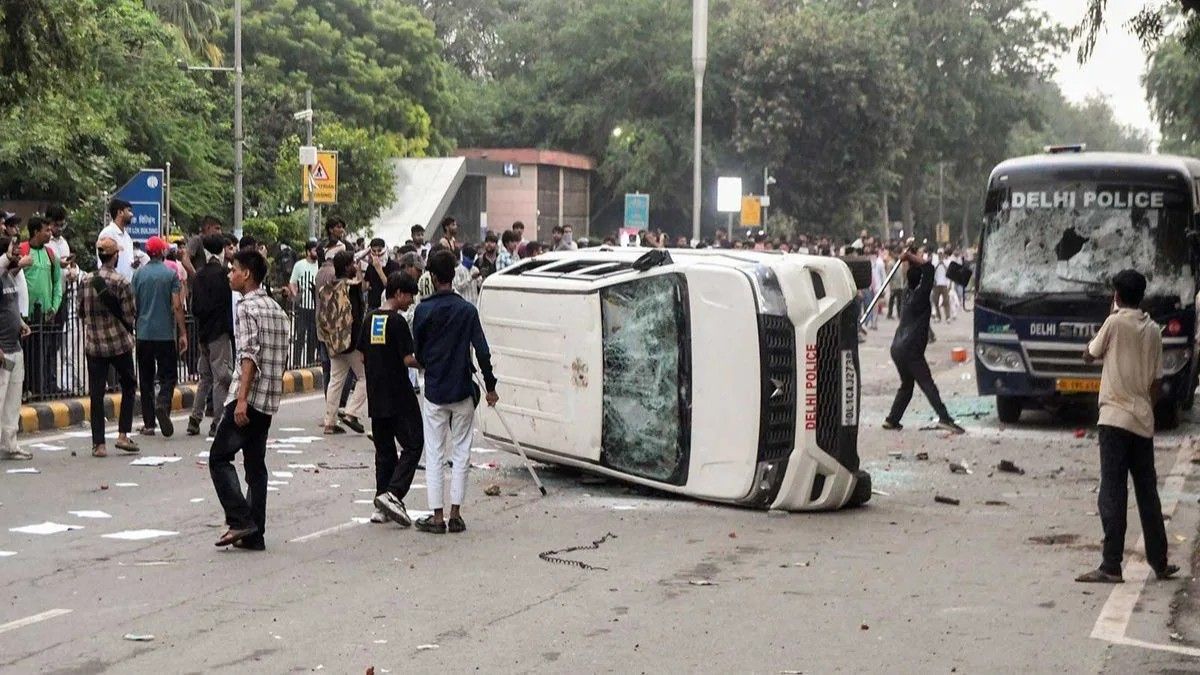
The Indian capital's law enforcement agency has widened its legal net in response to disturbances accompanying the Cockroach Janta Party's parliamentary demonstration, registering a total of 10 first information reports across multiple police stations in New Delhi. The filings represent a significant escalation in the official response to Monday's confrontations, in which security forces clashed with demonstrators marching towards Parliament House to demand the removal of Union Education Minister Dharmendra Pradhan over concerns about examination administration and integrity.
The distribution of cases reveals a coordinated investigative approach spanning the city's central administrative zones. Parliament Street police station accounts for four of the registered FIRs, while Connaught Place station holds three. The remaining three have been filed at Mandir Marg, Barakhamba Road, and Kartavya Path police stations respectively. This dispersal suggests that violence and related incidents occurred across multiple locations rather than being confined to a single flashpoint, indicating the scale of the Monday demonstrations and the scattered nature of the confrontations.
Critically, Delhi Police issued a formal denial through their New Delhi district command that allegations of fresh stone-throwing or police intervention circulating on social media platform X on Tuesday bore any truth. The Deputy Commissioner of Police explicitly characterized videos claiming to document Tuesday incidents as "false and misleading," warning citizens to depend exclusively on official government communications rather than unverified online content. This statement underscores the tension between ground-level claims and institutional accounts in an era when protest documentation reaches audiences instantly through digital channels.
The registered cases invoke an expansive legal framework designed to address various dimensions of the unrest. Authorities have employed provisions from the Bharatiya Nyaya Sanhita, India's recently reformed criminal code, alongside the Arms Act and the Prevention of Damage to Public Property Act. Specific allegations include alleged conspiracy, interference with government operations, violence directed at police officers, and destruction of state and civilian property. One FIR specifically addresses an alleged life-threatening assault on a Rapid Action Force operative, while another concerns unauthorised drone operation during parliamentary proceedings—a detail suggesting security concerns beyond conventional protest management.
Despite police denials regarding Tuesday's situation, the CJP protest maintained its presence at Jantar Mantar, the historic venue for civil disobedience in New Delhi. Demonstrators had resumed their sit-in following the removal of tents and temporary stage structures by security personnel the previous evening, and substantial police and Rapid Action Force contingents remained stationed at the location. The continued occupation of this symbolically charged space represents a defiant posture by protest organisers unwilling to accept Monday's violent dispersal as a conclusion to their campaign.
CJP spokesperson Ashutosh Ranka signalled that the movement would persist until Minister Pradhan's resignation materialised, framing the demonstration as sustained civil pressure rather than a single event. Ranka also alleged that numerous participants, explicitly mentioning students and volunteer activists, had sustained injuries during Monday's police response. His testimony further claimed that female demonstrators experienced mistreatment, naming Geetanjali J. Angmo, wife of environmental activist Sonam Wangchuk, as having faced particular hardship during the security response.
Police investigations have adopted a labour-intensive methodology to establish the sequence of events and potential premeditation. Authorities announced they are reviewing more than 250 video recordings to identify individuals involved in violent conduct and to determine whether orchestrated planning preceded the outbreak of street clashes. This forensic examination of digital evidence represents the contemporary standard for investigating mass protest incidents in urban India, where the prevalence of recording devices and social media creates both documentation and evidentiary challenge.
The procedural posture reflects broader tensions between protest management and accountability frameworks. Delhi Police released their own footage depicting stone-throwing in the Connaught Place district, simultaneously appealing for peaceful conduct while establishing visual documentation of alleged protester misconduct. This dual message—simultaneous evidence-gathering against demonstrators while requesting their voluntary compliance—illustrates the complex communication strategies law enforcement employs during extended civil disturbances.
From a Southeast Asian perspective, Delhi's handling of the CJP protest illuminates enduring questions about managing dissent in India's democratic system. The scale of the police response, the breadth of legal provisions invoked, and the deployment of force during a march by an opposition political party reflect the stakes surrounding educational governance controversies in Indian politics. For Malaysia and other regional democracies, the incident demonstrates how examination system controversies can catalyse broader political mobilisation when coupled with public trust deficits and institutional tensions.
The underlying demands reveal substantive governance concerns rather than merely partisan positioning. Education ministry examination irregularities represent genuine public policy failures affecting millions of young citizens, rendering the protest fundamentally rooted in accountability demands rather than abstract political rivalry. This distinction matters for understanding whether law enforcement responses are directed at preserving public order or suppressing legitimate accountability mechanisms.
The social media dimension adds complexity absent from protest dynamics of previous decades. The circulation of contested videos and claims of "false and misleading" content creates parallel realities where citizens encounter conflicting accounts of identical events. Police institutional authority competes with citizen-recorded evidence, each with constituencies of believers, complicating the establishment of what actually occurred and why.
Moving forward, the scale of pending investigations and the CJP's commitment to continued mobilisation suggest that Delhi may experience sustained protest activity as the legal proceedings unfold. The outcome of both the criminal investigations and the political campaign for ministerial accountability will likely shape public confidence in institutions and influence how similar educational governance controversies are handled politically going forward.

