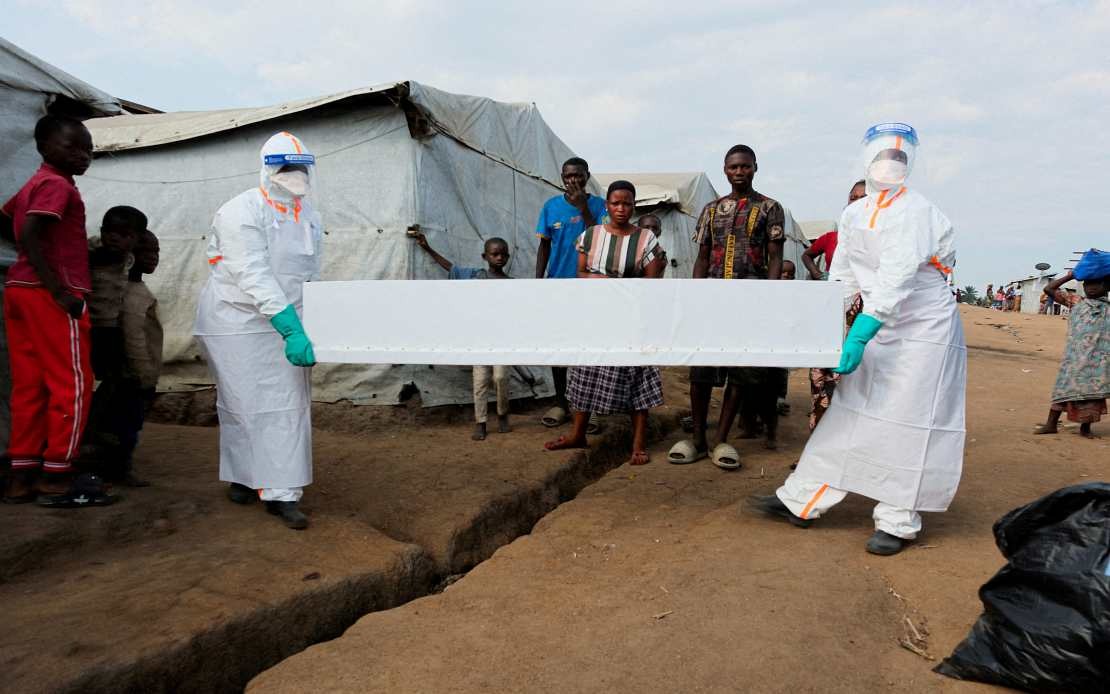
The Democratic Republic of Congo faces a deepening public health emergency as confirmed Ebola virus cases surged past the 1,000 threshold, with health authorities reporting 1,003 confirmed infections and 254 deaths as of mid-June. The outbreak, formally declared on May 15, has triggered widespread concern across the region, particularly given warnings from international health bodies that transmission rates could spiral beyond current containment capacity if immediate interventions prove insufficient.
The current mortality rate of 25.3 per cent underscores the severity of the crisis affecting populations in the eastern provinces of Ituri, North Kivu, and South Kivu. Health Minister Roger Kamba acknowledged that despite substantial recovery efforts—with at least 100 patients recovering—significant challenges remain in maintaining the contact follow-up infrastructure essential to breaking transmission chains. Approximately 365 patients remain either hospitalised or under isolation as medical teams work to stabilise cases and prevent further spread into adjacent communities.
The Africa Centres for Disease Control and Prevention issued a stark assessment last week, cautioning that failure to contain transmission rapidly could produce a catastrophe matching or exceeding the 2014-2016 West African epidemic, which claimed over 11,000 lives across Guinea, Liberia, and Sierra Leone. That historical context carries weight for regional policymakers: those earlier outbreaks demonstrated how quickly Ebola can overwhelm fragile health systems and trigger broader socioeconomic disruption. The DRC outbreak therefore represents not merely a localised crisis but a potential threat to stability across Central Africa.
Recent scientific findings have clarified the outbreak's origins in ways that both simplify and complicate the response picture. Researchers from Uganda's Department of National Health Laboratory and Diagnostic Services and Congo's Institute of National Biomedical Research confirmed that the circulating strain is Ebola Bundibugyo, stemming from a novel wildlife spillover event rather than emergence from dormant or cryptically spreading chains from previous outbreaks. This determination matters considerably: it indicates the outbreak is genuinely novel, eliminating false hopes that it might represent residual transmission from contained incidents, yet simultaneously confirming that zoonotic sources remain active and unpredictable.
Response operations centre on three fronts that health authorities emphasise must advance in parallel. Active field investigations continue to map transmission networks and identify at-risk individuals requiring monitoring. Epidemiological surveillance systems attempt to detect cases before clusters become unmanageable. Concurrently, prevention messaging and community engagement efforts seek to shift behaviour in ways that reduce exposure—particularly in regions where traditional burial practices and family care customs may inadvertently facilitate transmission among close contacts.
Health Minister Kamba reported that community communication initiatives are being scaled up alongside expanded diagnostic capacity and improved case management protocols. These measures reflect acknowledgement that technical medical capacity alone cannot suppress Ebola; population-level behaviour change and trust in health authorities prove equally critical. In contexts where healthcare systems have faced repeated stress and where suspicion of external actors remains common, building this trust requires sustained, culturally sensitive engagement rather than purely directive public health mandates.
The contact follow-up rate decline that Kamba noted presents a concerning indicator. Monitoring individuals exposed to confirmed cases represents one of epidemiology's most powerful tools for pre-empting spread; when this function deteriorates, gaps widen through which undetected transmission can proliferate. Resource constraints, insecurity in affected regions, and population displacement all complicate tracking efforts, suggesting that case numbers may understate the true scale of ongoing transmission.
For Malaysian policymakers and public health officials, the DRC situation carries instructive lessons regarding pandemic preparedness and response scaling. The outbreak demonstrates how rapidly infectious disease can move from affecting hundreds to exceeding thousands within weeks, and how international cooperation—whether through diagnostic expertise sharing or technical guidance—becomes essential when individual nations face overwhelming caseloads. Southeast Asian countries have made substantial investments in disease surveillance infrastructure; the DRC experience validates this priority and underscores the importance of maintaining readiness despite periods without active major outbreaks.
The strain confirmation also highlights the unpredictability of zoonotic spillover events in an era of climate change, deforestation, and human encroachment on wildlife habitats—factors affecting Southeast Asia as directly as Central Africa. Wildlife-to-human transmission pathways remain inadequately understood, and prevention depends partly on habitat management and agricultural practices that limit contact between human populations and reservoir species. The DRC outbreak thus represents a broader biosecurity challenge transcending national borders.
Looking forward, suppression of this outbreak will likely extend over months rather than weeks, requiring sustained international donor commitment, security improvements in affected provinces, and demonstrated improvement in case finding and isolation. The trajectory of the coming weeks will prove crucial in determining whether current interventions sufficient to flatten transmission curves or whether—as the Africa CDC warned—the situation deteriorates into a regional catastrophe reminiscent of the West African precedent. For neighbouring countries and the broader international community, maintaining vigilance and supporting DRC's response represents an investment in regional stability.
%22%2F%3E%3C%2Fpattern%3E%3C%2Fdefs%3E%3Crect%20width%3D%22100%25%22%20height%3D%22100%25%22%20fill%3D%22url(%23ph2z4zlg)%22%2F%3E%3Crect%20width%3D%22100%25%22%20height%3D%22100%25%22%20fill%3D%22url(%23ph2z4zlp)%22%2F%3E%3Ctext%20x%3D%2250%25%22%20y%3D%2250%25%22%20text-anchor%3D%22middle%22%20dominant-baseline%3D%22central%22%20fill%3D%22rgba(255%2C255%2C255%2C0.95)%22%20font-family%3D%22Georgia%2C%20'Times%20New%20Roman'%2C%20serif%22%20font-weight%3D%22700%22%20font-size%3D%22226%22%20letter-spacing%3D%22-0.02em%22%3EPolice%3C%2Ftext%3E%3C%2Fsvg%3E)
%22%2F%3E%3C%2Fpattern%3E%3C%2Fdefs%3E%3Crect%20width%3D%22100%25%22%20height%3D%22100%25%22%20fill%3D%22url(%23ph51habg)%22%2F%3E%3Crect%20width%3D%22100%25%22%20height%3D%22100%25%22%20fill%3D%22url(%23ph51habp)%22%2F%3E%3Ctext%20x%3D%2250%25%22%20y%3D%2250%25%22%20text-anchor%3D%22middle%22%20dominant-baseline%3D%22central%22%20fill%3D%22rgba(255%2C255%2C255%2C0.95)%22%20font-family%3D%22Georgia%2C%20'Times%20New%20Roman'%2C%20serif%22%20font-weight%3D%22700%22%20font-size%3D%22272%22%20letter-spacing%3D%22-0.02em%22%3EQatar%3C%2Ftext%3E%3C%2Fsvg%3E)