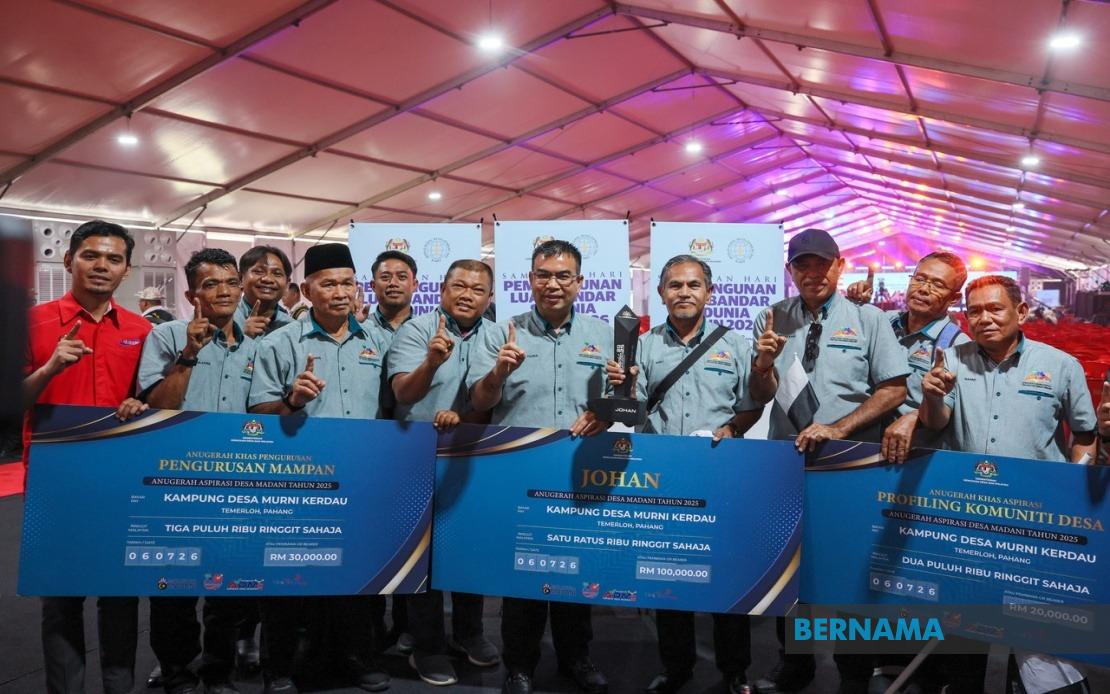
Desa Murni Kerdau, a village located in Temerloh within Pahang state, has emerged as a major winner at the World Rural Development Day 2026 celebration held at Tun Abdul Razak Stadium in Jengka Sentral. The village successfully claimed three significant awards during the prestigious event, marking a watershed moment in its development trajectory and positioning it as a model for rural advancement across the country.
The accolades bestowed upon Desa Murni Kerdau reflect the breadth of its accomplishments across multiple dimensions of rural development. The village was designated the 2025 MADANI Rural Aspiration Award Champion, the most prestigious of the three honours. Additionally, it received the Rural Community Profiling Aspiration Special Award and the Sustainable Management Special Award, recognising its comprehensive approach to balancing community welfare with environmental and organisational responsibility.
Deputy Prime Minister Datuk Seri Dr Ahmad Zahid Hamidi personally presented the flagship MADANI award, underscoring the significance attributed to the village's achievements at the highest levels of government. The two additional special awards were conferred by Datuk Rubiah Wang, Deputy Minister of Rural and Regional Development, further cementing official endorsement of the village's progress in implementing sustainable rural initiatives.
According to Mohamad Fazrul Ahmad, the Chairman of the Village Development and Security Committee for Desa Murni Kerdau, these recognitions serve as validation of the community's dedication to strengthening governance structures and enhancing local leadership capacity. He characterised the awards as testimonials to the village's systematic approach to fostering sustainable community development, suggesting that institutional frameworks established locally have successfully translated policy objectives into tangible improvements affecting residents' quality of life.
The village has demonstrated entrepreneurial vitality that extends well beyond traditional agricultural economies. Desa Murni Kerdau has successfully nurtured approximately 20 entrepreneurs across diverse sectors ranging from small and medium-sized industries and farming operations to the automotive sector. This diversification of the economic base has helped insulate the community from vulnerabilities associated with dependence on single-sector livelihoods, a persistent challenge in many rural Malaysian settings.
Tourism development has emerged as a significant pillar of the village's economic strategy. The community has gained recognition nationwide for its "Kampung Stay" tourism initiative, which has positioned Desa Murni Kerdau among the country's prominent rural tourism destinations. This venture exemplifies how villages can leverage their cultural heritage and traditional character as economic assets, creating employment and generating revenue streams that benefit broader community development while preserving authentic rural character.
The physical infrastructure and demographic composition of Desa Murni Kerdau reflect a well-structured settlement pattern. The village comprises approximately 200 residential units housing over 600 inhabitants, creating a community size that facilitates coordinated development initiatives whilst maintaining the social cohesion characteristic of traditional settlements. This scale has apparently enabled effective implementation of governance and development programmes without the administrative complexities that can impede smaller or larger communities.
The financial awards obtained from these recognitions will serve targeted community purposes rather than being retained in administrative coffers. Mohamad Fazrul indicated that prize money would be distributed directly to residents and channelled toward village improvement projects, demonstrating commitment to ensuring development benefits reach households directly. This approach contrasts with centralised resource allocation models and reflects growing emphasis on participatory development that empowers communities to determine investment priorities.
For Malaysian policymakers and rural development specialists, Desa Murni Kerdau presents a compelling case study in integrated rural development. The village has simultaneously advanced economic diversification, tourism integration, institutional governance, and sustainable management—elements that typically compete for limited resources. The replicability of this model across other Malaysian villages remains a significant consideration, particularly in light of the Rural and Regional Development Ministry's broader mandate to uplift rural standards of living nationwide.
The recognition carries particular resonance within the MADANI framework, the government's broader policy commitment emphasising prosperity, unity, transparency, and accountability. Desa Murni Kerdau's success in meeting MADANI criteria suggests that rural communities, with appropriate support structures and institutional capacity-building, can advance comprehensively across economic, social, and governance dimensions. This challenges narratives portraying rural development as inherently constrained by resource limitations or geographic disadvantages.
Looking forward, the international dimensions of World Rural Development Day celebrations reflect Malaysia's engagement with global rural development discourse. As Southeast Asian nations increasingly prioritise rural advancement amid urbanisation pressures, examples like Desa Murni Kerdau provide regionally relevant benchmarks for balanced development strategies that neither abandon rural communities nor romanticise rural life whilst ignoring legitimate aspirations for modern services and economic opportunity. The awards underscore that rural excellence remains achievable through systematic commitment to inclusive governance and strategic diversification.

