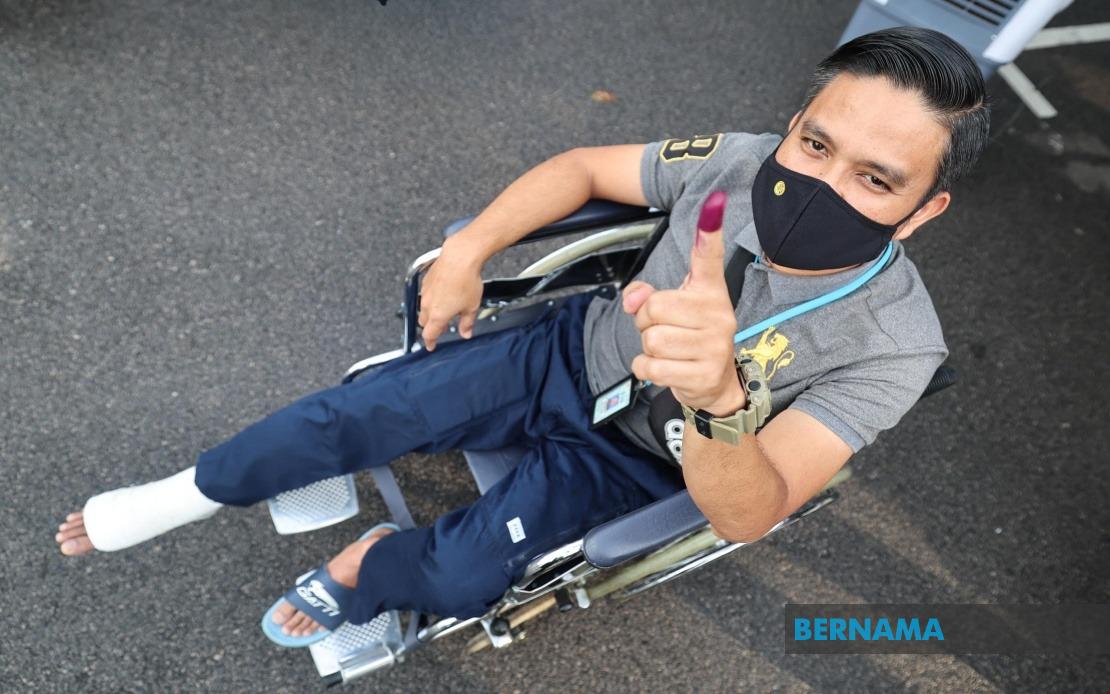
The 16th Johor state election witnessed a striking display of civic dedication when Sergeant Syahrizal Musa, a 40-year-old police officer, arrived at an early voting centre on a wheelchair to cast his ballot. Syahrizal had sustained the injury just days earlier while playing sepak takraw, the traditional Malaysian sport requiring considerable agility and footwork. Despite medical advice to remain on leave until July 16, the officer made the deliberate choice to fulfil his electoral responsibility, travelling from the police quarters in Tampoi with a friend to reach the Johor Police Contingent Headquarters voting centre.
The decision reflected Syahrizal's deep sense of duty that has characterised his police career spanning more than two decades. In conversation with reporters at the centre, he emphasized that his physical condition posed no legitimate barrier to participation in the democratic process. Having served the Royal Malaysia Police for over 22 years, he noted that this represented his first time voting whilst using a wheelchair, yet he expressed determination that such circumstances would not deter him from exercising his franchise. His commitment underscored a broader principle: that voting constitutes a fundamental responsibility for Malaysian citizens regardless of temporary health setbacks.
Syahrizal's background reveals a man deeply engaged with his community beyond his professional obligations. Originally from Seri Iskandar in Perak, he has maintained an active involvement in sepak takraw throughout his life, even representing the police contingent in multiple tournaments before his recent injury. Having transferred to Johor Police Contingent Headquarters in 2014 after nine years stationed at the Muar district police office, he has become rooted within the Johor policing establishment. This sporting engagement alongside his security role demonstrates the multifaceted nature of service within Malaysia's uniformed personnel.
The injury itself, while painful, proved relatively contained in medical terms. Doctors confirmed that Syahrizal sustained only a minor tear to his Achilles tendon, the thick connective tissue running along the back of the calf that bears substantial stress during athletic activity. Sepak takraw, requiring rapid directional changes and explosive lower-body movements, placed extreme demand on this vulnerable anatomical structure. The medical prognosis suggested recovery within a fortnight, yet the immediate pain and mobility restrictions were sufficiently severe to warrant official medical leave extending through mid-July.
The early voting arrangements for Johor's election provided critical accommodation for military and police personnel who would face operational demands during the regular polling period. A total of 64 polling centres operated specifically for early voting, facilitating participation among 24,751 eligible early voters. This population comprised 12,041 personnel from the Malaysian Armed Forces alongside their spouses, and an additional 12,710 members of the Royal Malaysia Police and General Operations Force with their respective families. The infrastructure essentially recognised that security personnel, by virtue of their professional responsibilities, might face scheduling conflicts with standard election day procedures.
Syahrizal's participation within this structured framework represented both personal principle and systemic design functioning effectively. His insistence upon voting despite injury illustrated the human dimension of democratic participation, where individual citizens prioritise their civic engagement even when substantial personal inconvenience results. From a systemic perspective, the early voting arrangement enabled his participation without compromising either his medical recovery or his professional obligations. The synchronisation of democratic access with the realities of security personnel's working lives demonstrated thoughtful election administration.
The broader electoral context underscores why Syahrizal felt compelled to participate despite his injury. The 16th Johor state election represented a significant democratic exercise, with 172 candidates contesting across 56 state assembly seats. Approximately 2.7 million ordinary voters would proceed to the polls on the Saturday following the early voting period, each casting ballots that collectively would determine Johor's political direction. In this context, even individual votes carry meaningful weight within democratic legitimacy, a principle that evidently resonated deeply with Syahrizal's understanding of civic responsibility.
Syahrizal's public appeal carried particular resonance for wider Malaysian electoral participation. Speaking with media representatives, he encouraged fellow citizens to exercise their franchise, framing voting as essential to determining both the state's and nation's collective future. This appeal transcended the particular circumstances of his injury, addressing instead the fundamental question of why electoral participation matters. In a nation where voter turnout occasionally concerns democratic observers, the sight of a wheelchair-bound police officer making deliberate effort to cast his ballot transmitted a powerful symbolic message about the importance of engagement.
The sepak takraw context added a distinctly Malaysian cultural dimension to the narrative. Unlike many Western nations where such stories might involve injuries from mainstream sports, Syahrizal's injury emerged from enthusiastic participation in a sport deeply embedded within Malaysian and broader Southeast Asian identity. His willingness to prioritise voting over continued physical recuperation represented a local variation on universal democratic themes, demonstrating how civic values can intersect with cultural particularities. The image of a sepak takraw player foregoing comfortable recovery to fulfill voting duties resonated powerfully within Malaysian cultural contexts.
The incident also reflected positively on institutional support within Malaysia's security apparatus. The designation of early voting centres specifically at police and military facilities, combined with the provision of accessible voting arrangements for personnel facing mobility challenges, indicated organisational commitment to enabling broad participation. Syahrizal's successful vote casting would have required staff assistance in navigating the polling booth whilst using a wheelchair, suggesting behind-the-scenes facilitation that enabled his participation. Such practical accommodation, though sometimes overlooked, proves essential to realising inclusive democratic access.
Looking forward, Syahrizal's example established a template for understanding democratic participation beyond narrow utilitarian calculations. When a police officer chooses to vote despite genuine physical pain and medical advice to rest, the decision reflects something deeper than mere civic obligation. It suggests rather an understanding of voting as fundamentally connected to identity, community membership, and personal stake in collective outcomes. His 22-year record of never missing an election, even whilst managing a career that has relocated him across multiple Johor postings, demonstrated consistency that transcended any single electoral cycle.
The symbolic resonance extended to questions about democratic resilience within Malaysian society. At a moment when various pressures and competing demands fragment citizen engagement, the visible determination of an injured officer to participate offered quiet testimony to persisting democratic commitment. Whether measured through early voting statistics, turnout rates on polling day, or individual stories like Syahrizal's, Malaysia's electoral processes continued functioning as mechanisms for popular voice and civic expression. The sergeant's wheelchair at the polling centre became less an image of limitation and more an emblem of determination to engage meaningfully with democratic processes.

