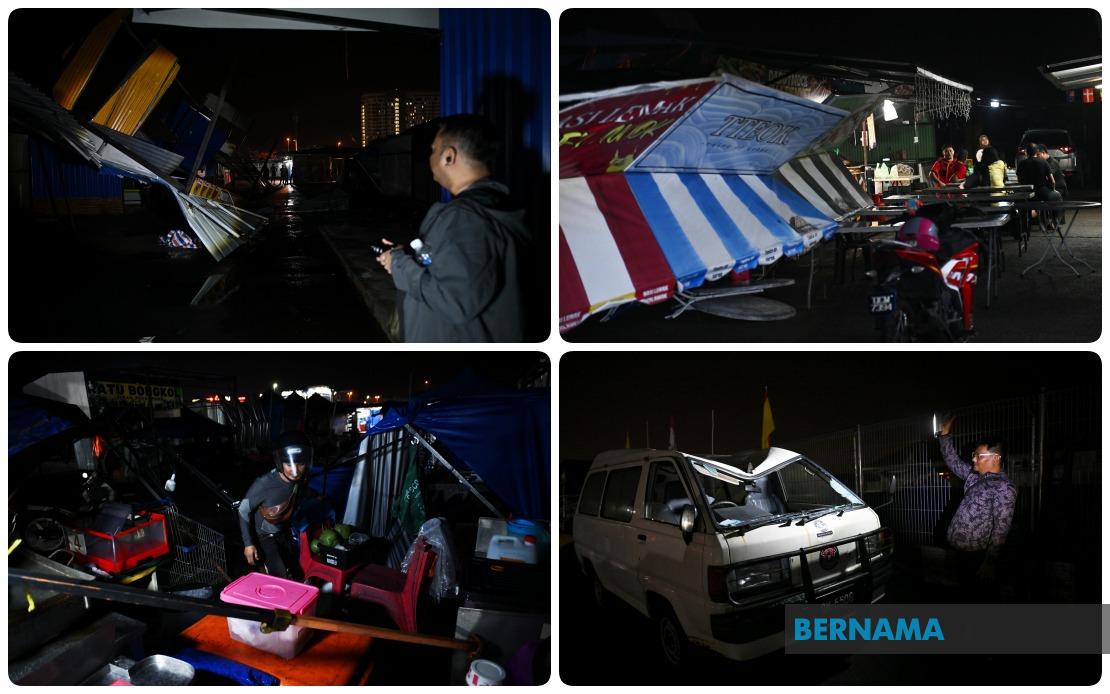
Kuching residents experienced one of the most destructive weather events to strike a local business hub when a violent thunderstorm tore through the N6 Metrocity 2 Youth Night Market during peak trading hours, forcing authorities to shut down operations and leaving hundreds of vendors grappling with substantial financial losses. The sudden deluge and fierce winds that swept across the night market proved so severe that traders abandoned their stalls and fled to safety as enormous canopy structures lifted and flew through the air like projectiles, creating a hazardous environment that left even seasoned business operators shaken.
The tempest struck during what would normally have been bustling weekend evening hours, when the night market draws its largest crowds of customers and generates significant revenue for the hundreds of small business operators who depend on regular trading activity. Mohamad Faisal, a 42-year-old vendor present during the incident, described the chaotic scene that unfolded as the weather deteriorated without warning. He recalled approaching his trading site when the conditions suddenly became life-threatening, with canopies tearing loose from their moorings and becoming airborne obstacles that forced vendors to scatter in different directions to escape potential injury. The sheer violence of the winds demonstrated the unpredictable power of tropical weather systems and highlighted the vulnerability of semi-permanent market structures to extreme atmospheric conditions.
The physical damage across the night market proved extensive and costly. Hamzah Hassan, deputy chairman of the N6 Metrocity 2 Youth Night Market management committee, characterized the storm as the most severe natural disaster event the trading site had experienced throughout its operational history. More than 40 individual trader lots suffered significant damage from blown-away canopies and structural collapse, representing approximately one-seventh of the approximately 300 total trading positions operating at the venue. Beyond the individual trader stalls, the collective infrastructure that serves the entire market suffered considerable harm, including the destruction of the main stage area, collapse of the management office structure, and rupture of electrical supply cables that are essential for normal operations.
Financial calculations undertaken by market management revealed that the economic impact on individual traders varied considerably depending on the size and construction specifications of their canopy structures. Most vendors faced individual losses estimated between RM2,000 and RM5,000 solely for the replacement or repair of their canopy systems, with some traders reporting damage costs at the higher end of this range. These figures do not account for secondary losses including damaged cooking equipment such as grills and stoves, contaminated merchandise inventory, broken water containers, and other business assets destroyed or rendered unusable by the storm. For traders who have been operating at the night market for extended periods—some for as long as a decade—these unexpected expenses represent significant financial strain that could threaten business viability.
The market's management has initiated efforts to secure assistance from government agencies, elected representatives, and cooperative organizations to help distribute the financial burden among the affected vendors. Hamzah Hassan appealed directly to relevant ministries and local political representatives to consider providing emergency relief or support packages to help traders recover from the disaster. Such appeals reflect the recognition that many individual traders lack sufficient financial reserves to independently absorb losses of this magnitude, and that market recovery may depend on coordinated assistance from multiple institutional sources. The situation underscores the economic vulnerability of hawker traders operating within semi-permanent market structures in Malaysia's urban and semi-urban areas.
The Malaysian Meteorological Department had issued specific weather warnings ahead of the damaging storm, providing an alert that thunderstorm conditions would affect multiple areas across Sarawak during a defined time window. The meteorological warning covered the period from 5 pm to 9 pm and encompassed numerous locations including Kuching, Serian, Siburan, Samarahan, Simunjan, Kapit and Song. While such advance warnings allow residents and business operators to prepare for deteriorating conditions, the actual intensity of the storm apparently exceeded expectations or preparation capacity, resulting in infrastructure damage that forecasts alone could not prevent. The incident raises important questions about the adequacy of structural engineering standards for temporary market canopy systems in Southeast Asian environments subject to periodic severe weather events.
The closure of the N6 Metrocity 2 Youth Night Market represents a temporary halt to economic activity that affects not only the vendors themselves but also the broader Kuching community that relies on the venue as a source of affordable dining, consumer goods, and evening entertainment. Night markets function as important cultural and commercial institutions throughout Malaysia and the broader Southeast Asian region, providing livelihood opportunities for small traders while serving as gathering spaces for families and social communities. The closure disrupts this established pattern of economic and social interaction, with implications extending beyond the immediate financial losses experienced by traders.
The storm event also highlights the ongoing infrastructure vulnerability faced by informal and semi-formal commercial sectors throughout Malaysia. Many night markets, hawker centers, and outdoor trading venues operate with canopy structures and temporary buildings designed primarily for weather protection rather than storm resilience. These structures, while functional under normal conditions, may offer insufficient protection against extreme meteorological events that are potentially becoming more frequent or intense due to long-term climate pattern changes. The Kuching incident therefore serves as a practical case study in the need for improved engineering standards, better weather forecasting communication, and more robust disaster response mechanisms for protecting the livelihoods of traders who form the backbone of Malaysia's informal economy.
As Kuching's trading community works toward recovery and reopening of the affected night market, the incident prompts reflection on broader urban planning and business continuity challenges facing Malaysian cities. The balance between accommodating informal commercial activity, maintaining public safety, protecting trader livelihoods, and adapting infrastructure to weather-related risks requires coordinated attention from multiple stakeholders including municipal authorities, business associations, and government agencies. The appeal for assistance from relevant ministries and representatives suggests that recovery from such events may require institutionalized mechanisms rather than relying solely on individual trader resilience or market management resources.

