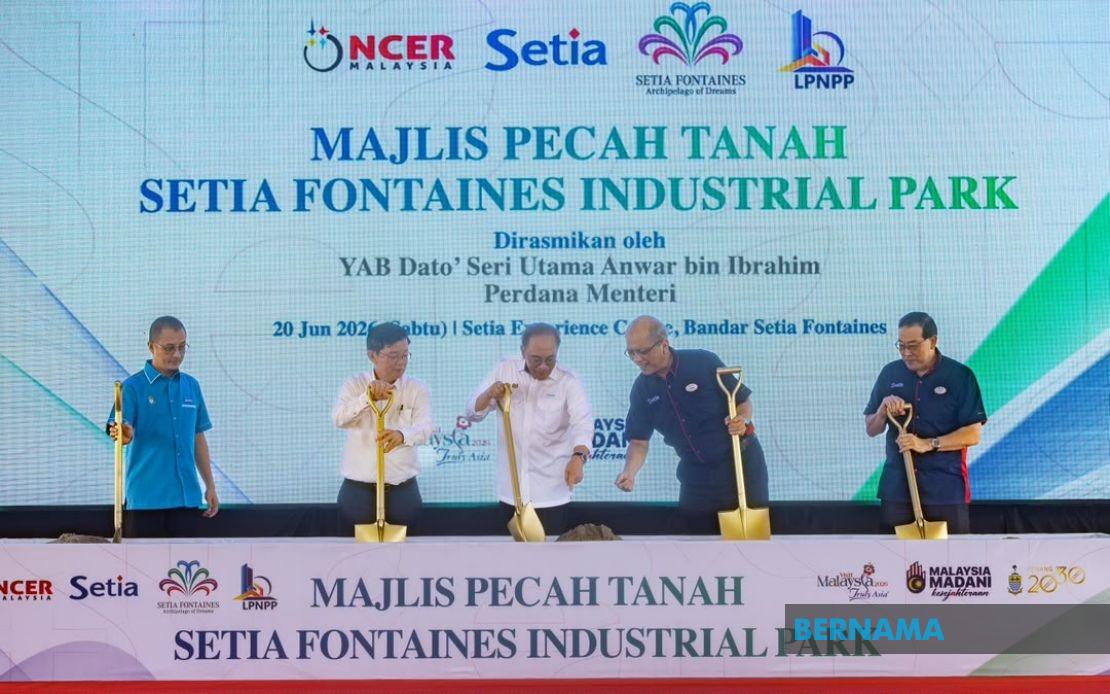
Prime Minister Datuk Seri Anwar Ibrahim has called for a fundamental shift in how Malaysia approaches development, insisting that both government-linked entities and private enterprises must prioritize opportunities for middle- and lower-income communities. Speaking at the groundbreaking ceremony for the Setia Fontaines Industrial Park in Bandar Setia Fontaines, Kepala Batas, Anwar underscored that rapid economic growth and surging investment levels risk deepening inequality unless deliberate measures are taken to ensure broader-based prosperity across all income tiers.
The Prime Minister's remarks reflect growing concerns about wealth concentration and inequality in Malaysia despite the country's sustained development trajectory. Anwar articulated a vision where economic expansion serves as a vehicle for shared advancement rather than a tool that amplifies existing disparities. His emphasis on inclusive growth comes as Malaysia navigates a complex economic landscape marked by technological disruption, evolving manufacturing patterns, and shifting employment dynamics that threaten to leave behind workers without adequate skills or access to opportunity.
Anwar specifically referenced major institutional investors and sovereign wealth funds, naming Khazanah Nasional Berhad, Permodalan Nasional Berhad, and the Employees Provident Fund as entities whose investment decisions carry significant implications for income distribution. By invoking these organizations directly, the Prime Minister signaled that inclusive growth is not merely aspirational rhetoric but an expectation that will shape how government approvals are granted for major projects. This approach suggests a tightening of accountability measures for how public and quasi-public capital is deployed across the economy.
Crucially, Anwar distinguished between headline economic indicators and genuine improvements in living standards for ordinary Malaysians. Economic statistics showing robust growth rates or foreign direct investment inflows mean little if workers and communities cannot access the jobs or entrepreneurial opportunities these developments create. This distinction addresses a widespread frustration among middle- and lower-income Malaysians who have watched their purchasing power stagnate even as aggregate GDP figures have climbed, creating a disconnect between national economic narratives and household economic realities.
The Setia Fontaines Industrial Park development exemplifies the type of project Anwar believes should be structured with inclusive growth mechanisms. Located in Seberang Perai, the park is intended to catalyze economic advancement in a region that has historically lagged behind Penang Island and the state's southern corridor in terms of industrialization and employment opportunities. By anchoring advanced manufacturing and technology-oriented sectors in Seberang Perai, the development could substantially alter employment geography within Penang and reduce regional imbalances that have persisted for decades.
The industrial park represents Malaysia's broader pivot away from labor-intensive, back-end manufacturing toward higher-value, technology-driven production. This transition offers the prospect of better-paying jobs and more stable employment prospects compared to traditional assembly-line work. However, such opportunities remain inaccessible to workers lacking relevant technical qualifications. Anwar acknowledged this critical skills gap and emphasized that the workforce development component must receive equal priority to physical infrastructure and facility development.
Anwar highlighted the essential role of coordination between industry, educational institutions, and training providers in bridging the skills divide. He specifically mentioned Universiti Sains Malaysia alongside technical and vocational education and training institutions as critical partners in ensuring that local workers possess the competencies demanded by advanced industrial sectors. This emphasis on institutional collaboration recognizes that individual initiative alone cannot overcome systemic skills deficits—comprehensive coordination across the educational ecosystem is necessary to produce workers ready for high-quality employment.
The rapid pace of technological change compounds the challenge of maintaining workforce relevance. Technologies that define industrial operations today may be obsolete within one or two years, necessitating continuous learning and adaptation. This reality means that traditional one-time vocational training programs are insufficient; instead, workers need access to ongoing professional development embedded within educational partnerships that keep pace with industry evolution. Anwar's insistence that training be closely aligned with universities and educational institutions reflects recognition of this accelerating change dynamic.
Anwar's framing also implicitly critiques a development approach that has allowed opportunities to concentrate among those already positioned to benefit from economic growth. By conditioning government approval of major projects on demonstrated inclusive opportunity creation, the Prime Minister is attempting to redirect how development capital flows through the economy. This represents a meaningful departure from purely market-driven development models that assume benefits automatically distribute equitably—an assumption that Malaysian economic history has repeatedly disproven.
The implications extend beyond Penang to shape how major development projects nationwide will be evaluated and approved. Government agencies and sovereign wealth funds reviewing investment proposals will increasingly face pressure to articulate explicit mechanisms through which lower- and middle-income communities participate in and benefit from new economic activities. This shift could drive more intentional partnership structures between large developers and smaller enterprises, supply chain arrangements that include local suppliers, and workforce development programs specifically designed to prepare disadvantaged communities for emerging opportunities.
For Malaysia's broader development agenda, Anwar's message signals that inclusive growth is not a policy afterthought but a central organizing principle. As the country seeks to transition toward higher-income status and compete in advanced technology sectors, the government recognizes that social cohesion and economic stability depend on ensuring that this transition translates into tangible improvements for all income groups. Without such inclusion, rapid development risks generating resentment and instability among those perceiving themselves left behind, potentially undermining the political support necessary for continued economic transformation.
The challenge ahead lies in translating this inclusive growth rhetoric into binding mechanisms and measurable outcomes. How government entities will verify that projects actually deliver promised opportunities for lower-income groups, what remedies exist if developers fail to meet inclusive targets, and how success will be monitored remain largely unspecified. The effectiveness of Anwar's initiative will ultimately depend on whether these oversight mechanisms receive proper implementation and whether political will remains steadfast when inclusive requirements conflict with investor interests or project timelines.
%22%2F%3E%3C%2Fpattern%3E%3C%2Fdefs%3E%3Crect%20width%3D%22100%25%22%20height%3D%22100%25%22%20fill%3D%22url(%23ph366w1g)%22%2F%3E%3Crect%20width%3D%22100%25%22%20height%3D%22100%25%22%20fill%3D%22url(%23ph366w1p)%22%2F%3E%3Ctext%20x%3D%2250%25%22%20y%3D%2250%25%22%20text-anchor%3D%22middle%22%20dominant-baseline%3D%22central%22%20fill%3D%22rgba(255%2C255%2C255%2C0.95)%22%20font-family%3D%22Georgia%2C%20'Times%20New%20Roman'%2C%20serif%22%20font-weight%3D%22700%22%20font-size%3D%22320%22%20letter-spacing%3D%22-0.02em%22%3ETV3%3C%2Ftext%3E%3C%2Fsvg%3E)
%22%2F%3E%3C%2Fpattern%3E%3C%2Fdefs%3E%3Crect%20width%3D%22100%25%22%20height%3D%22100%25%22%20fill%3D%22url(%23ph50o6fg)%22%2F%3E%3Crect%20width%3D%22100%25%22%20height%3D%22100%25%22%20fill%3D%22url(%23ph50o6fp)%22%2F%3E%3Ctext%20x%3D%2250%25%22%20y%3D%2250%25%22%20text-anchor%3D%22middle%22%20dominant-baseline%3D%22central%22%20fill%3D%22rgba(255%2C255%2C255%2C0.95)%22%20font-family%3D%22Georgia%2C%20'Times%20New%20Roman'%2C%20serif%22%20font-weight%3D%22700%22%20font-size%3D%22170%22%20letter-spacing%3D%22-0.02em%22%3EMalaysia%3C%2Ftext%3E%3C%2Fsvg%3E)
%22%2F%3E%3C%2Fpattern%3E%3C%2Fdefs%3E%3Crect%20width%3D%22100%25%22%20height%3D%22100%25%22%20fill%3D%22url(%23ph5vazwg)%22%2F%3E%3Crect%20width%3D%22100%25%22%20height%3D%22100%25%22%20fill%3D%22url(%23ph5vazwp)%22%2F%3E%3Ctext%20x%3D%2250%25%22%20y%3D%2250%25%22%20text-anchor%3D%22middle%22%20dominant-baseline%3D%22central%22%20fill%3D%22rgba(255%2C255%2C255%2C0.95)%22%20font-family%3D%22Georgia%2C%20'Times%20New%20Roman'%2C%20serif%22%20font-weight%3D%22700%22%20font-size%3D%22170%22%20letter-spacing%3D%22-0.02em%22%3EMalaysia%3C%2Ftext%3E%3C%2Fsvg%3E)