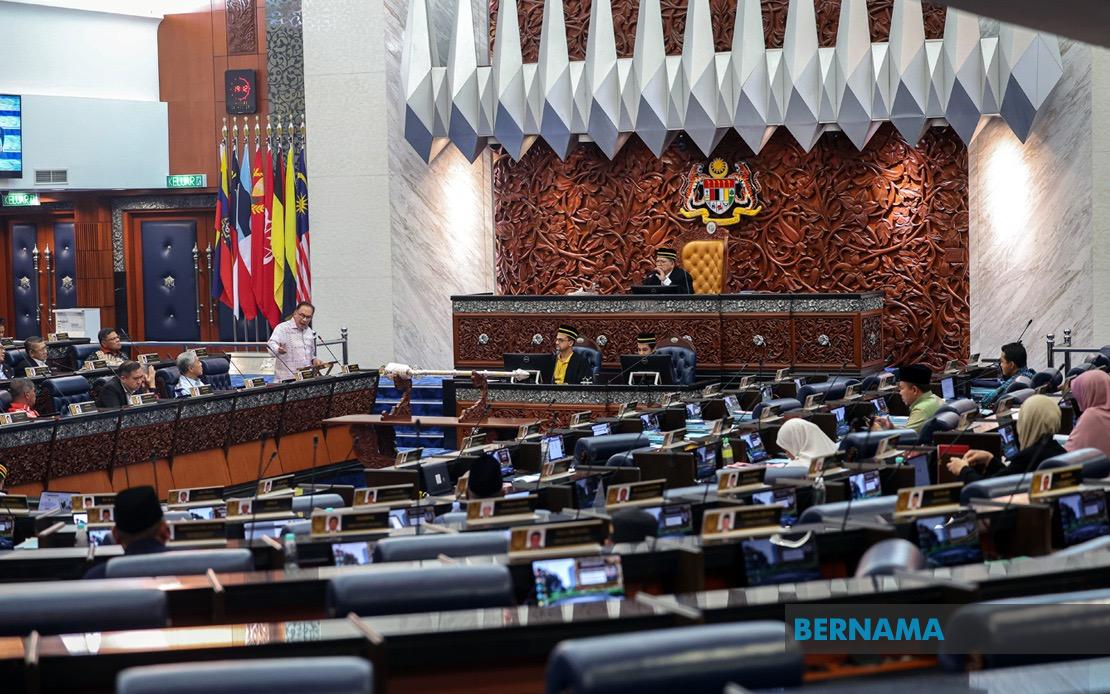
Parliament passed a motion yesterday to channel RM14.5 billion in leftover Malaysian Government Investment Issues (MGII) proceeds into the Development Fund, marking another step in the government's strategy to ringfence borrowings specifically for capital projects rather than recurrent spending. The voice vote, supported by lawmakers across the chamber, underscores broad consensus on maintaining fiscal discipline by separating development financing from operational budgets—a principle that underpins Malaysia's constitutional framework for public spending.
Deputy Finance Minister Liew Chin Tong outlined the mechanics during yesterday's parliamentary sitting, explaining that the Development Fund operates as a dedicated repository for capital spending, replenished through multiple channels including transfers from the Consolidated Revenue Account, loan repayments, and proceeds from government debt instruments. The MGII programme sits within this architecture as a key funding mechanism, with Parliament's approval enabling the government to channel domestically-raised capital toward priority infrastructure and development initiatives scheduled for 2026.
The RM14.5 billion figure represents the net proceeds after accounting for refinancing obligations. Between January and May 2026, the government issued RM40 billion in MGII securities. However, RM25.5 billion of this amount was earmarked to repay maturing MGII debt, leaving RM14.5 billion as new capital available for the Development Fund. This refinancing component highlights an ongoing challenge facing Malaysia's debt management: a substantial portion of each new issuance must simply replace expiring obligations rather than fund fresh spending.
Within the broader MGII programme for 2026, the government expects total issuances to reach RM95 billion. Breaking this down reveals the competing demands on Malaysia's borrowing capacity: RM55 billion serves to refinance maturing MGII, RM2 billion partially covers redemptions of Malaysian Islamic Treasury Bills (MITB)—short-term shariah-compliant instruments favoured by Islamic finance investors—while the remaining RM38 billion plugs part of the anticipated fiscal deficit. This allocation demonstrates how heavily refinancing weighs on the government's annual borrowing envelope, constraining resources available for new initiatives.
The constitutional requirement that Malaysia's government borrow exclusively for development expenditure, with operating costs covered solely from tax revenue and general receipts, creates a rigid framework that Deputy Minister Liew emphasized during questioning. This distinction matters because it legally prevents the state from using securities markets to finance wage bills, subsidies, or administrative expenses—forcing the government to extract any needed constraint on recurrent spending through revenue measures rather than borrowed funds. While this rule supports long-term fiscal health, it also means that shortfalls between government revenue and recurrent spending cannot be masked through external financing, creating political pressure whenever economic growth disappoints tax collections.
Parliament heard confirmation that additional MGII proceeds from June through December 2026 will require separate approval at the next legislative session, a staged approach that breaks the approval process into manageable segments aligned with actual issuance schedules. This piecemeal authorization reflects both procedural tradition and practical necessity, as officials cannot predict exact market conditions or borrowing requirements months in advance.
A notable concern surfaced during parliamentary exchanges regarding potential "crowding out" effects in Malaysia's domestic financial market. When government securities issuances become too large, they can absorb available investable funds and potentially crowd out lending to the private sector, reducing capital availability for business expansion. Datuk Zulkafperi Hanapi raised the prospect that institutions like the Employees Provident Fund (EPF) and Retirement Fund Incorporated (KWAP), which manage vast pension and retirement assets, might channel excessive proportions into government debt at the expense of private investment opportunities. Deputy Minister Liew countered by noting that the government has progressively reduced new borrowing year-on-year in recent periods, though specific figures were not detailed.
Liew also reframed government securities issuance as beneficial to institutional investors seeking reliable returns within Malaysia's economy. From this perspective, MGII and related instruments provide EPF, KWAP, insurance companies, and other large investors with domestic investment vehicles offering competitive yields without currency risk. Without such local opportunities, these institutions might redirect capital overseas, potentially weakening demand for Malaysian ringgit and creating broader currency pressures. This dynamic reflects a genuine tension in emerging market finance: governments need domestic investors to fund spending, yet excessive reliance on captive domestic savers can suppress private credit availability.
The Development Fund itself operates beyond the annual budget cycle that most Malaysians associate with parliamentary approval. Rather than funding specific projects line-by-line, it functions as a reserve of capital awaiting deployment through separate government programmes and project approvals. This architecture allows for smoother implementation of multi-year infrastructure initiatives without forcing project starts and completions into arbitrary fiscal-year boundaries. Capital projects often span several years from planning through completion, making a dedicated development fund more administratively efficient than treating each year's allocations in isolation.
The approval yesterday sits within a broader pattern of Malaysia's efforts to signal fiscal responsibility to international markets and rating agencies. By demonstrating that parliament enforces strict separation between development and operating expenditure, the government reinforces its credibility with foreign investors and lenders assessing sovereign risk. Rating agencies and bond market analysts view such institutional discipline as indicative of deeper commitment to sustainable public finances. Conversely, any drift toward using development borrowing for recurrent spending would trigger immediate scrutiny and potentially higher borrowing costs across all government debt.
For Malaysian taxpayers and citizens, the mechanics of MGII and the Development Fund operate largely invisibly, yet shape the quality and pace of infrastructure delivery. Every ringgit channeled into development rather than wasted on inefficiency ultimately determines whether new roads, hospitals, schools, and ports materialize as promised. The constitutional ringfencing of development borrowing represents an attempt—imperfect but meaningful—to prevent government debt from becoming a tool for financing mere consumption while leaving infrastructure deficient and future generations burdened by unproductive obligations.
The parliamentary approval also signals continuity in Malaysia's fiscal policy direction under current leadership. While coalition politics sometimes introduces uncertainty in budget execution, the broad support for MGII transfers suggests sustained commitment to development financing principles across political factions. As Malaysia navigates moderating economic growth and demographic shifts favoring aging populations, maintaining this distinction between capital and recurrent spending becomes increasingly critical to preserving space for growth-supporting investment within fiscal constraints.

