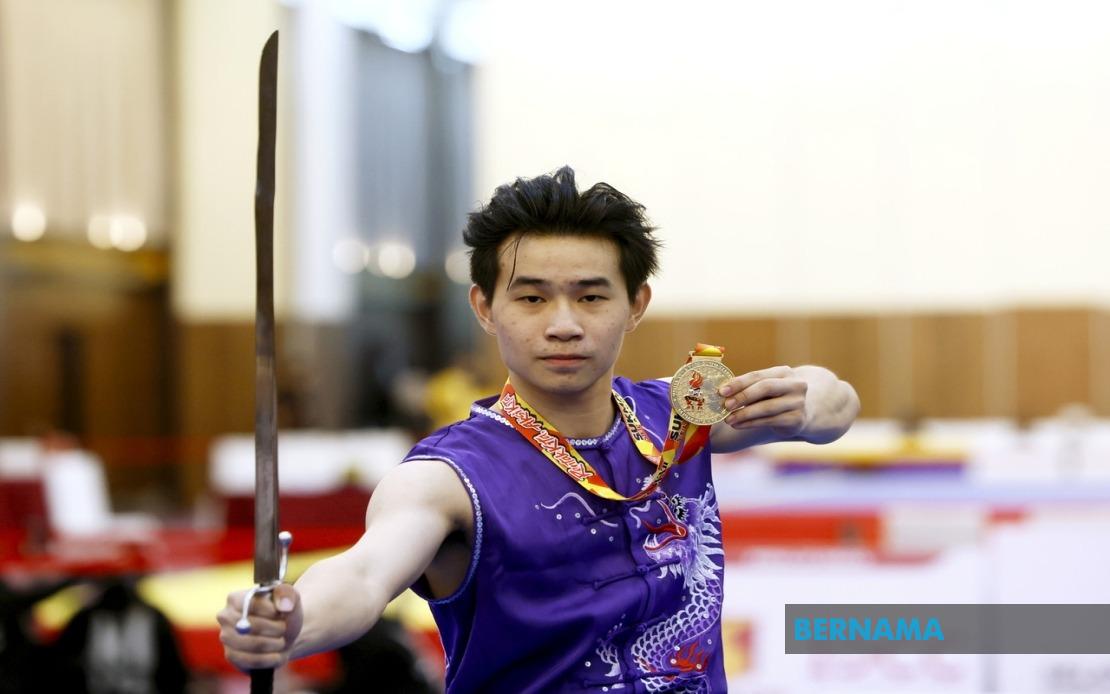
Penang wushu competitor Wee Din Jun has concluded his Malaysia Games career on a triumphant note, capturing gold in the men's nandao nangun competition at the 2026 SUKMA held in Shah Alam despite battling a hip injury sustained just weeks before the Games. The 21-year-old's victory marks a striking turnaround for an athlete whose previous two appearances at Malaysia's premier sporting event were marked by inconsistency and regret, offering an inspiring narrative of resilience and mental fortitude in competitive martial arts.
Din Jun's performance at the Ideal Convention Centre in Shah Alam saw him accumulate 9.600 points, a commanding margin that allowed him to surpass Sarawak's John Phang, who earned silver with 9.563 points. Selangor's Tan Yu Zhe rounded out the podium with a bronze-medal finish, recording 9.550 points. The precision demanded by wushu competition means these fractional differences—often hundredths of a point—can determine success or failure, underscoring the technical excellence Din Jun demonstrated under pressure and physical constraint.
The significance of this achievement cannot be fully appreciated without examining Din Jun's trajectory through successive SUKMA editions. At the 2022 Games in Kuala Lumpur, the then-teenager managed only a bronze medal—a respectable showing that nonetheless left him hungry for higher honours. However, his return to SUKMA two years later in Sarawak proved deeply disappointing. Competing across three events, Din Jun struggled with execution, committing critical errors that cost him any medal whatsoever. For many young athletes, such a reversal would weigh heavily on confidence and motivation heading into a third and final opportunity.
What distinguishes Din Jun's response is his mental approach to redemption. Speaking to Bernama after his victory, the Bayan Lepas native reflected candidly on his previous letdown and the mindset shift that enabled his comeback. Rather than obsessing over past failures or the pressure of proving himself in his farewell Games appearance, Din Jun adopted a philosophy of acceptance and present-moment focus. His coaching staff played a crucial role in this reframing, explicitly advising him to remain calm and to extract enjoyment from his performance rather than fixate on outcomes.
Din Jun's own commentary on his victory reveals the psychological maturity required to compete at the highest amateur levels. He described deliberately avoiding distraction or negative anticipation, choosing instead to channel his energy exclusively into executing his techniques with precision. This approach—surrendering the outcome to focus entirely on process—represents a sophisticated understanding of sports psychology that many elite competitors never fully develop. In wushu, where judges evaluate form, flow, and technical execution as much as raw athleticism, mental clarity directly translates to performance quality.
The hip injury Din Jun overcame adds another dimension to his triumph. Sustaining a significant lower-body injury just one month before a major competition placed him in a precarious position: withdraw and miss his final SUKMA opportunity, or compete while managing pain and risk further damage. The decision to proceed and ultimately medal demonstrates not only physical courage but also a level of commitment to his sport and to his final competitive chapter that speaks volumes about his character. Such injuries typically demand weeks of rehabilitation, making his rapid return to competitive form all the more noteworthy.
Beyond the immediate narrative of personal redemption, Din Jun's achievement carries meaning within Malaysia's broader wushu development. Penang has historically produced competitive martial artists, and maintaining that pipeline of talented performers requires success stories that capture public attention and inspire younger practitioners. Din Jun's gold medal, earned against strong regional competition, reinforces Penang's standing in the discipline and potentially motivates the next generation to pursue wushu training with increased seriousness.
The athlete's acknowledgment of his former coach—now based in China—adds a poignant undertone to his victory. Unable to present medals to Din Jun in previous SUKMA appearances, this coach presumably invested significant effort in preparing him for his final campaign. International coaching relationships, while enriching Malaysia's sports development, can create bittersweet moments when coaches return to their home countries. Din Jun's dedication of his gold medal to this former mentor reflects both gratitude and a desire to finally deliver the result they jointly pursued.
Looking forward, Din Jun has flagged his intention to contest the nanquan event in subsequent competition days, offering him a chance to potentially add another medal to his SUKMA record and orchestrate a genuinely memorable finale to his amateur career. Competing across multiple wushu events requires versatility and resilience, demanding that athletes master distinct technical disciplines and mental approaches for each competition. Should he succeed again, Din Jun would depart SUKMA with a composite record of gold, prior bronze, and redemption—a narrative arc more compelling than any single medal could represent.
For Malaysian sports observers and wushu enthusiasts across Southeast Asia, Din Jun's trajectory embodies broader themes about resilience, coaching quality, and the redemptive potential of sporting competition. His journey from bronze to zero to gold illustrates that Games outcomes are rarely final verdicts on athletic potential, and that mental preparation and emotional intelligence can prove as decisive as physical conditioning. As SUKMA 2026 continues, Din Jun's example serves as a reminder that comebacks are possible for those willing to embrace process over outcome and to learn from setback rather than be defeated by it.

