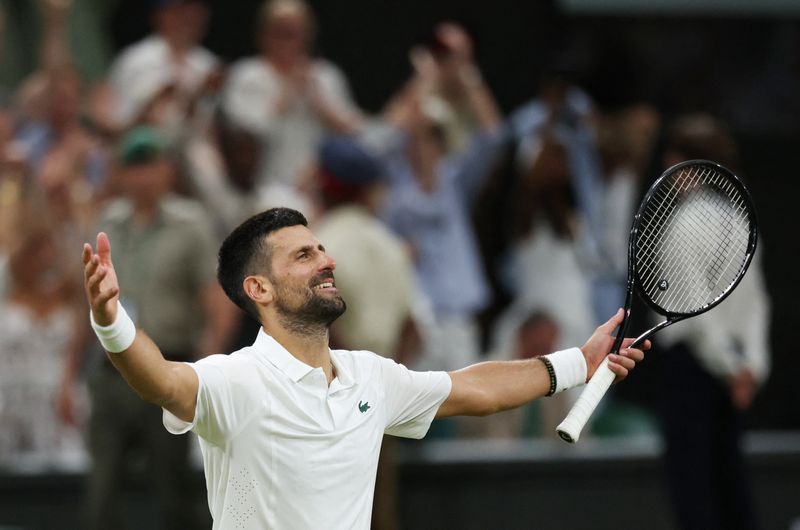
Novak Djokovic's remarkable longevity at Wimbledon reached new heights on Tuesday when the 39-year-old Serbian defeated Canadian Felix Auger-Aliassime in a monumental quarter-final contest that stretched five hours and 15 minutes, the longest such match in the tournament's history. The scoreline of 7-6(10) 3-6 6-3 6-7(4) 7-6(10-4) reflected the unrelenting nature of a battle that extended across multiple sets and two tiebreak deciders, with neither player yielding ground without a desperate struggle. The victory propelled Djokovic into his eighth consecutive Wimbledon semi-final, an unprecedented achievement that further cemented his status as the tournament's most dominant force in the modern era.
The milestones accumulated during this run underscore just how singular Djokovic's accomplishment has become. His 106th victory at the All England Club in the preceding round saw him surpass Roger Federer's longstanding record for most match wins at the venue, a particularly symbolic breakthrough given their historical rivalry. More significantly, his progression to the last four for the eighth successive year represents uncharted territory in men's professional tennis. Federer, who won eight Wimbledon titles, never achieved this feat of reaching consecutive semi-finals with such consistency, making Djokovic's feat a genuine watershed moment in the sport's annals.
The passage through to the semi-finals came at considerable physical cost, with the extended match testing Djokovic's endurance and mental fortitude. The opening set encapsulated the match's defining characteristic: neither player could construct a decisive advantage, leading to a prolonged tiebreak that extended to 10-10 before Auger-Aliassime's costly error at the net handed the set to the seventh seed. The Canadian responded by commandeering the second set convincingly, breaking Djokovic's serve and holding firm to level the contest. The drama intensified when match officials closed the Centre Court roof at approximately 7.40 p.m. local time, a development that prompted visible frustration from Djokovic, though he recalibrated his approach thereafter.
The third set proved pivotal as Djokovic, seemingly reinvigorated by the changed conditions indoors, elevated his level considerably. His groundstrokes became crisper and more penetrating, allowing him to finally breach Auger-Aliassime's determined resistance in the sixth game. With momentum shifting perceptibly in his favour, Djokovic seized control and extended his advantage, though Auger-Aliassime's combative spirit never wavered. The Canadian's frustration occasionally boiled over, notably when he struck his chair with his racket during the fourth set, yet such moments of pent-up emotion never translated into the breakthrough that might have shifted the trajectory decisively.
The fourth set culminated in another tiebreak, underlining the remarkable equilibrium between the two competitors. Auger-Aliassime's capacity to recover and force a fifth set showcased the quality that has positioned him among professional tennis's emerging forces, yet against Djokovic's accumulated experience and tactical acuity, such resilience ultimately proved insufficient. A deciding fifth set ensued, one of the rarest outcomes at Wimbledon despite the tournament's traditional best-of-five-set format in men's singles. For 12 consecutive games, the pair remained locked at 6-6, demanding a sudden-death match tiebreak to determine the victor.
It was in that final, high-stakes tiebreak that Djokovic's vast reservoir of experience at tennis's most demanding moments manifested itself most clearly. Drawing upon years of navigating similar pressure-cooker scenarios, he navigated the super tiebreak with greater composure than his younger opponent, ultimately prevailing 10-4 in that format. The deafening roar from a thoroughly engaged Centre Court crowd testified to the entertainment value and intensity that had unfolded across the five-hour-plus encounter, with spectators having witnessed one of the year's finest tennis exhibitions.
Djokovic's own assessment of the encounter reflected his characteristic blend of humility and confidence. "I won with a racket and a lot of heart," he remarked in his courtside interview, subsequently elaborating on the psychological demands inherent in prolonged, closely-contested matches. He acknowledged the extreme tension and emotional toll of contests where fortunes swing unpredictably and the scoreline remains level throughout extended passages. The management of nerves under such circumstances, he suggested, constitutes one of the principal differentiators between elite performers and the rest of the field. His comment that he wished the match had been the final—thereby obviating the need to recover for subsequent rounds—resonated with anyone who understood the magnitude of the physical exertion expended.
The victory sets up a mouth-watering semi-final against Jannik Sinner, the reigning Wimbledon champion and current world number one. This encounter promises to represent another significant chapter in an emerging rivalry that carries considerable implications for the trajectory of men's professional tennis. Djokovic's persistent pursuit of an eighth Wimbledon crown, which would match Federer's record, and his assault on the all-time Grand Slam majors tally of 25—a mark that would surpass Australian legend Margaret Court—continues unabated. Yet he characteristically deflected questions about these distant milestones, maintaining his laser-like focus on the immediate task of recovery and preparation for the semi-final rather than contemplating career tallies and historical rankings.
For Malaysian and Southeast Asian tennis enthusiasts, this clash encapsulates the sport's ongoing evolution. Djokovic represents a generation of players who have transcended traditional notions of athletic longevity, fundamentally challenging assumptions about when professional players enter inevitable decline. His continued relevance at 39, competing against the world's best and prevailing in contests of such gruelling intensity, suggests that modern sports science, training methodology, and psychological resilience have fundamentally altered what constitutes achievable longevity. Sinner, meanwhile, represents the new guard—younger, powerful, and equipped with the technical innovations that characterise current professional tennis.
The broader narrative surrounding Djokovic's Wimbledon campaign extends beyond individual statistics or record books. His achievements at the All England Club have accumulated across nearly two decades of uninterrupted excellence, a testament to his singular dedication to the sport. The eight consecutive semi-final appearances represent not merely the victory of one particular fortnight but rather the culmination of a career-long commitment to excellence and continuous improvement. For the region's tennis-watching community, his continued prowess serves as a reminder that sporting greatness is not merely a function of youth or natural talent but of sustained competitive hunger and meticulous preparation.
The semi-final against Sinner will likely determine whether Djokovic's quest for an eighth title advances further or whether the changing of the guard in men's tennis has truly begun in earnest. The contrast in their trajectories—Djokovic's relentless pursuit of records and titles despite his age, Sinner's ascendancy as the sport's new dominant force—encapsulates contemporary professional tennis's defining tension. Regardless of the outcome, Djokovic's triumph over Auger-Aliassime will be remembered as a masterclass in competitive resilience, demonstrating that experience, mental fortitude, and strategic sophistication remain formidable weapons even in the face of physical challenges that would have ended the careers of lesser competitors.

