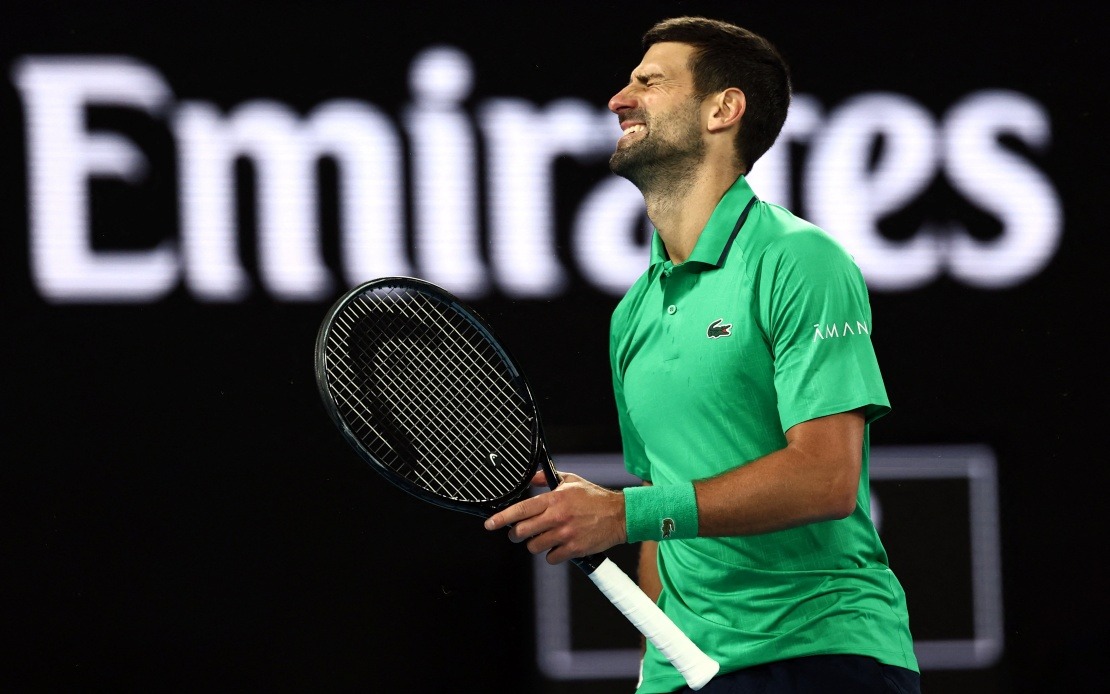
Novak Djokovic has cemented his place in tennis history by reaching a significant milestone at the All England Club, matching Roger Federer's benchmark of 105 men's singles match victories at Wimbledon. The Serbian champion's journey to this achievement came through a hard-fought encounter against French 25th seed Arthur Rinderknech on Friday, where he prevailed 7-5, 6-4, 1-6, 7-6 (7-4) in a demanding three-hour battle on Centre Court. This victory also marked Djokovic's 18th appearance in the fourth round at the grass court Grand Slam, underscoring his remarkable consistency and dominance at the tournament over nearly two decades.
At 39 years old, Djokovic brought a touch of levity to his accomplishment while addressing the media immediately after his victory. The 24-time Grand Slam champion playfully suggested a novel solution to the record-tying situation, proposing that he and Federer settle the matter with a head-to-head match to determine who would claim the 106th victory. His characteristically light-hearted response masked the genuine magnitude of what he has achieved at a venue where he has enjoyed profound success throughout his career. "To be able to make history in this sport is a huge honour and a privilege," he reflected during his on-court interview, acknowledging both the personal significance and the broader importance of such milestones in professional tennis.
Beyond the statistical achievement, Djokovic's reflections revealed the deep emotional connection he maintains with Wimbledon. The Serbian star described the tournament as a childhood dream venue, one that has remained central to his aspirations since youth. However, he demonstrated his characteristic focus on the immediate task ahead rather than dwelling on records and numbers. His philosophy of concentrating on winning the next match rather than chasing statistics has served him well throughout his career and continues to guide his approach in pursuit of further titles. Djokovic's path toward potential glory continues, with a fourth-round encounter against Russian qualifier Roman Safiullin awaiting him in the coming days.
In the men's draw, defending champion Jannik Sinner also advanced smoothly, dispatching American Jenson Brooksby in straight sets with a 6-4, 6-3, 6-4 victory. The Italian world number one showcased the form that saw him claim the title last year, extending his exceptional third-round record at Grand Slam tournaments to an impressive 20 consecutive victories, an Open Era record for men's singles. Sinner's dominant performance was buoyed by the enthusiastic support of the Wimbledon crowd, which he acknowledged after the match had concluded. The backing of the spectators appeared to energise the defending champion as he systematically dismantled his opponent's resistance across the three sets.
The women's draw has begun to take shape with several compelling storylines developing. Aryna Sabalenka, the top seed and holder of two Australian Open titles, continued her impressive campaign by defeating Jelena Ostapenko, the 2017 French Open champion, with a commanding 6-4, 6-4 victory. Sabalenka's pursuit of a maiden Wimbledon title represents one of the major narratives of this year's tournament, as the Belarusian has never previously secured the grass court Grand Slam trophy that has eluded some of tennis's most accomplished players. Her demonstration of controlled aggression and tactical precision against the dangerous Ostapenko illustrated why she remains the favourite in the women's competition.
Sabalenka's path through the tournament has taken an intriguing turn with the announcement that she will next face Naomi Osaka, a four-time Grand Slam champion who has been steadily rebuilding her career following a period away from competitive tennis. Osaka's progression to the fourth round represents a personal breakthrough, as she has never previously reached this stage at Wimbledon in her professional career. The Japanese star advanced to this encounter through a dominant display against Daria Kasatkina, whom she defeated 6-1, 6-3 in a commanding performance that underlined her returning form.
The prospective showdown between Sabalenka and Osaka carries significant weight in professional women's tennis, pitting two contrasting playing styles and personalities against each other. Sabalenka acknowledged the significance of facing another powerhouse competitor, characterising Osaka as an exceptionally aggressive player who would present a formidable challenge requiring maximum effort. The Belarusian's measured assessment of her upcoming opponent reflected the respect these elite performers share for one another, while simultaneously demonstrating her confidence in her own ability to compete at the highest level. Her determination to "fight and do whatever it takes to get through" underscored the intensity and competitiveness that drives elite professional tennis.
For Southeast Asian tennis enthusiasts and observers, this tournament presents compelling storylines that extend beyond the individual achievements of top-ranked players. Sabalenka and Osaka represent two distinct regions and playing philosophies within professional tennis, with their potential meeting serving as a microcosm of the global nature of the sport. The success and progression of Asian players in particular has become increasingly significant within the broader tennis landscape, and Osaka's return to the fourth round at a major championship carries particular resonance for supporters throughout the region.
The opening week of this Wimbledon championship has established clear hierarchies among both the men's and women's competitors, with Djokovic and Sinner emerging as dominant forces in the men's draw while Sabalenka appears positioned as the principal threat to aspirants in the women's competition. The convergence of record-breaking achievements, compelling individual narratives, and high-quality tennis has already captured widespread attention from global audiences. As the tournament progresses into the latter stages, the intensity of competition will intensify, with psychological and physical demands mounting on all remaining competitors.

