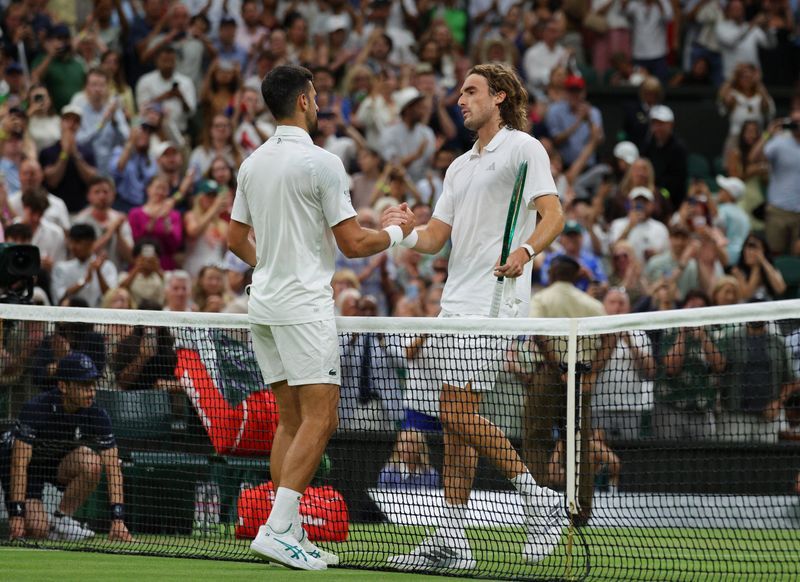
Novak Djokovic's dominance on grass remained evident as the 39-year-old Serbian champion dispatched Stefanos Tsitsipas in straight sets on Wednesday at the Wimbledon Championships, advancing to the third round with a 6-3 6-4 6-2 scoreline that masked the gulf in quality between the two competitors. The victory was never in doubt once Djokovic seized control of the match's pivotal moments, particularly in the second set where decisive breaks would determine the contest's trajectory.
The Centre Court clash, promoted as a heavyweight encounter in the tournament's official programme, quickly evolved into a one-sided affair that showcased why Djokovic remains among tennis's most formidable operators despite his age. The match provided further evidence that the Serbian legend possesses an almost supernatural capacity to capitalise when opponents falter under pressure, a trait that has defined his 25-year career at sport's highest level. His opponent, once heralded as a potential Grand Slam champion during his ascendant years, struggled to maintain the intensity required to compete with a player who has won more major titles than any other man in the sport's history.
The defining moment arrived at 4-4 in the second set when Tsitsipas faced break point with two consecutive opportunities to finish the rally decisively. The Greek player's two overhead attempts, which typically represent the most straightforward of tennis opportunities, sailed wide of their intended targets, representing the kind of technical lapses that separate champions from mere contenders. Djokovic immediately capitalised on this generosity, breaking serve and effectively dismantling any realistic pathway Tsitsipas possessed toward an upset victory. From that juncture, the match became an exhibition of controlled precision as Djokovic claimed eight of the final ten games to leave his opponent defeated across all three sets.
The loss extended Tsitsipas's personal wilderness against Djokovic to a remarkable 12 consecutive defeats in their head-to-head rivalry, a record that underscores the Serbian's psychological and technical superiority in their matchups. Despite Tsitsipas's ranking descent to 87th in the world, ostensibly suggesting vulnerability, Djokovic's performance indicated no compassion for the struggling opponent. The efficiency with which the Serb completed the contest—requiring less than two hours from start to finish—left little doubt regarding his current physical condition and competitive sharpness as he pursues his eighth Wimbledon crown and what would represent his 25th Grand Slam title overall.
Tsitsipas arrived at the tournament navigating a period of considerable professional upheaval. The 27-year-old Greek competitor had recently made the controversial decision to terminate his coaching relationship with his father, Apostolos, a partnership that had defined his entire professional trajectory. This personnel change occurred while his international ranking collapsed dramatically, a concerning development for a player who once occupied positions within the top ten and appeared destined for a sustained period among tennis's elite. The circumstances surrounding his participation at Wimbledon, occurring amid this tumultuous backdrop, inevitably raised questions about his mental readiness for competition at the championship's intensity level.
Tsitsipas's return to Wimbledon following a disappointing previous edition carried symbolic weight. Twelve months earlier, he had been forced to retire midway through his first-round match due to chronic back pain so severe that it had threatened the longevity of his career. The decision to withdraw represented a low point in the career of a player who had already experienced the crushing disappointment of losing Grand Slam finals to Djokovic—specifically at Roland Garros in 2021 and the Australian Open in 2023. His redemptive opportunity to prove he had overcome these obstacles dissolved quickly on Wednesday against an opponent determined to extend his already impressive tally against the Greek player.
Djokovic's next opponent will be 25th-seeded Frenchman Arthur Rinderknech, a considerably different proposition than Tsitsipas presented. The Serbian's trajectory toward claiming his eighth Wimbledon title and record 25th Grand Slam championship now proceeds without significant threats in the early rounds, allowing him to accumulate match practice while managing the physical demands of an extended tournament campaign. Victory over Rinderknech would position him merely one match victory away from equalling Roger Federer's men's record of 105 match wins specifically at Wimbledon, a milestone that carries considerable historical significance in grass-court tennis.
Following his clinical performance on Centre Court, Djokovic addressed the crowd with characteristic grace and humility. The Serbian star acknowledged his satisfaction with the quality of his tennis, expressing gratitude for the privilege of competing at his age on the sport's most prestigious stage. His observation that age represents merely a numerical concept rather than a determinative factor in athletic performance carried particular resonance, considering he continues competing at the highest levels against players typically a decade younger. His sartorial choice of a cream blazer, a look that would have appeared equally at home on a younger player, reinforced his assertion that age need not define capability or perspective.
The performance provided reassurance for Djokovic supporters concerned about his prospects for a deep run at Wimbledon. His movement remained crisp, his serve dependable, and his decision-making acute, qualities essential for sustaining success across multiple rounds against increasingly competitive opponents. The victory also illustrated how far Tsitsipas has fallen from his status as an emerging Grand Slam contender, transforming the Wimbledon narrative from a potential surprise upset into another confirmation of Djokovic's continued mastery over the tennis world's younger generation.

