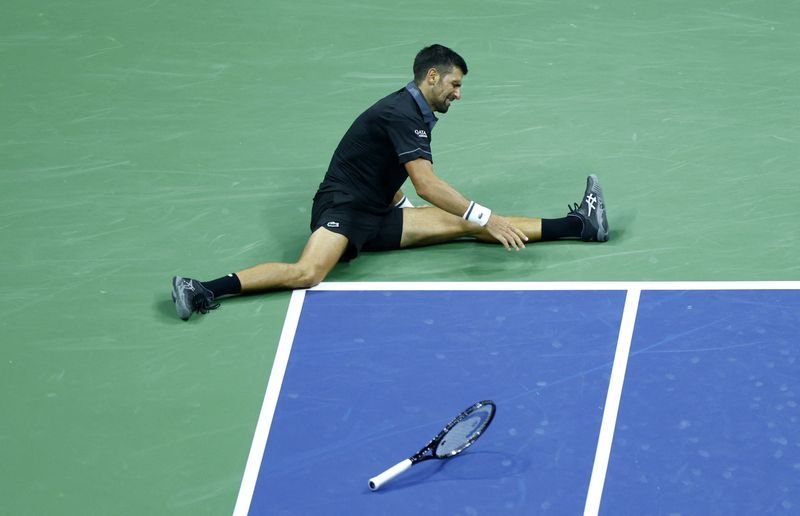
Novak Djokovic's pursuit of a record 25th Grand Slam title came to an abrupt and humbling halt at the US Open when the Serbian icon succumbed to unseeded Argentine challenger Mariano Navone in a brutal first-round encounter on Sunday. The unseeded world number 49 triumphed 7-6(5) 5-7 4-6 6-2 6-1 in a marathon four-hour-36-minute battle, marking a watershed moment in tennis and dealing a devastating blow to a player who has dominated the sport for nearly two decades.
The loss represents the earliest exit Djokovic has experienced at a Grand Slam since the 2006 Australian Open, underlining both the significance of this upset and the physical toll mounting on his ageing body. The 39-year-old was visibly shaken throughout the encounter, wrestling with multiple ailments that progressively undermined his ability to execute the precision and power that have defined his career. Mid-match nausea forced him to vomit into a courtside bin during the third set, a stark and distressing moment that captured the magnitude of his physical distress and foreshadowed the eventual capitulation that would follow.
Djokovic's arrival in New York carried considerable scrutiny regarding both form and fitness. A recent first-round exit at Cincinnati, where he fell to Thiago Agustin Tirante merely two weeks prior, had already cast shadows over his preparation and readiness for Flushing Meadows. Despite holding the fourth seeding, questions loomed about whether the legendary champion could muster the physical resilience required to mount another championship campaign. Those doubts proved prophetic within mere hours of stepping onto the court.
The match unfolded with initial promise for Djokovic, who established a commanding 3-0 advantage in humid New York conditions. However, the tactical adjustments by Navone, coupled with environmental intervention—the roof closed as rain swept across the court—shifted momentum decisively. The Argentine clawed back to level at 4-4 before forcing the first-set tiebreak, which he captured with aplomb, drawing thunderous crowd response that signalled the emergence of a formidable challenger. Djokovic recovered sufficiently to claim the second set, suggesting a potential comeback narrative might materialise, yet the physical deterioration accelerated rather than reversed from that point forward.
The turning point crystallised during the third set when Djokovic's gastrointestinal issues manifest publicly, forcing the courtside interruption. Though he regrouped to secure that set with a 5-4 lead, the fourth proved catastrophic. His serving mechanism—the cornerstone of his professional dominance—began misfiring due to escalating back problems. Navone seized upon this vulnerability with the composure of a player suddenly aware that history beckoned, clinching the fourth set and maintaining pressure through a dominant fifth-set performance to secure the most significant victory of his emerging career.
The emotional aftermath underscored the devastating personal impact. Djokovic was moved to tears courtside, a rare display of vulnerability from a champion accustomed to managing adversity with stoicism. In the post-match interview, he articulated the cumulative nature of his struggles, revealing that vomiting episodes have plagued nearly every match throughout 2024—a troubling pattern suggesting deeper physiological issues rather than isolated match-day complications. The combination of gastrointestinal distress, back pain, shoulder discomfort, and muscular cramps created a cascading physical collapse that overwhelmed even a competitor of his legendary mental fortitude.
Navone's response captured the surreal nature of his achievement. The 25-year-old Argentine, world-ranked 49th and virtually anonymous on the Grand Slam stage, could scarcely comprehend that he had just defeated the player many regard as the greatest tennis competitor ever assembled. His courtside remarks betrayed both jubilation and disbelief, while subsequent comments to ESPN revealed the magnitude of the upset had not yet fully registered—his phone would not cease ringing as news of the victory reverberated across Argentine media and the global tennis community. The prospect of returning home to hero's reception seemed to dwarf even the immediate glory of the achievement itself.
For Malaysian and Southeast Asian sports followers, this outcome carries particular resonance. The region has witnessed Djokovic's dominance across two decades, from his maiden Grand Slam in 2008 through to his unprecedented reign at the top of the rankings. His decline, while natural in the arc of any athlete's career, nonetheless marks a generational shift in tennis. The emergence of younger challengers like Navone, combined with mounting physical frailties, suggests the Djokovic era—one that has defined professional tennis since approximately 2011—is entering its terminal phase.
The broader implications extend beyond one match or one tournament. Djokovic's struggles with recurring gastrointestinal and musculoskeletal issues suggest medical complexities that may prove resistant to quick resolution. At 39, recovery periods lengthen substantially, and the cumulative wear on a body subjected to four decades of elite athletic demands accelerates deterioration. Whether he can address these persistent physical challenges and engineer even a partial resurgence remains uncertain, but this defeat at the US Open suggests that the window for redemption is rapidly narrowing.
The narrative surrounding Djokovic's quest for a 25th Grand Slam has dominated tennis discourse for years, particularly as he pursued rivals Rafael Nadal and Margaret Court's records. Yet this premature exit at Flushing Meadows may ultimately crystallise the conversation differently—not as a saga of near-misses and pursuits unfulfilled, but rather as the denouement of an extraordinary but ultimately finite career. In this sense, Navone's triumph becomes more than an isolated upset; it represents a symbolic passing of the torch, however unwieldy that torch may prove in coming years.
Djokovic's post-match refusal to contemplate retirement, despite the evident physical struggle, suggests he retains competitive appetite and determination to continue. Yet the trajectory visible on Sunday—increasingly pronounced physical breakdown, mounting vulnerabilities exploitable by ascending talent, and an inability to execute even basic technical elements—presents a sobering portrait of a champion no longer operating at peak capacity. Whether he can reverse this trajectory or whether this defeat marks the beginning of a steep decline remains tennis's most pressing question heading into the remainder of 2024.

