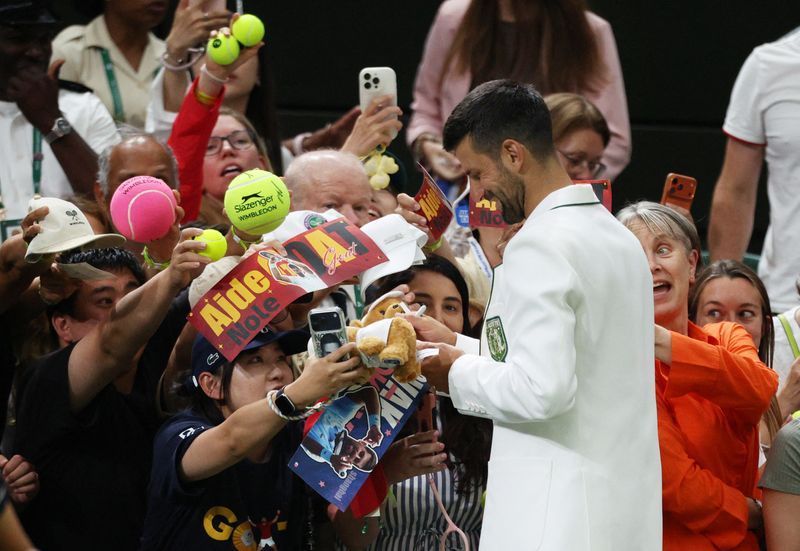
Novak Djokovic's commanding performance at Wimbledon on Wednesday revealed more than just the gap in quality between the world's elite and aspiring challengers. The 24-time Grand Slam champion's 6-3 6-4 6-2 dismantling of Stefanos Tsitsipas demonstrated the kind of psychological advantage that comes from playing loose and confident tennis, allowing the Serbian great to indulge in spontaneous moments of levity that would have seemed out of place had the match been closer.
With his dominance never in question, Djokovic turned his attention to entertaining those around him. During a routine equipment adjustment, he asked a ball girl assisting courtside to trim black tape from his right shoulder using scissors. As she carefully performed the task before a global television audience of millions, Djokovic suddenly cried out in apparent agony, creating the immediate impression he had suffered an injury at her hands. The unsuspecting staff member visibly recoiled in shock, clutching her chest as the gravity of what she believed had happened began to register—the prospect of inadvertently harming one of sport's greatest athletes on live television.
The tension broke instantly when Djokovic's face erupted into laughter, the ruse exposed and the moment transformed from potential crisis into shared hilarity. The ball girl, initially mortified, quickly recognised the prank and joined in the amusement. The exchange exemplified how comfort with one's position and performance can manifest as genuine warmth toward those around you. Djokovic himself acknowledged this dynamic when explaining his behaviour afterward, noting that such spontaneous humour emerges naturally when one is cruising through a match rather than scrambling to stay competitive.
In his on-court interview following the victory, Djokovic's playful mood continued unabated. He spotted Rory McIlroy, the twice Masters champion, seated in the Royal Box wearing his Green Jacket—the iconic prize awarded annually to the Augusta National Golf Club champion. The Northern Irish golfer, who has captured golf's most prestigious events multiple times over his career, found himself the subject of Djokovic's good-natured admiration and covetous remarks.
Djokovic, dressed in his personalised cream-coloured blazer that he had worn throughout the championship, gestured toward McIlroy's attire with genuine interest. The tennis champion queried whether the jacket was indeed the Masters prize, and upon confirmation, declared his desire to own it. What followed was a characteristically cheeky proposition: Djokovic suggested a wager—his cream blazer against McIlroy's Green Jacket, to be decided through tennis rather than golf. The suggestion drew roars of approval from the Centre Court crowd, clearly entertained by the cross-sport banter between two world-class athletes at the pinnacle of their respective disciplines.
The exchange highlighted the distinctive culture at Wimbledon, where tradition and formality coexist with moments of spontaneous humour. The Royal Box, typically a space reserved for dignified observation, became briefly transformed into an arena for good-natured ribbing between champions. McIlroy's presence at the championships itself reflected the broader appeal of Wimbledon to elite competitors across multiple sports, drawn by the tournament's prestige and the quality of tennis on display.
For Malaysian and Southeast Asian readers, Djokovic's performance and demeanour offer interesting observations about championship-level tennis in the 2024 season. The Serbian player's dominance over Tsitsipas, combined with his evident comfort and confidence, suggests he remains a formidable force despite the emergence of younger competitors. His casual brilliance—executing the performance requirements while maintaining humour and generosity of spirit—demonstrates the mental fortitude required to sustain greatness at the highest levels of professional sport.
The victory margin against Tsitsipas was emphatic, with no set reaching even five games and the match concluding in little more than two hours of play. This type of performance, where an opponent is simply outclassed, rarely generates the tension that can make matches compelling viewing. Instead, Djokovic's ability to entertain through personality and wit became the narrative, showing how athletes can maintain audience engagement even when the competitive outcome appears decided early.
The banter with McIlroy also underscores the camaraderie that often exists among elite athletes across different sports, despite the intense competition within their respective fields. Both men have proven capable of winning at golf and tennis's highest levels—McIlroy through demonstrated mastery of his sport, Djokovic through his competitive record that speaks for itself. Their interaction suggested mutual respect and a shared understanding of what it takes to compete and succeed when the stakes are highest.
Djokovic's demeanour throughout the match and in its aftermath reinforced his status not merely as a supreme technician but as someone capable of bringing considerable personality to his sport. In an era where tennis can sometimes feel overshadowed by the commercial and controversial aspects of professional competition, such moments remind audiences why the sport at its best remains compelling: it showcases not just skill and athleticism, but also the human capacity for grace, humour, and connection, even in victory.

