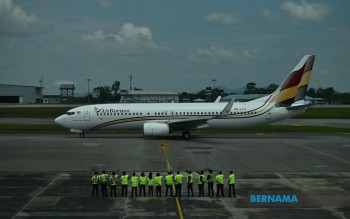
Deputy Prime Minister Datuk Seri Fadillah Yusof formally welcomed AirBorneo Airways' inaugural commercial flight at Kuala Lumpur International Airport Terminal 1 on July 20, underscoring the political importance of Sarawak's newest airline venture. Flight MY5005 arrived from Kuching carrying Sarawak Premier Tan Sri Abang Johari Tun Openg alongside state government officials and notable guests, signalling strong state backing for the Sarawak-owned carrier's launch into the competitive Malaysian aviation market.
The event represents more than a routine airline inauguration; it embodies Sarawak's strategic push to control its own air connectivity infrastructure after decades of relying on established carriers. AirBorneo chairman Datuk Amar Mohamad Abu Bakar Marzuki, who also serves as Sarawak's state secretary, framed the milestone as central to the state's economic future. He characterised aviation links as an economic lifeline essential for connecting communities, sustaining local businesses, and creating employment opportunities across Sarawak's dispersed population.
The timing of AirBorneo's commercial launch reflects broader regional trends within Malaysia, where state governments increasingly seek autonomy over critical economic sectors. Sarawak's decision to establish its own airline follows similar patterns in other states' infrastructure development, though the capital investment and operational complexity make aviation ventures particularly ambitious undertakings. The chairman's emphasis on strengthening Sarawak's control over air connectivity suggests frustration with existing arrangements and a determination to capture more value from the aviation sector for the state economy.
Operationally, AirBorneo's entry into commercial service marks the airline's transition from planning to active implementation using two wet-leased Boeing 737-800 aircraft. These narrow-body jets, standard for regional operations across Southeast Asia, provide the capacity and efficiency needed for shuttle routes between major population centres. The aircraft leasing arrangement allows AirBorneo to commence operations without the enormous upfront capital expenditure of aircraft purchase, a pragmatic approach common among new regional carriers establishing themselves in competitive markets.
From July 21, 2026, AirBorneo will increase frequency on the Kuching-Kuala Lumpur corridor to twice-daily flights, positioning the route as the backbone of its initial domestic network. This schedule demonstrates confidence in demand along Malaysia's busiest regional corridor, where existing operators already manage substantial traffic. The airline's pricing strategy—RM375 for Economy and RM736 for Business Class one-way fares—sits competitively within the current market, though slightly above some discount carriers while below premium full-service operators, suggesting AirBorneo is targeting the middle market.
AirBorneo chief executive officer Megat Ardian Mohd Aminuddin positioned the launch as a transformational moment for the airline, emphasising operational excellence and customer experience as foundational pillars for sustainable growth. His remarks reflected the typical rhetoric of new airline launches worldwide, yet carried particular weight given Sarawak's investment and expectations. The CEO's focus on safety and reliability addressed implicit concerns about a startup airline, attempting to reassure both passengers and industry partners about operational standards from inception.
The federal government's presence at the ceremony, including Tourism, Arts and Culture Minister Datuk Seri Tiong King Sing, Women, Family and Community Development Minister Datuk Seri Nancy Shukri, and Deputy Transport Minister Datuk Hasbi Habibollah, reflected Kuala Lumpur's acknowledgment of the venture's political significance. This high-level attendance demonstrated that despite potential competitive concerns from established carriers, the federal government views AirBorneo as aligned with national aviation policy objectives, particularly regarding regional development and connectivity enhancement.
Looking beyond the Kuching-Kuala Lumpur route, AirBorneo's strategic roadmap prioritises network expansion across Malaysia's domestic market, with Singapore designated as the first international destination. This progression is logical from a business perspective, as the Singapore route would extend AirBorneo's reach into Southeast Asia's most economically developed city-state while remaining operationally manageable with its modest fleet. International expansion requires additional regulatory approvals and groundhandling arrangements, making Singapore's established aviation infrastructure an attractive first step beyond Malaysian borders.
For Malaysian aviation, AirBorneo's launch introduces meaningful new capacity and competition along key domestic routes at a time when the sector experiences varying demand pressures. The airline's emergence may incentivise existing operators to enhance service quality or adjust pricing on the Kuching route, potentially benefiting consumers. Conversely, the sector's ability to accommodate another carrier comfortably, particularly one starting with limited fleet capacity, will depend on overall travel demand resilience and economic conditions across the Sarawak-Peninsular Malaysia corridor.
The political dimension of AirBorneo's launch extends beyond ceremonial recognition; it reflects Sarawak's broader assertion of economic agency within the Malaysian federation. State governments increasingly view control of strategic sectors as essential to long-term prosperity and autonomy. Sarawak's airline investment signals determination to reduce dependence on federal-level carriers and capture more value from the growing connectivity between the state and the peninsula. This mirrors comparable regional autonomy movements across Southeast Asia, where provincial governments assert control over infrastructure development.
Malaysian travellers and businesses, particularly those with connections to Sarawak, will monitor AirBorneo's execution closely. The airline's success or difficulties will shape perceptions of state-owned enterprises' operational competence and may influence future government investment decisions in aviation and other sectors. With twice-daily service between Kuching and Kuala Lumpur commencing in 2026, passengers will have additional choice alongside Malaysia Airlines, AirAsia, and other carriers, though market consolidation dynamics may evolve as the startup matures and demand patterns stabilise.

