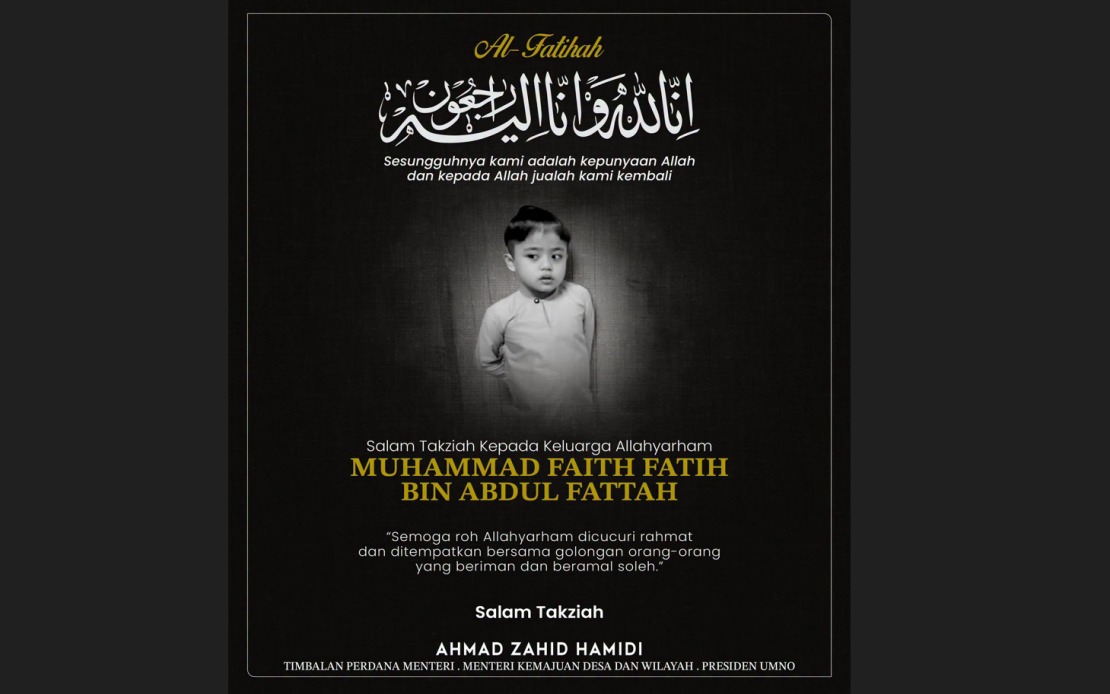
Deputy Prime Minister Datuk Seri Dr Ahmad Zahid Hamidi has conveyed his deepest sympathies to the family of Muhammad Faith Fatih Abdullah Fattah, a six-year-old boy with autism who was discovered deceased in an oil palm plantation near Sungai Sumun in Hutan Melintang, Perak, on the evening of June 30. The tragic discovery came after an intensive search and rescue effort following the child's disappearance from his home, highlighting the acute dangers that children with special needs face in both their immediate surroundings and broader community spaces.
Through a statement posted on his social media account on July 1, Ahmad Zahid, who represents the Bagan Datuk parliamentary constituency, described the incident as profoundly distressing given the vulnerability of children with developmental and behavioural conditions. The Deputy Prime Minister emphasised the particular anguish experienced by parents and caregivers when losing a child, especially one requiring specialised care and attention due to their autism spectrum condition. His public acknowledgment of the family's grief served to bring national attention to both the immediate tragedy and the broader challenges faced by families managing autism within Malaysia's social support infrastructure.
In his statement, Ahmad Zahid conveyed respect for the family's loss while drawing on religious sentiment appropriate to the Malaysian context. He invoked prayers for the deceased child and requested that those in the community recite Al-Fatihah, the opening chapter of the Quran, as an expression of collective mourning and spiritual support. This public gesture reflected both his parliamentary duty to acknowledge significant community losses and the cultural and religious frameworks through which such tragedies are typically processed within Malaysian Muslim-majority society. He further appealed for divine strength and forbearance for the grieving parents and extended family members navigating their loss.
According to Bagan Datuk police chief Supt Mohammad Ali Mohd Jali, authorities received notification of the child's disappearance at approximately 4:54 pm on June 30. The boy had last been observed in the living room of his family residence, after which he vanished without trace. The initial hours of the missing child report prompted swift coordination between police and search and rescue personnel tasked with locating the youngster within a timeframe when every moment carried critical implications for the child's safety and survival.
The search operation extended into the evening, with rescue teams systematically combing through the surrounding areas, including the extensive oil palm plantation landscape characteristic of rural Perak. At 10:08 pm, the search concluded with the grim discovery of the child's body in a drain located within the plantation zone. The circumstances surrounding how the child entered the plantation area and subsequently came to be in the drain remain subjects of ongoing investigation, raising questions about supervision, the accessibility of agricultural land to residential areas, and potential gaps in child safeguarding protocols within mixed-use rural environments.
The incident underscores significant vulnerabilities experienced by children with autism and other developmental conditions in Malaysia. Children on the autism spectrum frequently exhibit behaviours classified as elopement—the tendency to wander away from safe spaces—which can place them at considerable risk if they venture into hazardous environments such as agricultural zones, water bodies, or traffic-heavy areas. The tragedy in Hutan Melintang represents a stark reminder that despite increased national awareness of autism spectrum disorders, practical safeguarding measures, community education, and preventative infrastructure remain insufficient in many Malaysian communities.
Community and healthcare advocates have long highlighted the necessity for enhanced supervision protocols, better spatial design that restricts access to dangerous areas, and improved coordination between local authorities and families managing children with special needs. The incident may prompt renewed discussions within government circles regarding land-use planning in mixed residential and agricultural areas, particularly concerning the installation of barriers or warning systems around water drainage in plantation zones. Additionally, it raises questions about the adequacy of support services available to parents and caregivers of children with autism, including respite care, community awareness programmes, and emergency response training.
The death also reflects broader societal challenges in Malaysia regarding disability awareness and inclusion. While the country has made legislative progress through the Persons with Disabilities Act 2008 and various national policies promoting disability rights, implementation at community and local levels often lags significantly. Many rural and semi-rural areas lack specialised services, trained professionals, and community infrastructure designed with neurodivergent children in mind. The tragedy in Perak illustrates how systemic gaps can have devastating consequences for some of Malaysia's most vulnerable citizens.
Despite Ahmad Zahid's public acknowledgment of the family's loss, the incident also raises important questions about the adequacy of government support mechanisms for families managing autism in Malaysia. Autism spectrum disorder affects approximately one child per 100 in Malaysia, according to conservative estimates, yet public awareness, funding for services, and accessibility of specialised care remain inconsistent across different regions and socioeconomic groups. The Deputy Prime Minister's expression of sympathy, while appropriate, underscores the need for substantive policy interventions and resource allocation beyond ceremonial condolences.
Moving forward, child protection organisations and autism advocacy groups are expected to utilise this incident as a catalyst for promoting enhanced safety standards and community support frameworks. The tragedy illustrates the intersection of child welfare, disability rights, and public safety—areas requiring coordinated attention from multiple government agencies, local authorities, healthcare providers, and community stakeholders. For Malaysian families with children on the autism spectrum, the incident serves as both a heartbreaking reminder of inherent risks and a potential impetus for systemic improvements that could prevent similar tragedies.
The loss of Muhammad Faith Fatih Abdullah Fattah represents a profound tragedy for his family and community. As Ahmad Zahid's public condolences circulate through Malaysian society, they accompany an implicit call for the nation to strengthen its protective mechanisms and support systems for its most vulnerable young citizens. The incident demands that beyond words of sympathy, concrete actions be taken to create safer communities and more comprehensive support networks for children with special needs across Malaysia.

