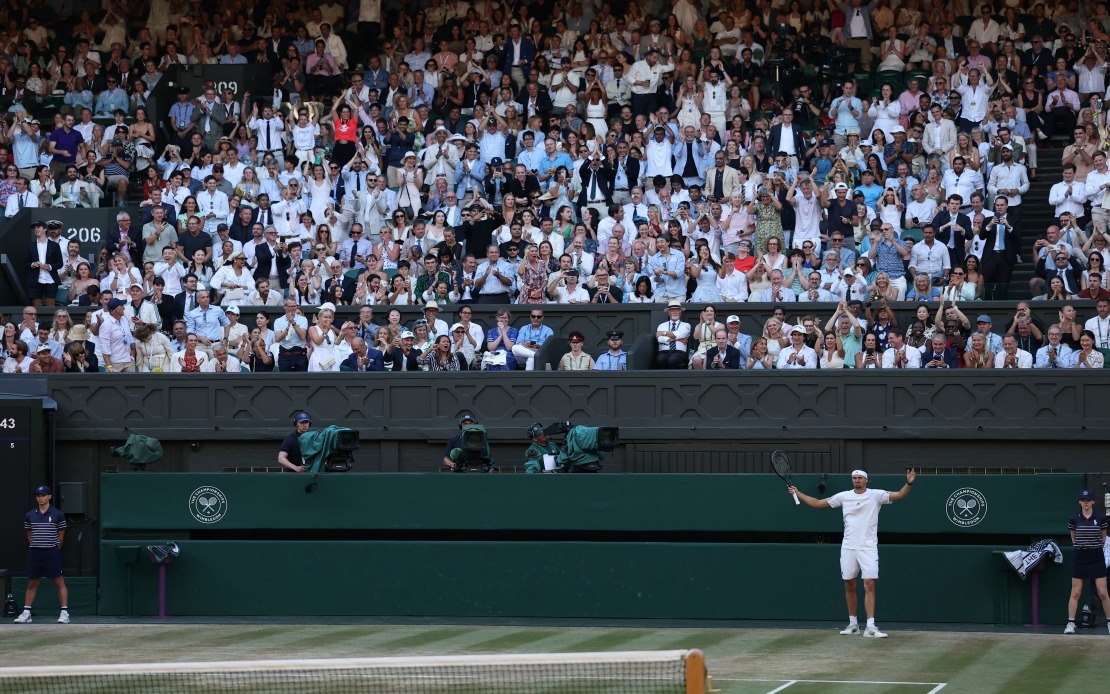
Jannik Sinner's commanding four-set victory over Alexander Zverev in the men's singles final concluded a memorable two-week championship at Wimbledon, delivering the kind of decisive conclusion that leaves the All England Club satisfied with its narrative arc. Yet for all the significance of that result, the tournament will be remembered equally for the remarkable human stories that unfolded across its courts, each offering its own compelling emotional resonance.
Marka Noskova's path to the women's title epitomised the unpredictability that makes Grand Slam tennis compelling viewing. The 21-year-old Czech player squandered an extraordinary five championship points during a devastating collapse in the second set, surrendering a commanding 5-2 advantage to plunge herself into a deciding set. The sequence recalled painful memories of Jana Novotna, the late Czech champion whose own tears shed on the shoulder of the Duchess of Kent after faltering against Steffi Graf in the 1993 final remain etched into Wimbledon's collective memory. Novotna endured a five-year wait until claiming her own Grand Slam triumph in 1998, but Noskova demonstrated the mental fortitude that separates champions from mere contenders. Taking a bathroom break to reset her mind, the teenager walked past the championship trophies positioned near the corridor and made a quiet but resolute promise to herself: she would return to claim the biggest prize. That resolve would prove decisive in the final set, transforming defeat into victory and confirming Noskova as a talent destined for sustained success at the sport's highest level.
Mitch Fery's run through the draw captured the imagination of British tennis followers in a manner rarely witnessed during recent years of relative decline for the home nation. The 23-year-old wildcard from Wimbledon itself, ranked a modest 114th in the world, reached the semi-finals through a combination of clinical shotmaking and unwavering mental composure. His quarter-final victory over Zizou Bergs represented the moment when the narrative truly crystallised, providing the defining moment that would define his fortnight. Facing an opponent ranked significantly higher, Fery found himself in parlous positions throughout the match, trailing 4-1 in both the fourth and fifth sets while battling the physical toll of competitive tennis on the sweltering outdoor Court 18. Three nosebleeds interrupted play, yet he refused to permit the mounting adversities to diminish his focus. After forcing a tie-break to level the match, Fery maintained his nerve as Bergs progressively lost his composure, ultimately prevailing in the deciding 10-point tiebreak that separated the two players. The victory elevated Fery to elite company, making him only the fifth British man this century to advance beyond the first week at the All England Club, a statistic underlining the rarity of homegrown success during this particular era.
Novak Djokovic's quarter-final encounter represented precisely the kind of extended examination that the 39-year-old Serbian champion did not require at this stage of his career and the tournament. The match evolved into a five-hour 15-minute examination, establishing a record as the longest quarter-final in Wimbledon history. The contest concluded within eight minutes of the 11pm curfew, a timeline that emphasised the sheer attritional nature of the encounter. Djokovic was forced to request treatment for a calf injury following the opening set, subsequently engaging in a heated confrontation with tournament referee Denise Parnell regarding the roof closure prior to the third set. Though the 24-time Grand Slam champion ultimately defeated third seed Félix Auger-Aliassime, the physical and mental reserves expended during that gruelling contest evidently compromised his subsequent performance. Against Jannik Sinner in the semi-final, Djokovic's accumulated fatigue and diminishing resources proved insufficient to overcome his younger opponent's vitality and precision.
Katerina Muchova's semi-final encounter with Coco Gauff distilled the entire tournament's drama into a single, extraordinary tie-break that lasted 18 pulsating minutes. Both players accumulated match points during an extended sequence of critical moments, with the tension mounting with every stroke exchanged across the net. At 8-8, Muchova received a time violation warning before dispatching a forehand beyond the baseline, inadvertently granting Gauff the first opportunity to clinch the match. Yet the American 22-year-old inexplicably misdirected a drop-shot that appeared to offer nothing but victory, sending the ball into the net through a combination of disbelief and poor execution. Muchova responded by converting her own first match point opportunity, but as she shaped to complete the decisive volley, her feet betrayed her positioning as she slipped dramatically on the grass court surface. Gauff's resulting cross-court forehand flew past the recovering Czech ninth seed to reverse the momentum once again. The subsequent sequence proved definitive, as Muchova regrouped and methodically manoeuvred Gauff around the court before the American's exhausted forehand found the net, confirming the Czech player's passage into the final.
Serena Williams' return to competitive tennis constituted the most compelling narrative of the opening week, generating anticipation that transcended typical sporting interest. The 44-year-old American superstar received a wild card entry and made her first appearance nearly four years after announcing her evolution away from professional competition. When she entered Centre Court for her opening match, the assembled crowd delivered a lengthy standing ovation, an emotional reception that underscored her iconic status within the sport. Against joint champion Australian player aged merely 24, Williams mounted an early break in the deciding set that suggested her competitive appetite remained intact and victory remained possible. Her powerful hitting and tactical awareness appeared sufficient to secure a memorable comeback victory for the first time since the 2019 semi-finals. However, Williams gradually faded during the closing stages as her younger opponent, bolstered by the significance of facing such a legendary figure, summoned the composure necessary to seize the opportunity. Subsequent analysis revealed that Williams had sustained a knee injury late in the opening set, an underlying injury that fundamentally compromised her physical mobility and contributed directly to her inability to sustain her early momentum throughout the match. The injury precluded her participation in a potential doubles reunion with her sister Venus, denying tennis enthusiasts the opportunity to witness the renowned partnership in action once more.

