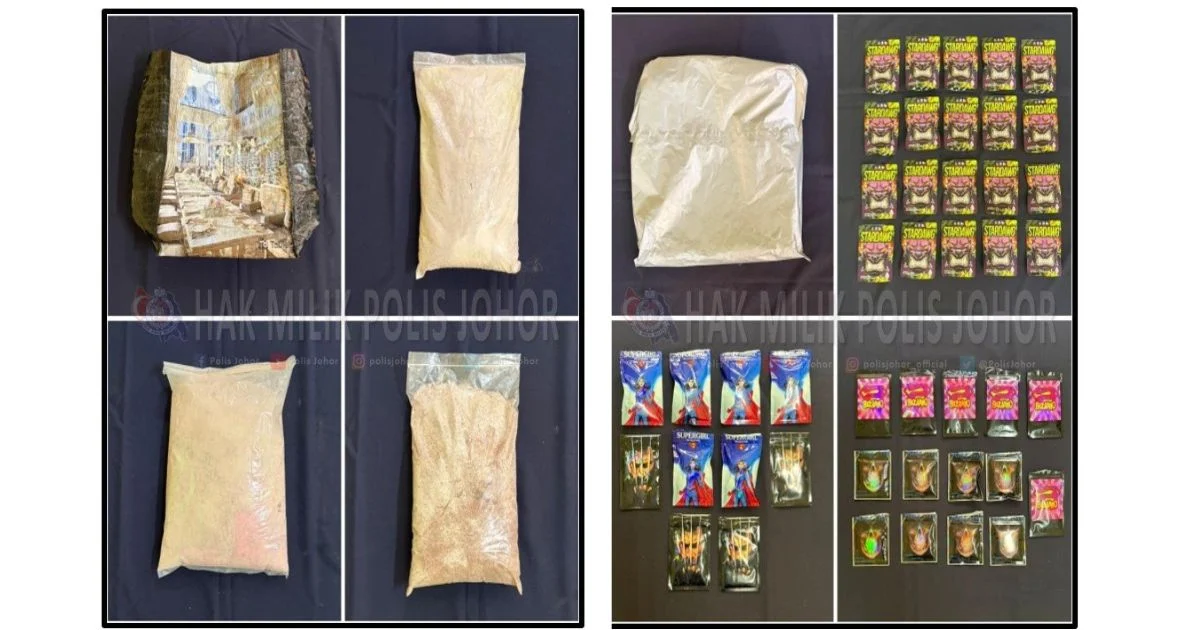
Law enforcement authorities in Johor Baru have successfully dismantled a drug trafficking operation centred in the Kulai district, culminating in the arrest of a married couple and the recovery of a substantial haul of illegal narcotics. The seizure, valued at approximately RM3.59 million, represents a significant blow against organised drug distribution networks operating within the state, one of Malaysia's major urban and industrial centres.
The operation reflects ongoing efforts by police forces across Malaysia to combat the distribution of illicit drugs, which remains a persistent challenge for law enforcement. The targeted approach—focusing on a specific couple rather than isolated street-level dealers—suggests authorities had developed intelligence indicating a more structured supply chain. Kulai, situated between Johor Baru and Kota Tinggi, has historically been an area of concern for drug-related activities, given its proximity to major transport corridors and industrial zones that can facilitate distribution networks.
The arrest of individuals operating as a married couple is particularly noteworthy, as spousal partnerships in drug operations are often designed to exploit legal complexities and evade detection. By operating as a household unit, such networks can launder proceeds more effectively, maintain operational security through family bonds, and distribute responsibilities in ways that complicate investigation and prosecution. The coordination required to maintain such arrangements typically indicates a level of sophistication beyond casual trafficking.
The monetary value attributed to the seized materials—RM3.59 million—provides insight into the scale of the operation. This substantial figure suggests the syndicate was not merely supplying local retail markets but likely functioning as a mid-tier distributor supplying multiple dealers across the region. The valuation methodology used by authorities typically reflects street-level retail prices rather than wholesale costs, meaning the actual purchasing cost to the operators would have been considerably lower, demonstrating the substantial profit margins inherent in drug trafficking.
For Malaysian enforcement agencies, drug seizures of this magnitude are common enough to indicate systemic challenges rather than isolated incidents. The Johor state police, responsible for one of the nation's largest populations and busiest commercial corridors, regularly conduct operations targeting trafficking networks. This particular bust demonstrates the continued commitment of local law enforcement to disrupt supply chains at intermediate levels, where impact can be maximised.
From a regional perspective, the Johor location carries particular significance. The state serves as a gateway between Malaysia's peninsula and Singapore, making it a natural transit point for narcotics destined for various Southeast Asian markets. The Johor-Singapore border, despite sophisticated surveillance systems, remains a challenge for interdiction efforts. Drug networks utilising the Kulai area would have potential access to multiple smuggling routes, whether by road through the various border checkpoints or via maritime routes along the Johor coast.
The implications for the broader war on drugs in Malaysia are mixed. While individual seizures represent tactical successes, the underlying economics of drug trafficking remain attractive to criminal enterprises. The profit potential demonstrated by cases like this—where RM3.59 million in product represents merely one syndicate's inventory—explains the persistence of trafficking networks despite consistent law enforcement pressure. For every operation disrupted, alternative suppliers typically move to fill the market gap.
The arrest and investigation phase following such seizures typically proves as important as the initial apprehension. Authorities will seek to trace the supply chain upward to identify source distributors and downward to identify retail networks and customers. In Malaysia's context, such investigations frequently reveal connections to larger transnational trafficking organisations, which rely on local operatives like the Kulai couple to manage distribution. Intelligence gathered during interrogation can therefore illuminate broader criminal networks operating across Malaysia and potentially throughout Southeast Asia.
For residents of Johor and particularly Kulai, this operation provides evidence that police operations continue despite competing demands on law enforcement resources. However, it also reflects the ongoing presence of drug distribution infrastructure within residential areas. The location of such operations in Kulai—a town of approximately 400,000 people with significant industrial activity—demonstrates that trafficking networks operate across diverse settings, not merely in isolated or degraded urban neighbourhoods.
The success in recovering RM3.59 million worth of narcotics removes that quantity from potential circulation within local communities. Drug-related harm extends beyond direct users to families, workplaces, and social services, making supply-side interventions valuable even when demand-reduction efforts remain incomplete. The arrest of the couple may also serve a deterrent function, though evidence suggests supply-side enforcement alone has limited long-term impact on trafficking volumes without complementary demand-reduction and treatment initiatives.
Moving forward, this operation underscores the importance of community-based intelligence in identifying trafficking operations. Police have consistently emphasised that public reporting of suspicious activities—unusual traffic patterns, frequent visitors, or observable drug-related behaviour—provides essential leads for investigations. Kulai residents and those across Johor remain frontline observers in identifying criminal operations affecting their communities.

