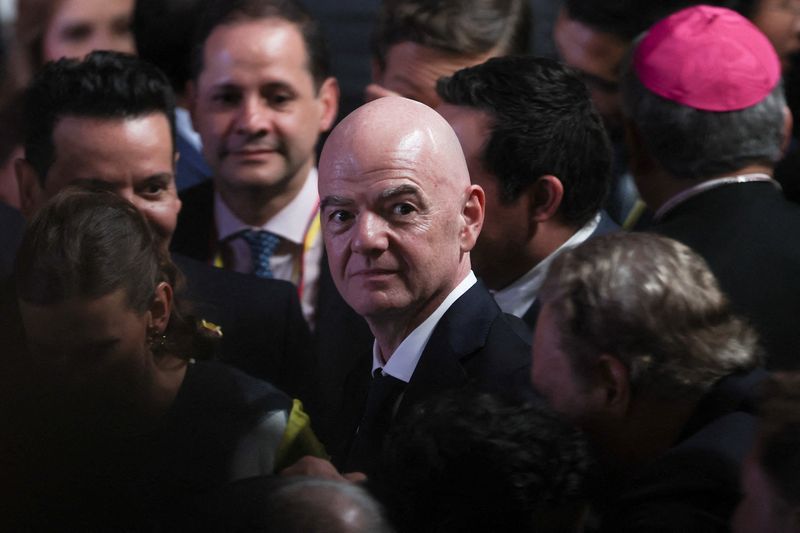
The Royal Dutch Football Association (KNVB) has escalated pressure on FIFA's leadership by formally withdrawing confidence in President Gianni Infantino and proposing a sweeping institutional overhaul. In a statement issued on Sunday, the KNVB—one of FIFA's 211 member associations and a founding member dating back to 1904—declared it wants to convene an International Summit on the Future of FIFA in Amsterdam. The purpose is not merely to install new leadership but to fundamentally restructure how world soccer's governing body operates, with the expectation that Infantino depart by 2027.
The timing of the KNVB's move reflects mounting dissatisfaction with Infantino's presidency among global football powers, particularly in Europe. The catalyst appears to be Infantino's recently abandoned proposal to monetize FIFA's signature events by selling stakes in tournaments like the World Cup to private equity investors. This scheme prompted alarm among regional confederations and member nations, who view such commercialization as a betrayal of football's collective heritage. Infantino faces re-election in March 2025, and discussions are underway among major football federations about whether to trigger a formal vote of no confidence before that ballot.
What distinguishes the KNVB's intervention is its insistence that personnel change alone cannot cure FIFA's systemic ailments. The Dutch association has identified three critical reform priorities: establishing stronger governance architecture with meaningful checks and balances on executive power, embedding human rights and environmental sustainability considerations into FIFA's decision-making processes, and fostering genuine international cooperation rather than top-down diktat. For Malaysian and Southeast Asian football stakeholders, this push for democratization carries particular significance, as smaller federations have historically wielded minimal influence over FIFA's strategic direction and resource allocation.
The KNVB specifically highlighted what it views as dangerous concentration of authority around the FIFA presidency. The association observed that FIFA's administrative structure grants insufficient independence to institutional operations separate from the President's office, creating conditions for unilateral decision-making without adequate oversight. This critique resonates with criticisms emerging from the Asian Football Confederation and other regional bodies, which have long struggled to secure proportionate representation in FIFA's governance councils and budget allocation processes.
A particularly notable dimension of the Dutch proposal concerns revenue distribution. The KNVB is advocating that FIFA commit to reinvesting up to 90 percent of its distributable revenue back into soccer development globally. This targets a perennial grievance among developing football nations, including those across Southeast Asia, which receive minimal financial support for grassroots infrastructure, coach development, and youth academies. Currently, FIFA generates vast sums through broadcast rights, sponsorships, and tournament ticket sales, yet much of this wealth flows to wealthy European and South American confederations while peripheral regions languish in poverty.
The KNVB's proposal pointedly reframes the reform agenda as a collective exercise rather than a European initiative imposed on the rest of the world. By emphasizing that any new direction must be developed "together with FIFA's 211 Member Associations and the confederations from all parts of the world," the KNVB signals that the summit should include meaningful input from African, Asian, and Oceanian federations. This inclusive framing is strategically important, as it pre-emptively counters accusations that European federations are simply attempting to reclaim leadership over FIFA after losing ground during Infantino's tenure.
Infantino has previously defended his approach by arguing that FIFA bears responsibility for narrowing the financial gap between wealthy and resource-constrained member associations. He contends that closing this disparity requires active intervention and creative financing mechanisms. However, the KNVB's counter-argument suggests that privatization and equity investment schemes represent the wrong pathway toward greater equality. Instead, the Dutch federation proposes that FIFA redirect its existing revenue streams more equitably—a position likely to resonate with smaller federations across Asia and Africa that have expressed skepticism toward proposals that might further commercialize the sport.
The KNVB's move gains additional weight from its historic stature within global football. As a founding member of FIFA in 1904 and a perennial UEFA power, the Netherlands commands respect that newer or smaller federations might not enjoy when raising governance concerns. Significantly, the statement notes that the KNVB had previously supported Infantino during his presidential election, revealing that this withdrawal of confidence represents a deliberate recalibration rather than consistent opposition. This shift suggests that even constituencies that initially aligned with Infantino have become convinced his tenure has become untenable.
The European context for these demands cannot be overlooked. UEFA, the European confederation to which the KNVB belongs, is simultaneously pursuing legal avenues against Infantino, having requested permission from a U.S. federal court to obtain testimony and documents from FIFA entities in Florida for use in a planned criminal complaint in Switzerland. This parallel legal strategy suggests that the governance reform initiative operates alongside, rather than in isolation from, potential criminal accountability mechanisms. For Southeast Asian federations, understanding this broader landscape is crucial, as it signals that major power centers within global football are coalescing around a vision of FIFA fundamentally transformed.
The proposed Amsterdam summit represents a potential inflection point for FIFA's institutional direction. If the KNVB succeeds in mobilizing support among other confederations—particularly the African Confederation, Asian Football Confederation, and CONMEBOL—the organization could face genuine pressure to implement structural changes beyond merely replacing its president. For Malaysian football stakeholders and Southeast Asia more broadly, the outcome of this reform initiative will likely determine whether smaller nations gain greater voice in FIFA's strategic planning and whether resources flow more equitably toward developing football infrastructure in less wealthy regions. The summit could either reinvigorate FIFA as a more inclusive and democratically accountable institution, or alternatively, it could fragment further, with disaffected federations pursuing alternative governance models.

