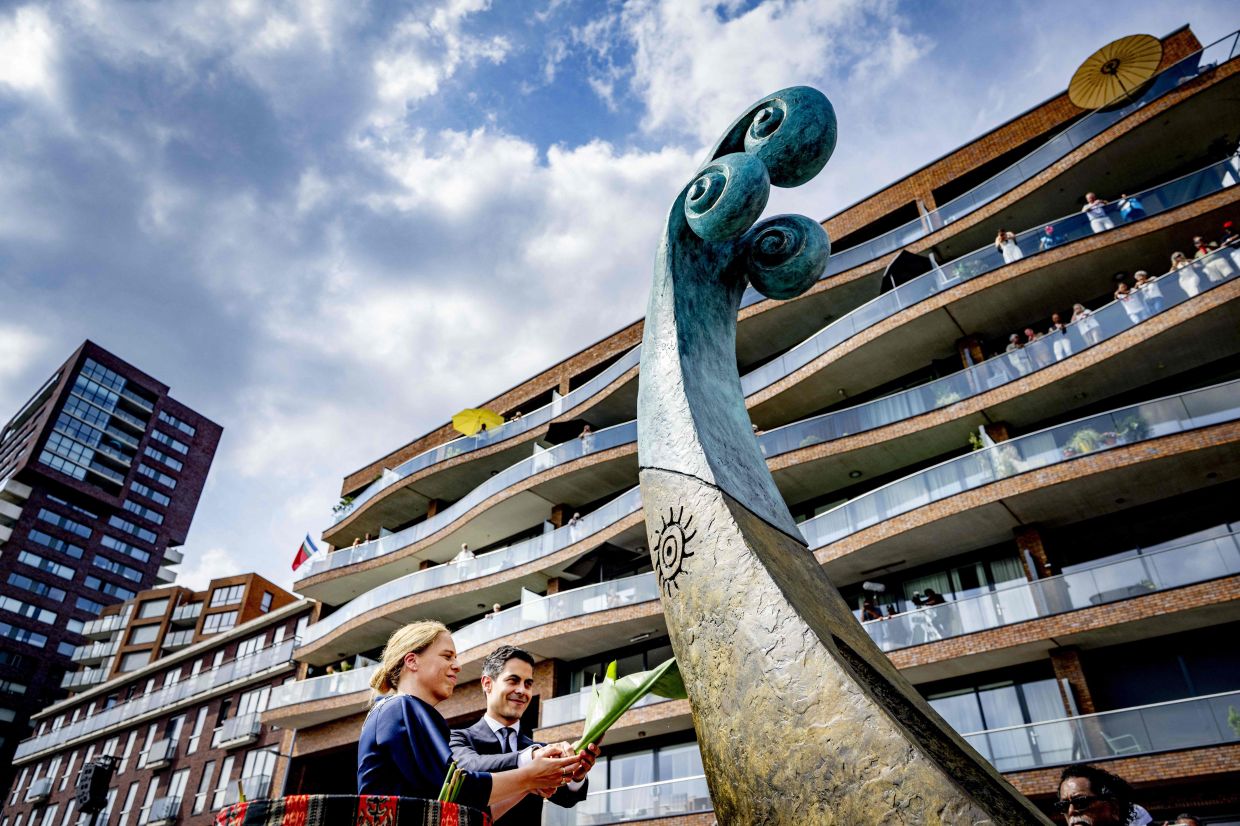
Dutch Prime Minister Rob Jetten delivered a formal state apology on Sunday to members of the Moluccan community, acknowledging more than seven decades of mistreatment and broken commitments by the Dutch government. The ceremony, held in Rotterdam, marked a significant moment for a diaspora community whose experiences have long remained marginalised in discussions of European colonial history and its aftermath. Jetten's words of contrition were directed at hundreds of Moluccans who gathered at the unveiling of the Ulu Kora monument, a memorial situated on the Lloydkade waterfront—the very location where ships first delivered these displaced people to Dutch shores in the late 1940s.
The historical context underlying this apology stretches back to Indonesia's struggle for independence following World War II. The Moluccan islands in eastern Indonesia, renowned historically as the "spice islands" for their valuable nutmeg and clove production, became a focal point of territorial dispute between the Dutch colonial administration and Indonesian nationalist forces. Many Moluccans, particularly those from Christian communities, chose to fight alongside the Dutch armed forces during this tumultuous period, believing their loyalty would be rewarded with security and recognition.
When Indonesia formally achieved independence in 1949, the Dutch government faced a complex political problem. Rather than leave their Moluccan allies to face potential retribution from the newly independent Indonesian state, Dutch authorities orchestrated what they framed as a temporary evacuation. Approximately 12,500 Moluccans were transported to the Netherlands as part of government-sponsored negotiations intended to protect them from persecution. The arrangement was explicitly presented as a provisional measure—these communities were told they would remain in the Netherlands only long enough for a separate Moluccan state to be established, at which point they would return home to rebuild their lives.
This promised homecoming never materialised. The Dutch government quietly abandoned its commitment to repatriation, leaving the Moluccan population stranded in a foreign country with no clear path forward. Rather than receiving the welcome and support befitting allies who had sacrificed for Dutch interests, the Moluccan arrivals encountered systematic indifference and institutional neglect. Those who had served in the military were summarily discharged from service without meaningful transition support. Housing conditions were uniformly poor, with many Moluccans confined to temporary accommodation that offered minimal dignity or privacy. Employment opportunities were scarce, and the broader Dutch society made little effort to facilitate their integration or cultural adjustment.
The practical consequences of this abandonment extended far beyond housing and employment. Moluccan families endured profound psychological trauma—a grief rooted in displacement, lost homelands, and the realisation that the nation they had served had essentially discarded them. This pain rippled through generations, compounded by the fact that official Dutch narratives rarely acknowledged their presence or contributions. For decades, the Moluccan experience remained a footnote in European discussions of decolonisation, overshadowed by debates that centred European perspectives and concerns rather than the lived realities of colonised and displaced peoples.
The frustration and anger accumulated by the second generation of Moluccans boiled over during the 1970s, when young Dutch-born Moluccans took increasingly violent action to draw attention to their plight. These incidents, including train hijackings and hostage situations, shocked Dutch society but also finally forced the question of Moluccan grievances into public consciousness. Yet even these desperate actions failed to generate meaningful institutional change or official recognition of the injustices their community had endured. The Moluccans remained trapped in a limbo of their own making—neither fully Dutch nor able to return to an Indonesia that had moved on without them.
In his apology, Jetten acknowledged the multifaceted nature of the harm inflicted. He spoke directly to the inadequate housing, the invisibility and abandonment, the unresolved longing for home, and the cascading grief within families separated by both geography and time. His words carried recognition that the Moluccan experience represented a failure of both governmental responsibility and human decency. Jetten notably refrained from making grandiose claims about the power of apology to heal historical wounds, instead expressing hope that his words might constitute a form of recognition and, as he framed it, an act of historical justice.
The unveiling of the Ulu Kora monument itself carries symbolic weight. By creating a permanent physical space in Rotterdam that acknowledges Moluccan suffering and sacrifice, the Dutch state has finally created a venue for public remembrance and collective acknowledgment. For Moluccans—many of whom clutched family photographs of first-generation community members now deceased—this monument represents a tangible recognition that their stories matter, that their pain was real, and that their presence in Dutch history deserves to be remembered.
For Southeast Asian readers, this moment resonates with broader questions about how postcolonial states address historical injustices and manage the consequences of independence struggles. Indonesia's own relationship with its former colonial subjects and diaspora communities reflects similar complexities. The Moluccan case also illustrates how decolonisation in Asia left behind vulnerable populations caught between nationalist projects and international diplomacy. Many Southeast Asian nations continue to grapple with the legacies of colonial-era migration and displacement, making the Dutch government's formal acknowledgment of its failures potentially instructive for regional discussions about historical responsibility and redress.
The apology also underscores evolving European attitudes toward colonial histories that had previously been sanitised or minimised in official narratives. As more European governments confront uncomfortable truths about their imperial pasts, the question of how to memoralise, apologise for, and ultimately reconcile with affected communities becomes increasingly central to contemporary governance. The Moluccan apology, while late in coming, demonstrates that acknowledgment and memorialisation, though imperfect remedies for historical trauma, can nonetheless represent meaningful steps toward recognition and dignity for those whose suffering was long dismissed or forgotten.