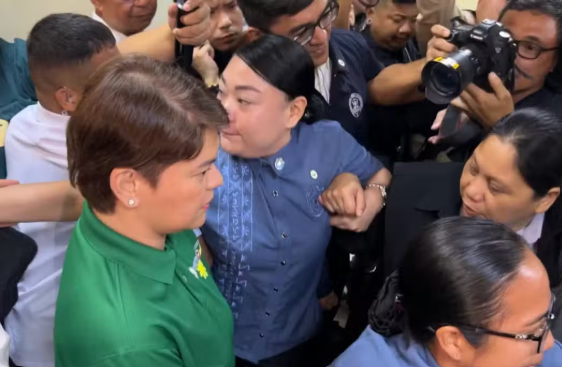
Philippine Vice President Sara Duterte struck a defiant tone on Tuesday as her Senate impeachment trial proceeded, borrowing from classical literature to articulate her determination to withstand the legal onslaught. Arriving at the chamber to consult with her legal team, Duterte told waiting reporters that "in this bloodbath and bludgeoning, I will be bloodied but unbowed"—a deliberate echo of William Ernest Henley's celebrated 1875 poem "Invictus," which has long served as a symbol of human resilience against overwhelming adversity. The choice of language signals how Duterte intends to frame her defence: not as a battle she expects to win cleanly, but as a trial of endurance where survival itself constitutes victory.
This latest articulation of her "bloodbath" rhetoric carries particular weight given the mounting severity of the charges she faces and the protracted nature of the proceedings ahead. The impeachment case comprises four distinct Articles, each targeting different aspects of her tenure as Vice President and reflecting the deep political divisions that have fractured the Philippine leadership structure. The accusations span financial impropriety, concealment of assets, procurement fraud linked to the Department of Education, and the most explosive allegation—that she made threats against the life of President Ferdinand Marcos Jr., First Lady Liza Araneta-Marcos, and former House Speaker Martin Romualdez.
The first and most concrete charge centres on the alleged misappropriation of P612.5 million in public funds. According to the impeachment complaint, P500 million from the Office of the Vice President's confidential and intelligence fund was spent without proper accounting, alongside P112.5 million from the Department of Education budget. The opacity surrounding these expenditures has become a flashpoint in Philippine political discourse, raising fundamental questions about executive accountability and the proper stewardship of taxpayer money. For Malaysian observers accustomed to their own governance scrutiny, the scale of such unaccounted spending reflects a broader Southeast Asian challenge regarding financial transparency in high office.
The second Article targets Duterte's asset declarations across multiple years, alleging she failed to accurately report her net worth in her Statements of Assets, Liabilities and Net Worth (SALNs) covering 2022 through 2024. This charge extends beyond simple omission to suggest intentional concealment and continued involvement in business ventures despite legal requirements for public officials to divest from such interests. Such allegations strike at the credibility of the entire governance apparatus and undermine public trust in the integrity of elected officials—concerns resonating throughout Southeast Asia where asset disclosure remains contested terrain.
Article III implicates Duterte in what the complaint characterises as bribery and irregular procurement processes involving Department of Education officials. This accusation suggests corruption extending beyond her office to implicate bureaucrats within the education sector, potentially widening the scope of investigation and indicating systemic irregularities rather than isolated lapses. The involvement of education funds lends particular sensitivity to these allegations, given the sector's importance to national development and poverty alleviation efforts across the region.
The fourth Article presents the most dramatic and politically charged allegation: that Duterte made threatening statements against the sitting President, the First Lady, and the former House Speaker. Assassination threats against national leaders represent the gravest form of political instability and carry constitutional implications far beyond typical corruption charges. Should this article prove substantive, it would suggest a breakdown in institutional norms and democratic decorum at the highest level of government, with ramifications extending across Philippine political institutions.
Duterte's defiant posture contrasts sharply with her conduct during the impeachment proceedings themselves. She has conspicuously absent from most House hearings in both 2025 and 2026, a strategy that has drawn criticism from political opponents who view her non-attendance as contemptuous of the process and evidence of unwillingness to answer questions under oath. This apparent contradiction between her rhetorical combativeness and her practical withdrawal from proceedings has become a point of contention among analysts and political observers.
The constitutional requirements for her conviction present a formidable barrier to removal. Under the 1987 Philippine Constitution, conviction requires approval from at least two-thirds of all senator-judges sitting in judgment. This supermajority threshold reflects constitutional design meant to protect high officials from partisan prosecution, yet it also means that fewer than one-third of senators need to vote for acquittal to preserve Duterte in office. The current composition of the Senate and the political alignments among its members thus become critical variables in determining the trial's ultimate outcome.
The projected 92-day timeline for the trial means proceedings will likely extend well into early 2027, creating months of sustained political turbulence and institutional preoccupation during a period when the Philippine government faces significant economic and security challenges. The prolonged nature of the trial raises questions about governmental efficiency and the opportunity cost of having the Senate consumed by impeachment proceedings rather than attending to legislative priorities affecting ordinary citizens.
For regional observers in Malaysia and Southeast Asia more broadly, the Duterte impeachment trial illuminates persistent governance challenges that transcend national boundaries. Questions of executive accountability, financial transparency, and the proper functioning of checks and balances remain contentious throughout the region. Duterte's invocation of Henley's "Invictus" may resonate emotionally with supporters, but the substantive allegations—misuse of public funds, hidden wealth, irregular procurement, and threats against leaders—require factual adjudication rather than rhetorical flourish. The trial's outcome will carry implications not only for Philippine governance but for regional perceptions of institutional strength in democratic institutions across Southeast Asia.

