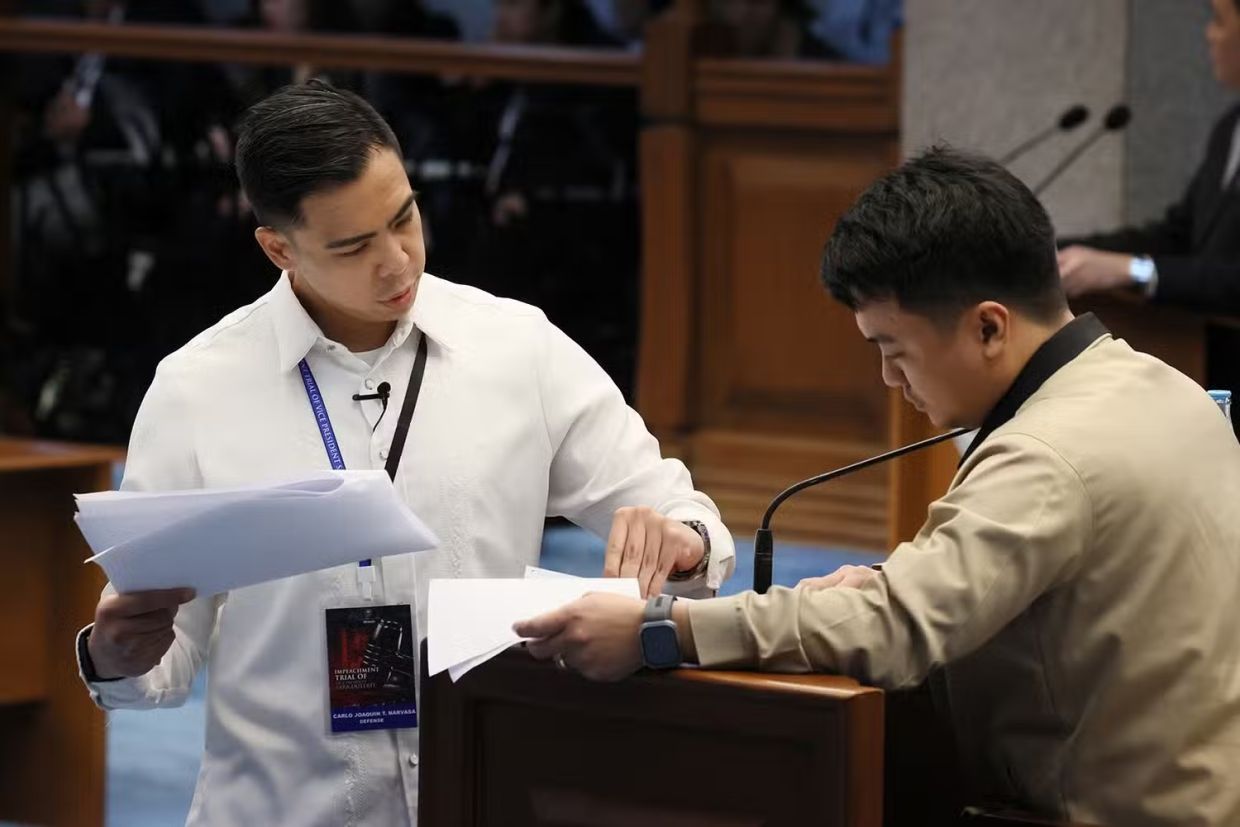
The impeachment trial of Philippine Vice President Sara Duterte shifted into a critical phase on Wednesday as her legal team launched an aggressive challenge to the prosecution's case, arguing that the remarks she made against President Ferdinand Marcos, first lady Liza Araneta-Marcos, and former Speaker Martin Romualdez fall outside the constitutional definition of impeachable conduct. With the Senate impeachment court now three days into proceedings, the defence team's opening salvos have centred on a fundamental question: whether statements made during an online press briefing on November 23, 2024, can legally constitute "other high crimes" as contemplated by the 1987 Philippine Constitution, regardless of how inflammatory or concerning they may have appeared to the public.
The constitutional argument forms the backbone of Duterte's defence strategy. Article XI, Section 2 of the Philippine Constitution restricts impeachable offences to a narrow list including culpable violation of the Constitution, treason, bribery, graft and corruption, betrayal of public trust, and the catch-all category of "other high crimes." Duterte's defence counsel Mark Vinluan contended that the prosecution has failed to demonstrate that the Vice President's remarks satisfy this exacting standard, essentially arguing that political rhetoric, however colourful or aggressive, does not automatically constitute grounds for removal from office. This interpretation reflects broader jurisprudential debates across democracies regarding where the line should be drawn between protected political speech and conduct serious enough to warrant impeachment, a distinction that has proven remarkably difficult to establish with precision.
Cross-examination of National Bureau of Investigation senior agent John Mark Calilung exposed significant evidentiary gaps in the prosecution's foundation. The defence highlighted that none of the three alleged victims—the President, the first lady, or former Speaker Romualdez—had filed formal criminal complaints or personally appeared before the NBI to provide statements. Instead, the investigation proceeded motu proprio, initiated by the bureau without a formal complainant triggering the inquiry. This procedural irregularity became a focal point for the defence's challenge to the investigative credibility and the weight of evidence supporting the impeachment complaint. Furthermore, Calilung acknowledged that the NBI's revised affidavit dated February 10, 2025, contained no testimony from the offended parties themselves nor from journalists who attended the November press briefing, raising questions about the thoroughness and independence of the investigation.
The defence strategy pivoted to recontextualising the Vice President's remarks within what they characterised as a broader pattern of government harassment and family threat. According to the defence narrative, Duterte was responding not as a government official but as a daughter, wife, mother, and sister who perceived her family to be under assault from government operations. Vinluan referenced what he termed "Operation Romanov," allegedly an intelligence surveillance initiative that exposed Duterte's family to security threats, and he presented evidence suggesting that her residences in both Davao and Manila had been profiled by government agents. Additionally, trusted security personnel assigned to protect the Vice President had reportedly been reassigned, compounding her anxiety and sense of vulnerability. This framing attempts to shift the lens through which her statements should be evaluated, moving away from the formal act of speaking as a public official and toward the personal circumstances that supposedly motivated her words.
The role of Duterte's chief of staff Zuleika Lopez emerged as a crucial emotional and legal linchpin in the defence's contextual argument. On the same day as the November 23 press briefing, Lopez was cited in contempt by a House committee investigating the confidential funds of the Office of the Vice President and the Department of Education. Video evidence presented by the defence showed Lopez visibly distressed, breaking down as she objected to her planned transfer to the Correctional Institution for Women in Mandaluyong City, expressing fears for her safety and insisting she was not a criminal. The defence maintained that Duterte's subsequent remarks were a direct emotional response to witnessing her chief of staff's detention and the broader institutional actions being taken against her office and staff. This narrative transforms the alleged threats from unprovoked attacks into reactions stemming from what the defence characterised as systematic oppression orchestrated by the House committee chaired by Representative Joel Chua, who now serves as one of the House prosecutors.
When pressed by Senator Risa Hontiveros about whether grave threats could be justified by legitimate grievances, defence counsel Carlo Narvasa carefully retreated from that extreme position, recognising that such an argument would push judicial boundaries too far. Instead, he emphasised that the context rendered Duterte's unconventional responses understandable, if not strictly justified. The distinction proved crucial, as Narvasa sought to establish that the Senate should weigh Duterte's state of mind and circumstances when evaluating whether her conduct rose to the level of an impeachable high crime. The questioning also exposed tensions within the Senate's procedural approach, as presiding officer Senator Francis Escudero eventually intervened to remind senator-judges that determinations of legal sufficiency belong in closing arguments rather than direct questioning. Senator Hontiveros noted that previous impeachment trials had permitted broader inquiry from the bench, suggesting that procedural norms themselves remain contested in these extraordinary proceedings.
A critical weakness in the prosecution's case centred on the absence of direct evidence that Duterte actually contracted an assassin to murder the President, first lady, or former Speaker. During Tuesday's proceedings, prosecution counsel Amando Ligutan acknowledged that the video recordings of her November 23 statements did not conclusively prove that she had hired someone to commit murder, but argued instead that her remarks demonstrated intent as part of a broader pattern of statements. This concession became the foundation for the defence's argument that without proof of actual criminal conspiracy or contracting of an assassin, the statements alone could not satisfy the constitutional standard for impeachment. Vinluan pressed the point relentlessly, noting that the prosecution itself had acknowledged the recordings lacked the evidentiary weight necessary to establish the core alleged criminal act. The defence further argued that interpreting Duterte's remarks as references to an assassin represented an interpolation by others rather than language the Vice President herself had used, suggesting that the assassination narrative had been imposed upon her statements through hostile interpretation.
The procedural vulnerabilities surrounding the NBI investigation extended beyond the absence of victim statements. Calilung's testimony revealed that the bureau had not secured sworn affidavits from any of the three targets of the alleged threats or from the journalists present at the press briefing, raising questions about whether even basic investigative protocols had been followed. When Narvasa pointedly asked whether the NBI had "really investigated this case," the prosecution objected before Calilung could respond, preventing a potentially damaging answer. The NBI agent did explain that he had executed an affidavit attesting to minutes of internal investigator interviews rather than obtaining direct witness statements, and that the bureau had complied with Department of Justice requirements and secured certification on the sufficiency of its preliminary investigation. Yet these bureaucratic formalities appeared hollow without substantive testimony from those most directly affected by the alleged threats, namely the President and first lady themselves.
The strategic choice by the defence to emphasise the investigative gaps and procedural shortcomings reflects a calculated assessment that the prosecution's case rests on shaky evidentiary foundations. Rather than mounting a full-throated defence of the Vice President's rhetoric or arguing that her words posed no genuine threat, the defence has instead focused on exposing weaknesses in how the case was constructed. This approach recognises that in impeachment proceedings, even matters of extraordinary constitutional gravity must satisfy basic evidentiary standards. The defence's repeated questioning of whether Duterte truly hired an assassin, combined with evidence that the alleged victims never personally appeared before the NBI, suggests that the prosecution may have proceeded on assumptions and inferences rather than solid investigative work. For Malaysian observers of Philippine politics, this dimension of the trial illustrates how procedural rigour and evidentiary completeness remain essential anchors even in highly charged political prosecutions.
The trial has now crystallised around competing visions of both constitutional interpretation and factual sufficiency. The prosecution maintains that Duterte's statements constituted grave threats against the President and first lady, thereby meeting the threshold of high crimes warranting removal from office. The defence contends that without proof of actual criminal conspiracy, without formal complaints from the alleged victims, and without proper investigative foundation, the case fails at multiple levels. Beyond the immediate legal questions, the trial touches on broader anxieties about institutional conflict within the Philippine government, the appropriate scope of impeachment as a political remedy, and the extent to which contextual factors such as alleged government harassment should influence judicial evaluation of allegedly threatening remarks. As the trial proceeds through witness testimony and legal arguments, senator-judges must navigate these competing imperatives while bearing in mind that their decision will have profound consequences for executive-legislative relations and the boundaries of impeachable conduct in the Philippine constitutional order.

