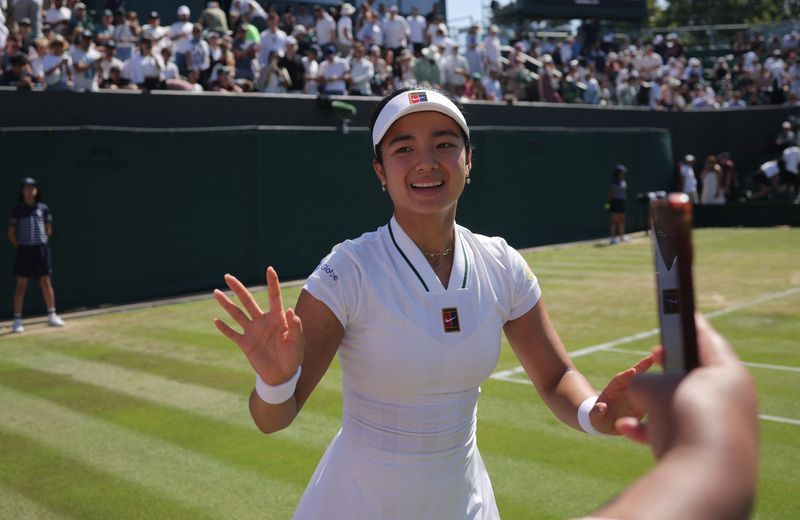
Alexandra Eala of the Philippines has achieved a milestone that will resonate across Southeast Asian tennis, becoming the first player from her nation to reach the third round of a Grand Slam tournament. The 21-year-old from Quezon City accomplished this feat at Wimbledon on Thursday with a commanding performance against Australia's Maya Joint, securing victory 3-6 6-2 6-0 after recovering from a slow start in the opening set. The achievement marks a watershed moment for Philippine tennis on the world's grandest stages, a breakthrough that carries significance beyond the court for a tennis-loving nation with limited representation at elite international competitions.
Eala's recovery from her first-set loss demonstrated the mental resilience and technical prowess that have propelled her rapid ascent through the professional rankings. Having lost the opening set, she recalibrated her approach and dominated the subsequent two sets with increasing authority, showcasing the aggressive baseline play and grass-court movement that have become her trademark. The turnaround against Joint, who had defeated Serena Williams in the first round, underscores the quality of Eala's current form and her growing confidence on the surface where she feels most comfortable. Her progression through the tournament has been methodical yet impressive, building momentum with each match in what represents only her sixth Grand Slam appearance.
The 29th seed will face an entirely different challenge in her third-round encounter against Iga Swiatek on Saturday. The Polish defending champion arrives as one of the sport's most accomplished players, possessing a record of six Grand Slam titles and a vast reservoir of experience in high-pressure situations. Yet Eala approaches the matchup without apparent intimidation, acknowledging the difficulty of the challenge ahead while expressing confidence in her ability to compete. Her measured assessment—that she intends to make the contest difficult for her opponent despite expecting a formidable test—reflects a maturity and self-awareness that often distinguishes emerging talents who are capable of sustained progress at the highest levels.
Culturally, Eala's journey carries weight far beyond tennis statistics and tournament progression. The young athlete has made deliberate choices to honour her heritage while competing on the international stage, decisions that have been supported by her sponsors and deeply felt by the player herself. Her Wimbledon gear includes a visor emblazoned with the Tagalog phrase "Kapag lumago, hindi na hihinto," which translates to "once it grows, it cannot be stopped"—a sentiment that captures both the aspirational nature of her breakthrough and the momentum building behind her career. Last year's Wimbledon debut saw her compete with a custom hair tie adorned with the sampaguita, the national flower of the Philippines, a small but symbolically significant gesture of connection to her homeland.
Eala's integration of her cultural identity into her professional identity sets her apart from many athletes who compartmentalize their personal and sporting lives. She has spoken movingly about the emotional significance of representing her nation on the world's greatest stages, framing her achievements not merely as personal accomplishments but as milestones for Philippine tennis collectively. This perspective has resonated with supporters back home, who have followed her progression with growing enthusiasm as she has climbed the rankings and begun competing regularly in significant tournaments. Her willingness to carry aspects of her culture onto the court—not as aesthetic flourish but as genuine expression of identity—appears to strengthen rather than distract from her competitive focus.
The trajectory that has brought Eala to this point represents sustained development rather than sudden emergence. She trains at the Rafa Nadal Academy in Mallorca, placing her within an elite coaching environment known for producing technically accomplished clay-court and all-surface players. Her rankings breakthrough into the top 50 last year has continued accelerating through 2024, with particular success on grass surfaces where her aggressive style and court coverage flourish. The Birmingham title victory last month and semi-final finish in Berlin demonstrated that her Wimbledon performance emerges from genuine seasonal form rather than a one-off flash of inspiration. This consistency on grass suggests that she has identified a surface suited to her game and is methodically building the technical and tactical understanding necessary to compete regularly at high levels.
For Malaysian and Southeast Asian tennis followers, Eala's success carries particular resonance. The region has produced occasional Grand Slam competitors but few have advanced so far so early in their careers or with such cultural prominence. Her achievement illustrates the capacity for Southeast Asian players to compete at the highest levels when provided with appropriate training environments, professional support structures, and competitive opportunities. Her story may inspire young players across the region to pursue professional tennis at the highest levels, potentially contributing to a gradual elevation of Southeast Asian tennis on the international circuit.
The practical implications of Eala's third-round appearance extend beyond immediate tournament progression. Success at this level generates ranking points that accelerate further opportunities, places her in future major tournament draws with higher seedings, and establishes her credentials in the sport's hierarchy. A victory against Swiatek, while appearing unlikely given the champion's pedigree, would catapult Eala into genuine contention and potentially trigger significant sponsorship and media interest. Even a competitive loss would strengthen her position at the sport's highest level and confirm her status as an emerging force in women's tennis.
Eala's approach to her newfound prominence emphasizes authenticity and personal values rather than calculated image management. She has resisted the temptation to adopt persona or present herself as someone other than who she is, instead allowing her tennis and her character to speak for themselves. This authenticity appears to resonate with observers who have followed her emergence, creating genuine rather than manufactured interest in her continued progress. As she prepares to face Swiatek and contemplate potential deep runs through upcoming Grand Slams, Eala carries not only the expectations of her own ambition but also the hopes and pride of an entire tennis nation.

