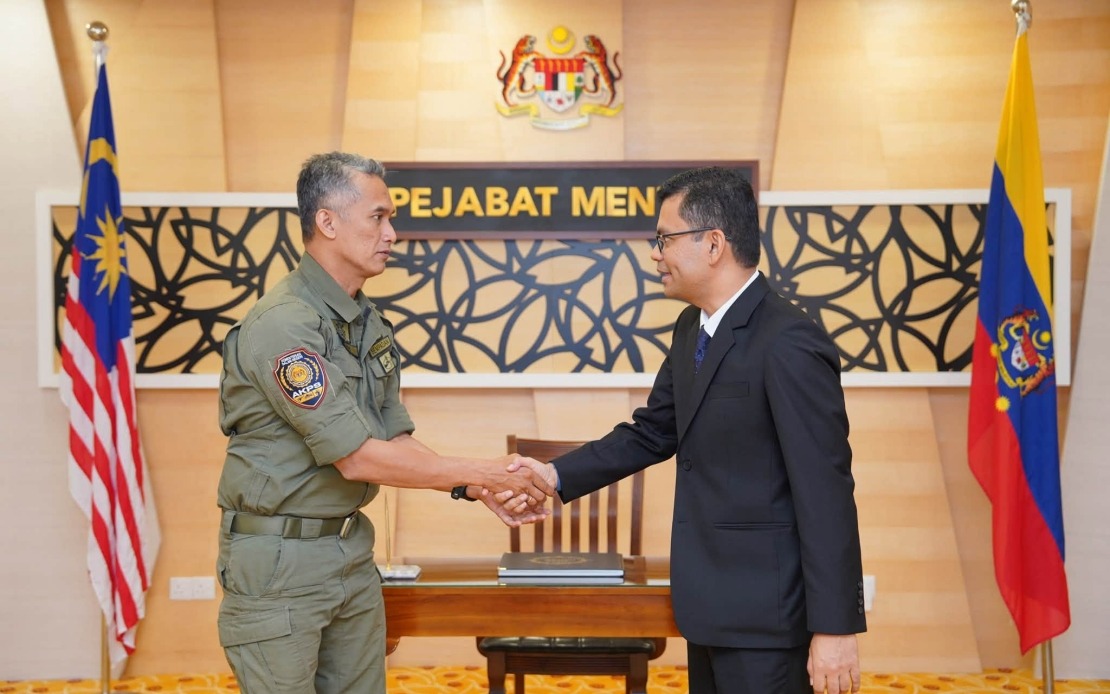
Malaysia's push to transform its border management framework gained momentum this week as the Economy Ministry and the Malaysian Border Control and Protection Agency (AKPS) convened to map out critical funding requirements for modernising the country's entry points. The discussions, which took place in Putrajaya during a courtesy call between AKPS director-general Datuk Seri Mohd Shuhaily Mohd Zain and Economy Minister Akmal Nasrullah Mohd Nasir, underscored the government's recognition that strengthening border capabilities through sustained investment is fundamental to both national security and economic resilience.
The timing of these talks is significant given that AKPS only commenced formal operations on January 1, 2025, marking a watershed moment in how Malaysia administers its borders. By consolidating previously dispersed enforcement functions into a single coordinated agency, the government has signalled an intention to eliminate inefficiencies and create a unified command structure at the country's critical entry points. The agency inherited responsibilities and personnel from six separate government bodies: the Immigration Department, Royal Malaysian Customs Department, Malaysian Quarantine and Inspection Services Department, Health Ministry, Department of Wildlife and National Parks, and Road Transport Department. This merger, while operationally complex, reflects international best practice in border administration where integrated approaches have demonstrably improved both security outcomes and trade facilitation.
At the heart of the Economy Ministry's engagement is recognition that border efficiency directly influences Malaysia's competitive position in regional commerce. When entry points operate smoothly with minimal delays, businesses can move goods and services across frontiers with greater speed and predictability. Conversely, bottlenecks at borders impose hidden costs on supply chains, discourage foreign investment, and reduce the attractiveness of Malaysia as a regional trading hub. The ministry's acknowledgement in its statement that AKPS capability enhancement will support "smoother trade" reflects understanding that contemporary border management must balance two historically competing priorities: security and facilitation. Nations that excel at borders do both simultaneously rather than treating them as zero-sum propositions.
The development blueprint being discussed encompasses four interconnected pillars. Infrastructure upgrades represent the foundational layer, ensuring that physical facilities at entry points—from checkpoint buildings to scanning stations—meet modern standards. Technology adoption forms the second pillar, with AKPS already positioning itself as an early adopter of cutting-edge solutions. The agency has prioritised smart border technology deployment, specifically integrated biometric systems that can rapidly process travellers and verify identities against databases in real time. Automated cargo scanning represents another technological frontier, allowing inspection staff to examine containerised goods without manual handling that is both time-consuming and labour-intensive. Real-time data integration powered by artificial intelligence constitutes the third element, enabling predictive analytics that can flag high-risk shipments or individuals before they arrive at borders, rather than discovering problems reactively.
The fourth pillar—strategic asset development and operational capacity enhancement—addresses the human and organisational dimensions of border management. AKPS leadership has explicitly identified human resource capacity building as a priority, recognising that technology remains merely a tool absent skilled personnel to operate and interpret its outputs. This reflects a mature understanding that border agencies require diverse expertise spanning customs valuation, quarantine protocols, immigration law, traffic management, and increasingly, cyber capabilities. Investment in training, career development, and retention mechanisms for border officers will determine whether AKPS can translate its mandate into reliable execution across Malaysia's numerous entry points.
From a Southeast Asian perspective, Malaysia's border modernisation carries spillover significance. As one of the region's most commercially dynamic nations and a crucial node in regional supply chains, Malaysian border efficiency affects not only domestic commerce but the seamless movement of goods throughout ASEAN. The tripartite borders Malaysia shares with Thailand and Brunei, along with its maritime boundaries and air entry points, collectively handle some of the region's heaviest traffic volumes. When Malaysia optimises these gateways, it generates positive externalities for neighbouring economies and demonstrates a model that other regional nations may emulate.
The financial implications of this transformation remain only partially visible. The Economy Ministry's reference to "development budget requirements" suggests that substantial capital allocation will be necessary to execute the planned upgrades and technology deployment. In the current global environment where government resources face competing demands, securing adequate funding for border modernisation requires sustained political commitment and demonstrated returns on investment. The ministry's involvement signals that border enhancement has achieved status as an economic priority rather than being relegated to a purely security consideration, a positioning that should facilitate budget approvals through government approval processes.
Mohd Shuhaily's previous statements about AKPS strategic direction indicate the agency is proceeding methodically rather than rashly. The emphasis on strengthening integrity alongside operational efficiency suggests that AKPS leadership recognises that border agencies facing capacity pressures can become vulnerable to corruption. A modernised, technology-enabled border system with transparent processes and automated decision-making reduces opportunities for discretionary conduct that can enable smuggling or facilitate illicit activities. This integrity focus, coupled with investment in human capacity, creates conditions where border officers can perform their duties effectively while remaining accountable.
The convergence of attention from both the Economy Ministry and AKPS leadership on development planning represents a constructive institutional alignment. Border agencies often operate in silos, negotiating independently with finance ministries and other government bodies for resources. By bringing these parties into coordinated discussion, Malaysia is creating forums where competing agency needs can be prioritised rationally and where the economic ministry can ensure border investments align with broader national development objectives. This coordination mechanism may prove as valuable as the specific infrastructure and technology projects themselves.
Moving forward, the success of this initiative will be measured against concrete indicators: processing times at entry points, incident rates of contraband discovery, trader satisfaction metrics, and the efficiency gains realised through automation. AKPS has positioned itself as a modernising force within Malaysia's government apparatus, and the Economy Ministry's supportive stance creates conditions for genuine transformation. Whether this partnership translates ambitious plans into tangible improvements at Malaysia's borders will define whether 2025 marks a genuine inflection point in how the nation manages its gateways to the world.

