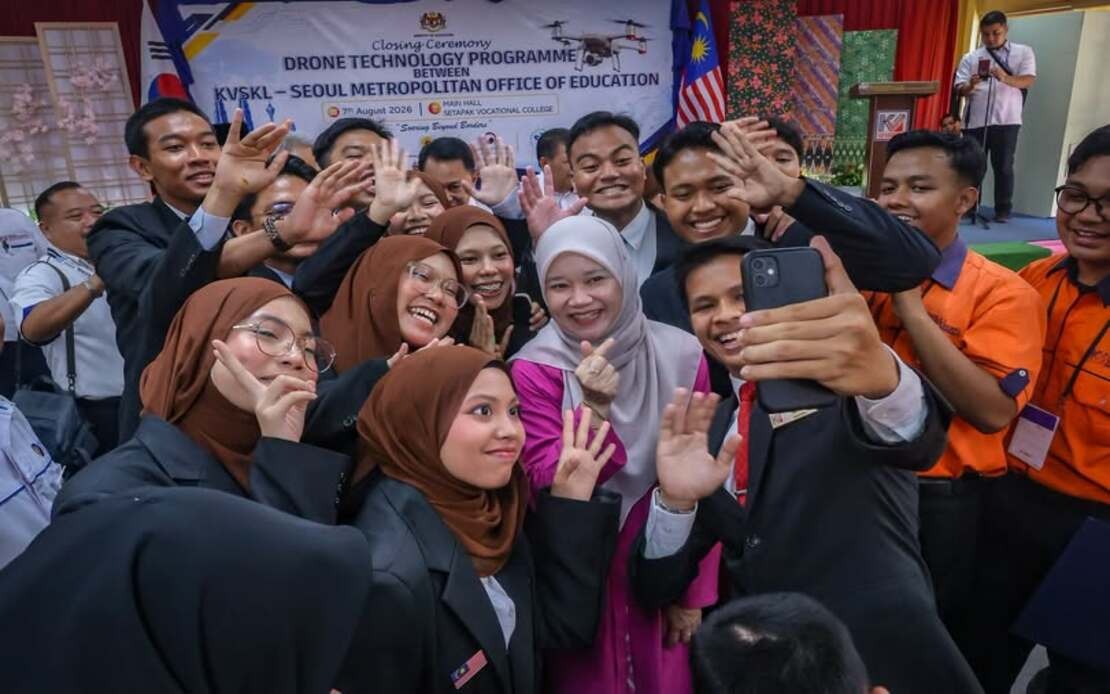
Education Minister Fadhlina Sidek has set an ambitious challenge for students at Setapak Vocational College: develop practical applications of drone technology to strengthen security measures across their campus within a month. The initiative emerged during a collaborative learning programme involving Seoul Metropolitan Office of Education and was attended by South Korean Ambassador to Malaysia Yeo Seung-bae, marking a significant knowledge-sharing moment between the two nations' educational institutions.
Fadhlina framed the challenge as more than an academic exercise. She tasked the vocational students with not merely mastering the technical operation of drones, but with cultivating creative problem-solving skills by identifying genuine security gaps within their learning environment and proposing technology-driven solutions. This pedagogical approach reflects a broader shift in educational philosophy—moving students from passive consumers of technology to active innovators capable of addressing real-world challenges.
The Education Minister emphasised that robotics, drone systems, and artificial intelligence have transitioned from theoretical constructs taught in textbooks to tangible tools already reshaping the contemporary workforce. Malaysia's vocational education sector, traditionally focused on technical trades, increasingly recognises the necessity of integrating emerging technologies into its curriculum. This shift acknowledges that tomorrow's technicians and engineers must possess literacy across multiple technological domains, not merely single specialisations.
During her visit to Setapak Vocational College, Fadhlina observed students engaging directly with drone operations and robotic systems. She deliberately highlighted instances where learners encountered difficulties, corrected course, and persevered—framing these moments not as failures but as essential components of genuine skill development. This emphasis on resilience and iterative learning reflects international best practices in STEM education, where failure serves as a diagnostic tool rather than a terminal outcome.
The South Korean partnership carries particular significance for Malaysia's educational trajectory. South Korea has built a formidable reputation for technological innovation and vocational excellence, combining traditional technical training with cutting-edge digital capabilities. By facilitating direct knowledge exchange between Seoul's educational authorities and Malaysian institutions, the collaboration creates opportunities for curriculum refinement and exposure to pedagogical methodologies proven effective in advanced economies.
For vocational education institutions across Malaysia, this initiative signals ministerial recognition that their students deserve equal access to emerging technologies previously concentrated in elite academic settings. Setapak's collaboration demonstrates how regional partnerships can democratise technological education, ensuring that students in vocational streams develop marketable skills aligned with global economic demands rather than remaining confined to conventional technical domains.
The one-month timeline Fadhlina imposed creates genuine urgency—students must move rapidly from theoretical understanding to practical conceptualisation. This compressed schedule mirrors real-world project management constraints they will encounter professionally, introducing authentic complexity into their learning experience. Moreover, the requirement to present formal proposals to the Education Minister elevates the exercise beyond classroom busywork, investing it with genuine stakes and professional expectations.
From a security infrastructure perspective, student-generated proposals could prove genuinely valuable. Educational institutions increasingly face pressure to enhance campus safety through technological means. Drones equipped with surveillance capabilities offer non-intrusive monitoring, particularly for perimeter security and identifying unauthorised access points. By leveraging student creativity within their own learning environment, the college simultaneously addresses practical institutional needs whilst providing authentic motivation for technical learning.
The broader implications extend beyond Setapak's campus. If this initiative proves successful, it establishes a replicable model for other vocational institutions nationwide. Malaysia's vocational colleges serve hundreds of thousands of students across diverse technical disciplines. Systematically introducing challenge-based learning incorporating emerging technologies could substantially enhance graduate employability whilst positioning Malaysia's vocational sector as genuinely innovative rather than derivative of academic traditions.
Fadhlina's emphasis on keeping the education system aligned with technological advancement reflects international competitive pressures. Nations investing strategically in vocational-technical integration with digital innovation create workforces substantially more adaptable to rapid sectoral transformation. Countries that segregate vocational training from emerging technologies risk producing graduates whose skills become obsolete within years rather than decades.
The challenge also implicitly addresses Malaysia's broader economic positioning. As the nation pursues transition toward higher-value manufacturing and service sectors, the capacity to rapidly upskill workforces in emerging technologies becomes strategically critical. Vocational education institutions capable of nurturing innovation and technological sophistication, rather than merely delivering standardised technical competencies, support this economic evolution.
Looking forward, the success of this initiative will likely influence how Malaysian vocational institutions structure their programmes. If student proposals generate implementable security solutions, it validates challenge-based learning as a pedagogical approach. Beyond the immediate security applications, however, the deeper value lies in cultivating among vocational students the mindset that technology exists fundamentally to solve authentic human and institutional problems—a perspective that distinguishes genuinely innovative practitioners from technicians merely executing predetermined procedures.

