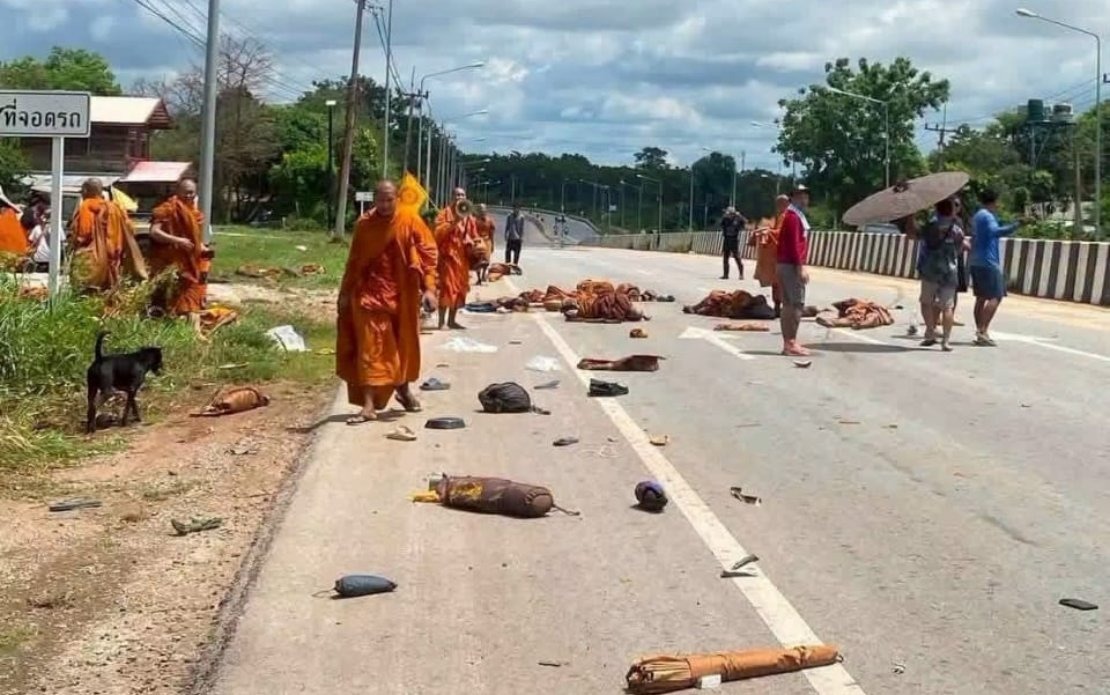
A tragic accident in Thailand's northeastern Mukdahan province claimed the lives of eight Buddhist monks on Thursday when a pickup truck veered into a pilgrimage group walking along Ban Na Si Nuan Road. The incident has reignited concerns about road safety in rural Thailand and raised difficult questions about vehicle access for underage drivers. The monks, engaged in a solemn religious walking pilgrimage to Nam Khun district in neighbouring Ubon Ratchathani province, became victims in seconds when the vehicle lost control and struck their formation.
According to Mukdahan authorities, five monks were killed instantly at the scene, while three additional victims succumbed to their injuries after being transported to hospital. The scale of injuries extended beyond fatalities—four monks sustained life-threatening wounds requiring intensive medical intervention, whilst ten others suffered moderate injuries. A total of 23 patients sought hospital treatment, comprising 22 monastic practitioners and one civilian supporter accompanying the religious group. The immediate medical response required extensive resources, prompting Mukdahan Hospital to issue urgent appeals for blood donations to sustain ongoing treatment protocols.
Investigators pieced together the sequence of events through witness testimony and accident scene analysis. Mukdahan Governor Warayan Boonnarat revealed that the monks had commenced their pilgrimage at approximately 11 am, deliberately walking against the direction of vehicle traffic along Ban Na Si Nuan Road in Mueang district—a standard pedestrian safety precaution. The formation initially appeared to offer protection; five monks at the front of the group successfully evaded the incoming vehicle. However, the remaining monks, positioned roughly two metres from the road's edge, found themselves directly in the truck's trajectory when the driver lost command of the vehicle and the pickup swerved onto the roadside.
The driver involved in the collision was identified as being under 15 years of age, raising immediate concerns about how a minor obtained access to operate a motor vehicle unsupervised. Mukdahan Provincial Police Commander Police Major General Phairoj Thaiputra confirmed that the juvenile had been taken into police custody pending investigation. Authorities emphasised that officers were actively gathering forensic evidence and conducting formal interviews with the driver's parents to establish the precise circumstances that led to the loss of vehicle control. The investigation will determine whether mechanical failure, operator error, or external factors contributed to the tragedy.
The legal implications of the incident extend beyond the young driver's own culpability. Police officials indicated they are examining whether the parents could face negligence charges for permitting an underage child to operate a motor vehicle. Thai law contains provisions addressing parental responsibility when minors cause harm through unauthorised use of family property, though enforcement of such charges varies considerably across jurisdictions. The case highlights a persistent challenge throughout Southeast Asia, where supervision of vehicle access for young drivers remains inconsistently regulated and enforced.
The monks' pilgrimage itself reflects deep-rooted Buddhist traditions in the region, where walking journeys to religious sites remain important spiritual practices. Such pilgrimages typically involve careful route planning and coordination with local authorities to ensure participant safety. The fact that the group was walking against traffic and maintaining distance from the roadway demonstrates their awareness of vehicular hazards, yet proves insufficient protection against an unexpected loss of vehicle control. The tragedy underscores how even cautious practices cannot entirely mitigate risks posed by uncontrolled vehicles on public roads.
For Malaysian observers, this incident carries sobering relevance. Thailand's road safety record, despite improvements, remains significantly worse than Malaysia's, with fatality rates substantially higher per vehicle kilometre. Underage driving, whilst less common in Malaysia due to stricter enforcement, still represents a concerning problem in certain rural and suburban areas. The incident serves as a cautionary reminder about the importance of rigorous licensing systems, parental supervision of vehicle access, and consistent law enforcement against underage drivers.
The broader context of road safety in the Mekong region reveals systemic challenges. Thailand, Laos, Cambodia, and Myanmar collectively experience road fatality rates among the world's highest. Contributing factors include mixed traffic patterns where pedestrians, motorcycles, and commercial vehicles share inadequate road infrastructure; variable enforcement of traffic regulations; and limited consequences for dangerous driving practices. Upgrading institutional capacity for traffic law enforcement and investment in safer road design remain ongoing priorities across the region.
The investigation's outcome will likely influence how Thai authorities approach underage driving enforcement and parental liability. If charges proceed against the parents, the case could establish stronger precedent for holding guardians accountable for children's unauthorised vehicle use. Such legal developments would represent significant progress in Thailand's road safety governance, though enforcement sustainability remains uncertain given resource constraints in provincial jurisdictions. The case also highlights the vulnerability of pedestrians, particularly those engaged in religious or community activities that require extended road exposure.
Monastic communities throughout Southeast Asia have historically maintained important roles in disaster response and social welfare. Following this tragedy, Thai Buddhist organisations may intensify advocacy for road safety measures, particularly those protecting religious practitioners and pedestrians. These voices could amplify pressure on policymakers to strengthen vehicle registration requirements, implement stricter penalties for underage driving, and improve road infrastructure in provinces where mixed traffic patterns create hazardous conditions.
For regional road safety advocates, the incident reinforces the urgent need for comprehensive approaches combining legal reform, enforcement consistency, and public awareness campaigns. Malaysia's relatively better road safety performance reflects not only superior vehicle technology and road standards, but also more consistent enforcement of traffic regulations and stronger penalties for serious violations. As Thailand and neighbouring countries work to improve their safety records, learning from jurisdictions with more effective enforcement systems becomes increasingly valuable. The eight monks killed represent tragic losses within their monastic communities and serve as powerful reminders of road safety's continuing importance across Southeast Asia.

