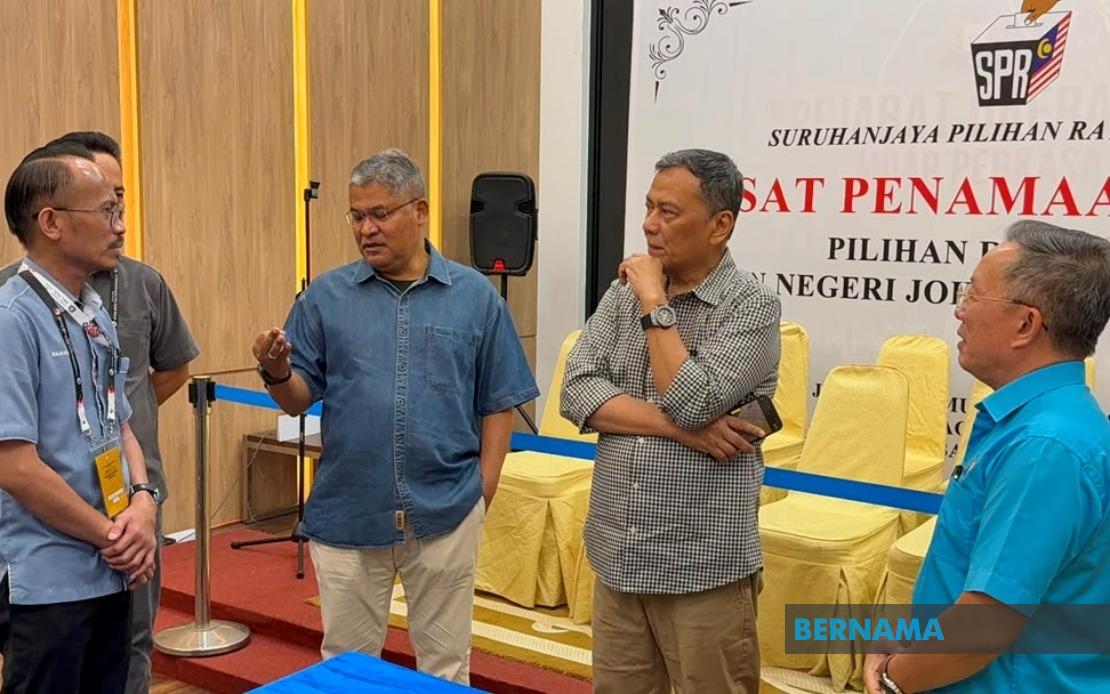
The Election Commission (EC) has wrapped up logistical preparations for the Johor state election nomination process scheduled for tomorrow, with officials confirming full operational readiness across all designated candidate centres. A survey of several Candidate Nomination Centres (PPC) in Johor Bahru reveals that final technical work is well advanced, with the regulatory body and supporting agencies aligned on implementation protocols to facilitate a streamlined nomination day.
At the Perling state constituency PPC located at Dewan Jubli Intan Hall, returning officer Nazatul Shima Mohamad expressed confidence in the day's execution, noting that the venue layout and coordination simulations with relevant agencies had been completed. She emphasised that all stakeholder organisations were equally committed to ensuring the nomination process would proceed without disruption, and made a direct appeal to prospective candidates to arrive early with all necessary documentation and deposit fees to expedite processing.
The Kota Iskandar centre, situated at the Main Hall of Iskandar Puteri City Council (MBIP) in Medini, has implemented a comprehensive security framework anticipating crowds of party supporters. Returning officer Shahrulizam Abdul Rashid outlined measures including coordinated police presence, designated road closures around the PPC, a 50-metre buffer zone restricting supporter access to the nomination venue itself, and carefully positioned tent structures with physical barriers to maintain separation between rival party groups. These logistical elements reflect the EC's experience managing political assemblies during nomination periods in previous state elections.
The nomination process will commence simultaneously across all 56 PPCs at 9 am tomorrow, running until 10 am, after which returning officers will make the official announcement of eligible candidates cleared to contest. The compressed timeframe requires precisely coordinated operations to process candidate papers, verify documentation, and confirm deposit submissions within the single-hour window. This standardised nationwide approach ensures fairness and prevents any centre from extending timelines that might advantage certain candidates.
The Johor election encompasses a substantial electorate, with the EC registering 2,727,926 eligible voters across the state. This comprises 2,703,175 ordinary voters alongside 12,041 military personnel and their spouses, and 12,710 police personnel and their spouses. The inclusion of uniformed service voters reflects Malaysia's constitutional provision for security personnel participation in electoral processes, requiring separate polling arrangements and security protocols to maintain operational continuity.
The election timeline commenced when the Johor State Legislative Assembly was dissolved on June 1, triggering the electoral schedule now culminating in tomorrow's nomination. The EC has scheduled July 7 for early voting, accommodating those with legitimate reasons for advance balloting, followed by the main polling day on July 11. This three-week campaign window provides political parties and candidates with adequate time for grassroots mobilisation across the state's diverse constituencies, ranging from urban centres like Johor Bahru to more dispersed rural areas requiring different campaigning approaches.
The EC's appeal to public supporters attending the nomination centres emphasises restraint and respect, explicitly warning against provocative behaviour or inter-party confrontations. This guidance reflects growing awareness of electoral tensions that can escalate rapidly in highly politicised settings, particularly when large numbers of competing party sympathisers congregate in confined spaces. By establishing physical barriers, managing vehicle access, and maintaining police presence, the EC is attempting to create conditions where nominal political competition can coexist with public order and personal safety.
For Malaysian observers, this Johor election represents a significant test of electoral administration following the series of state elections held across the country in recent years. The state carries particular political significance given its scale, economic importance, and historical role as a political stronghold. The logistical complexity of managing simultaneous nomination across 56 centres with thousands of potential candidates and their supporters underscores the institutional capacity the EC must maintain to administer elections consistently across Malaysia's diverse geography and population distribution.
The practical arrangements outlined by returning officers also highlight the technical sophistication required in modern election administration. Beyond simply processing nomination documents, the EC must coordinate with law enforcement, traffic authorities, and local councils to manage the public order dimensions of electoral processes. The specific measures described—from buffer zones to supporter tent allocation—reflect accumulated operational experience but also suggest ongoing adjustments to contain risks that previous elections may have illuminated.
Looking ahead to polling day on July 11, these nomination preparations represent the foundation for subsequent electoral stages. The integrity and smoothness of the nomination process establishes public confidence in the election framework generally, whereas disruptions or logistical failures can generate perceptions of favouritism or administrative weakness that persist throughout the campaign. As such, the EC's investment in detailed preparation and coordination tomorrow carries implications extending well beyond the single-day nomination process itself.

