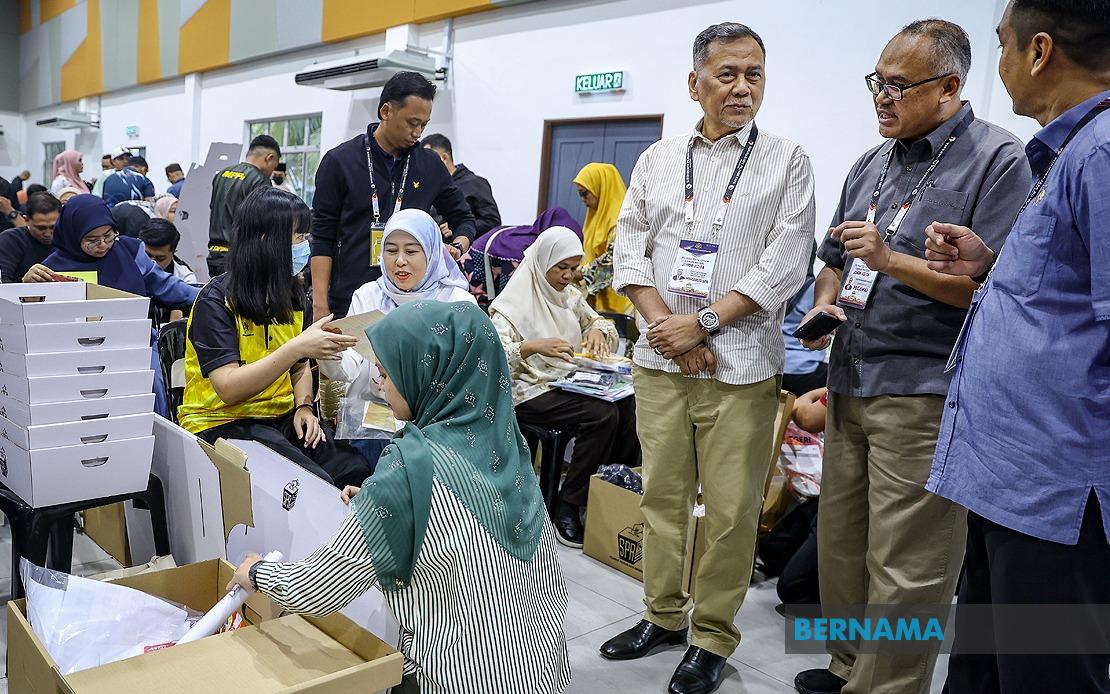
With voting set to commence tomorrow, the Election Commission has concluded intensive preparations across Johor's 56 state constituencies, putting in place the administrative machinery necessary to accommodate 2.7 million registered voters in one of Malaysia's largest state elections. Throughout the day, EC teams fanned out across polling centres and tallying venues, methodically verifying ballot boxes, testing election equipment, and ensuring that each location meets the operational standards required for a seamless electoral process.
Election Commission Chairman Datuk Seri Ramlan Harun underscored the magnitude of these final preparations, characterising them as foundational to delivering a successful polling day. During site inspections at the Sultan Ibrahim Jubilee Hall in Pontian and the Permas Multipurpose Hall in Kukup, he confirmed that Returning Officers across all 56 constituencies had substantially completed their setup duties, with ballot verification procedures proceeding without significant incident. The comprehensive nature of these checks reflects the Commission's approach to election administration: meticulous verification at every stage acts as a safeguard against operational mishaps that could undermine voter confidence or disrupt the democratic process.
On the ground in Johor Bahru, the practical reality of election preparation unfolded at Sekolah Kebangsaan Bukit Mutiara, where EC personnel were immersed in labelling materials, arranging furniture, and installing signage to guide voters through the polling experience. For the Puteri Wangsa constituency, supervisory teams converted twelve school classrooms into separate polling streams, a logistical undertaking designed to prevent bottlenecks and distribute voter flow efficiently. With 74 EC personnel and a security contingent of twelve police officers deployed to manage the location, the operation reflected the staffing intensity required to run a major election successfully. Crucially, accessibility considerations received explicit attention, with wheelchairs and disability provisions arranged in advance to ensure senior citizens and voters with mobility challenges could participate without barriers.
Similar intensive preparation was evident in Kluang, where the Sekolah Kebangsaan Kampong Melayu site accommodated approximately 3,000 voters across five polling streams established for the Mahkota constituency. Thirty EC personnel concentrated on meticulous setup procedures designed to prevent congestion during peak voting hours. This granular focus on individual constituency capacity planning reveals a systematic approach that acknowledges the diverse demographics and voter populations across different Johor regions. Such tailored preparation at the constituency level contrasts sharply with a one-size-fits-all methodology, recognising that each area presents unique logistical requirements.
In Batu Pahat, polling centre administrators at Sekolah Menengah Kebangsaan Dato' Seth in Yong Peng prioritised comfort and accessibility for demographic groups that often face practical voting obstacles. Special attention to elderly voters, young first-time participants, and persons with disabilities shaped facility design, reflecting a broader recognition within the Election Commission that equitable electoral participation requires proactive accommodation. These considerations become particularly salient in Malaysian elections, where demographic diversity across constituencies necessitates flexible, responsive operational planning.
Perhaps the most logistically demanding preparations occurred in Mersing, where the Tenggaroh constituency encompasses four offshore islands—Pulau Aur, Pulau Pemanggil, Pulau Sibu, and Pulau Tinggi—that require maritime transport of ballot boxes and election materials. The operation mobilised approximately fifty personnel, coordinated with the Marine Police Force and Mersing district police headquarters to secure transport routes and protect electoral assets in transit. This island logistics exercise exemplifies the geographic complexity that Southeast Asian island nations face in conducting elections, requiring coordination between civil, maritime, and security authorities to ensure that remote communities maintain equal electoral access. The tight security escort underscores the sensitivity surrounding ballot box transport, where chain-of-custody integrity forms a cornerstone of electoral legitimacy.
Voter participation in this election occurs within a competitive multi-party landscape. A total of 172 candidates are contesting the 56 state seats, with the two major coalitions—Pakatan Harapan and Barisan Nasional—fielding complete slates across all constituencies. Perikatan Nasional brings 33 candidates to the contest, signalling its emergence as a substantial political force in Johor, while smaller parties including Parti Bersama Malaysia, MUDA, the Malaysian Orang Asli Party, and the Socialist Party of Malaysia field more limited candidate lists. Six independent candidates also contest various seats, reflecting the diversity of political representation attempting to reach Johor voters.
The Election Commission Chairman's voter guidance carries practical significance as polling operations commence. Recommendations to vote during assigned time slots address a critical concern in large-scale elections: voter congestion that can lead to queuing delays and reduced accessibility. The instruction to bring identity cards reflects the mandatory voter verification procedures that safeguard electoral integrity by confirming voter registration status. These seemingly administrative details form essential components of an election system designed to balance accessibility with fraud prevention—objectives that sometimes create operational tension requiring careful calibration.
For Malaysian observers and particularly those in Johor, these preparations represent the culmination of months of planning, with the Commission investing substantial administrative resources to ensure that the franchise operates smoothly across diverse geographic, demographic, and infrastructural contexts. The scale of this undertaking—accommodating 2.7 million voters across 56 constituencies with varying accessibility challenges—demonstrates the institutional capacity required to administer democracy in a nation of Malaysia's size and regional complexity. The attention to detail evident in final-stage preparations suggests a professional commitment to electoral integrity and voter accommodation that will be tested when polling opens tomorrow and nearly three million citizens exercise their democratic right to determine Johor's political direction.

