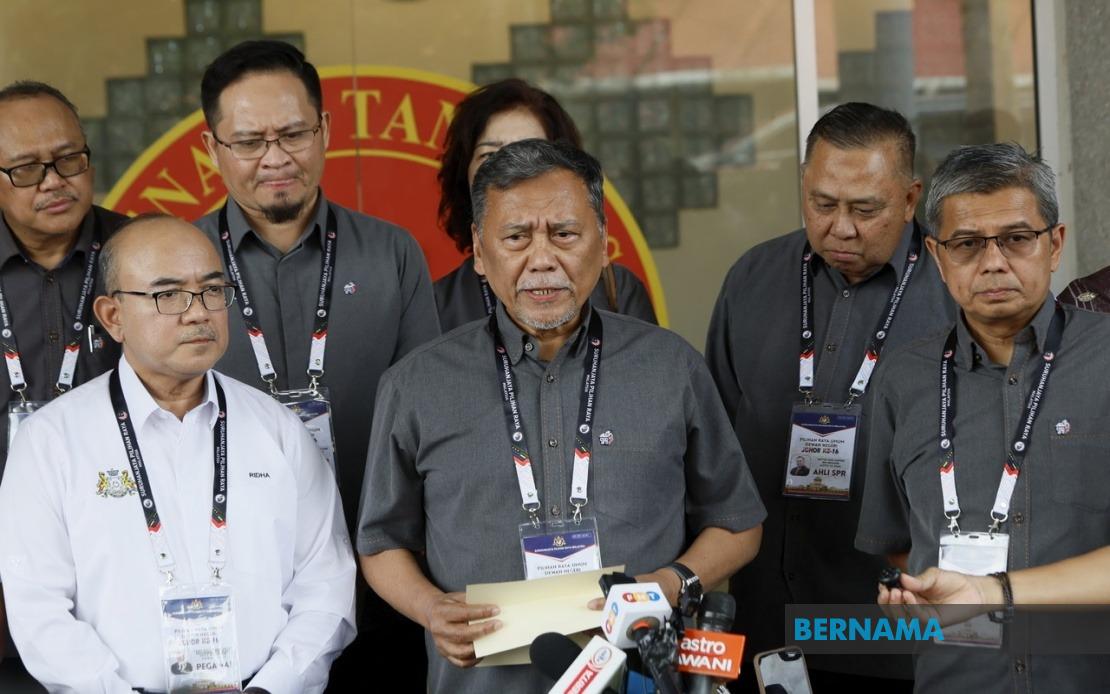
The Election Commission has set an ambitious 96 per cent participation target for early voting in the Johor state election, signalling confidence in the process even as the larger state faces its democratic exercise on Saturday. Election Commission chairman Datuk Seri Ramlan Harun anchored this projection in the commission's track record, noting that early voting has consistently achieved high turnout rates in previous contests. The target reflects institutional confidence in the voting infrastructure and voter engagement among the eligible early voting cohort, predominantly comprising security personnel and their families who vote ahead of the general population.
The early voting infrastructure deployed across Johor demonstrates significant logistical coordination. The Election Commission opened 62 early voting centres throughout the state, each operating on staggered schedules to manage voter flow. Twenty-nine of these centres wrapped up operations at noon, followed by five additional centres closing at 2 pm, with the remaining 28 staying open until 5 pm. This tiered approach, observed by Ramlan at Kem Mahkota in Kluang, allows the commission to manage administrative capacity while accommodating the diverse schedules of voters who cannot participate on polling day.
The early voting exercise encompasses 20,607 eligible electors, a substantial bloc representing the organised personnel most likely to participate in advance balloting. This cohort comprises 8,544 military personnel from the Malaysian Armed Forces alongside their spouses, and 12,063 police officers with their immediate family members. These groups constitute a disciplined, institutionalised voter base accustomed to structured civic participation, explaining both the high historical turnout rates and the commission's confidence in maintaining the 96 per cent projection. Their participation underscores the state election's significance as a democratic engagement exercise across multiple sectors of society.
The security arrangements surrounding early ballots reflect the Election Commission's commitment to electoral integrity. Ballot boxes from all 62 early voting centres are being transported to police stations for secure storage immediately following the close of voting at each centre. This custody arrangement ensures that early votes remain protected from tampering or compromise until the formal counting process commences. By consolidating ballots under police oversight, the commission establishes a clear chain of custody that can withstand scrutiny and maintains public confidence in the integrity of the electoral process.
The timing of vote counting represents a deliberate procedural choice with implications for electoral transparency and public communication. Unlike many jurisdictions where early votes are tabulated progressively throughout polling day, Malaysia's Election Commission has opted to delay counting until 5 pm on Saturday, after polls close. Ramlan indicated that the commission expects full results to be available before midnight, with possibilities of completing the count as early as 10 pm. This consolidated counting window, while potentially lengthening the period of uncertainty, concentrates all vote tabulation into a defined timeframe and reduces opportunities for preliminary results to influence voters still participating in regular polling.
The broader electoral context involves 2.7 million eligible ordinary voters who will participate in standard polling on Saturday. Ramlan's public appeal to these voters emphasised both participation as a civic responsibility and voting as a contribution to Malaysia's democratic system. This framing reflects institutional priorities in democratic societies where the legitimacy of outcomes depends substantially on demonstrated public engagement. High turnout, from the Election Commission's perspective, validates the electoral process and strengthens the mandate of whichever coalition or party emerges victorious from the 16th Johor State Election.
The 16th Johor State Election represents a significant democratic renewal in one of Malaysia's most important states, both economically and politically. Johor's electoral outcomes have historically influenced national political trajectories, making the state's voter participation and voting patterns subjects of considerable scrutiny. The focus on achieving high early voting turnout, and the infrastructure investment required to facilitate it, reflects recognition that democratic legitimacy in Malaysia derives partly from demonstrable mass participation.
The Election Commission's experience-based targeting represents evolution in electoral administration. By anchoring projections in historical data rather than optimistic speculation, the institution signals mature confidence in its processes and voter behaviour patterns. The 96 per cent figure, drawn from previous early voting experiences, provides a realistic benchmark that accounts for inevitable administrative friction, voter scheduling constraints, and natural variation. Achieving this target would represent successful democratic infrastructure functioning at scale.
For Malaysian voters and observers tracking the Johor election, the early voting phase serves as an indicator of overall engagement levels and a preview of potentially decisive voting patterns. Early voters, predominantly from disciplined institutional backgrounds, may vote differently than the broader population, making their choices analytically significant. The secured storage of their ballots and delayed counting preserves the secrecy and independence of the voting process while ensuring that security personnel contribute fully to democratic outcomes despite their unique scheduling circumstances.

