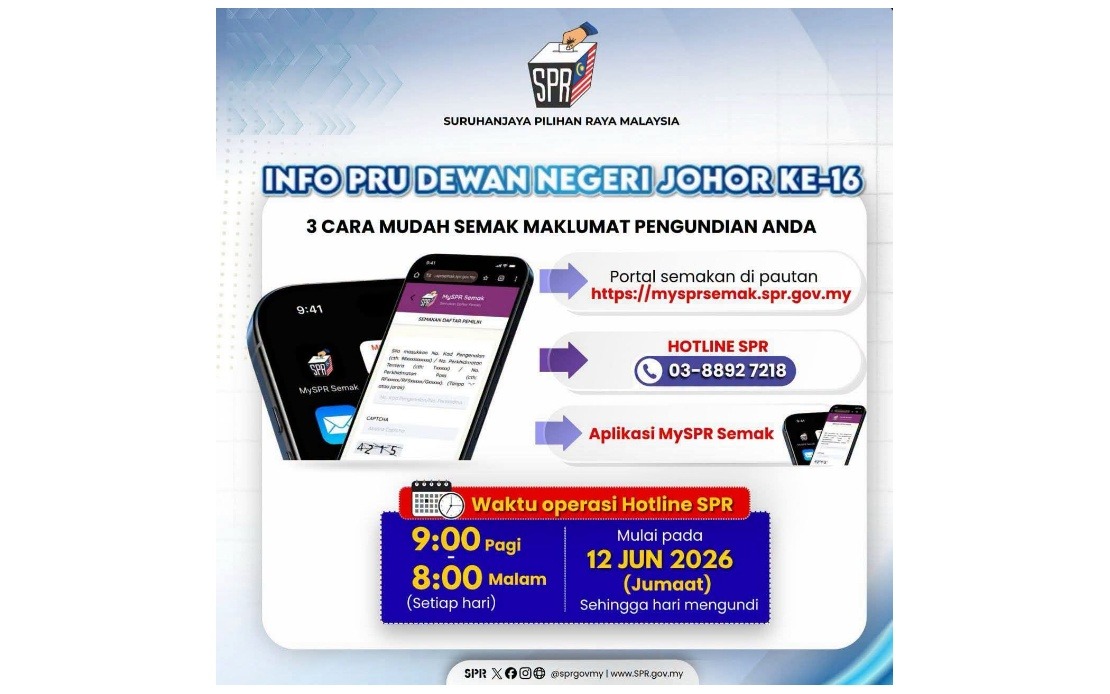
The Election Commission has issued a public reminder to all registered voters in Johor to confirm their polling centre assignments and voting information before this Saturday's state election, underscoring the importance of advance preparation to ensure smooth participation in the democratic process. Voters can access this information through the MySPR Semak online portal or the dedicated mobile application, both of which provide instant confirmation of where and how they will cast their ballots in the 16th Johor state election.
The initiative reflects the EC's commitment to minimizing confusion and delays on election day itself. By encouraging voters to verify their details in advance, the commission aims to reduce queue times at polling stations and prevent disenfranchisement due to incorrect venue information. This is particularly important given the scale of the election, with nearly 2.7 million eligible ordinary voters expected to participate across 56 state assembly constituencies. For many first-time voters and those relocating within the state, verifying this information beforehand can prevent unnecessary frustration when they arrive to cast their ballots.
The Johor state election on July 11 will determine the composition of the state assembly for the next term, with voters selecting representatives to fill 56 seats. This election comes at a significant moment in Malaysian politics, reflecting broader patterns of political realignment and voter preferences across the nation's second-largest state by population. The stakes are considerable not only for Johor itself but for the political trajectory of the broader Peninsular Malaysian landscape.
Early voting has already commenced, with 19,471 personnel from security and law enforcement agencies participating in advance balloting. Specifically, 7,960 military personnel and their spouses, along with 11,511 police officers including personnel from the General Operations Force and their family members, cast their votes last Tuesday. This arrangement ensures that members of the armed forces and police, whose duties may prevent them from voting on election day, can still exercise their democratic rights. The early voting figure provides a snapshot of organizational efficiency and reflects the significance these institutions place on civic participation.
The electoral contest itself is notably competitive, with 172 candidates vying for the 56 available seats. This represents an average of roughly 3.1 candidates per constituency, indicating vigorous competition across the state. Pakatan Harapan and Barisan Nasional have fielded candidates in all 56 seats, demonstrating their respective commitments to contesting every available position. Perikatan Nasional has nominated 33 candidates, reflecting its emergence as a significant political force in Johor and Malaysian politics more broadly. Parti Bersama Malaysia, a newer entrant to the electoral landscape, has put forward 15 candidates, whilst MUDA, the youth-focused party, is contesting four seats.
Beyond these major coalitions and parties, smaller political entities including Parti Orang Asli Malaysia, Parti Sosialis Malaysia, and six independent candidates are also participating in the election. This diversity reflects Malaysia's evolving political ecosystem and the growing willingness of voters to consider alternatives beyond the established two-coalition framework. The presence of ASLI, which specifically represents indigenous interests, highlights how electoral competition increasingly includes identity-based and issue-focused parties addressing specific demographic concerns.
The Johor state election serves as a significant electoral indicator for Malaysian politics. As one of the country's most populous and economically important states, voting patterns in Johor often signal broader national trends. The result will provide valuable insights into voter sentiment regarding state governance, economic management, and the performance of various political coalitions at the subnational level. Furthermore, Johor's historical significance as a politically decisive state means that the outcome carries implications extending well beyond the state's borders.
Voters should note that accessing the MySPR Semak platform requires their identification number and can be completed within minutes from any device with internet connectivity. The mobile application version offers additional convenience for those preferring smartphone access. Both platforms display the voter's assigned polling station location, the voting stream number, and any other relevant procedural information. Using these tools well in advance of election day allows voters to plan their travel logistics and anticipate any potential complications.
The Election Commission's appeal to voters to fulfil their civic duty comes amid a broader global context of democratic participation challenges. In Malaysia's case, voter turnout has historically varied, with younger and more mobile populations sometimes registering lower participation rates. By removing information barriers and making the electoral process more transparent and accessible, the EC is taking concrete steps to encourage maximum participation. The reminder that checking one's details is a straightforward process conducted online should help demystify electoral procedures for less-experienced voters and those unfamiliar with the technological infrastructure supporting Malaysian elections.

