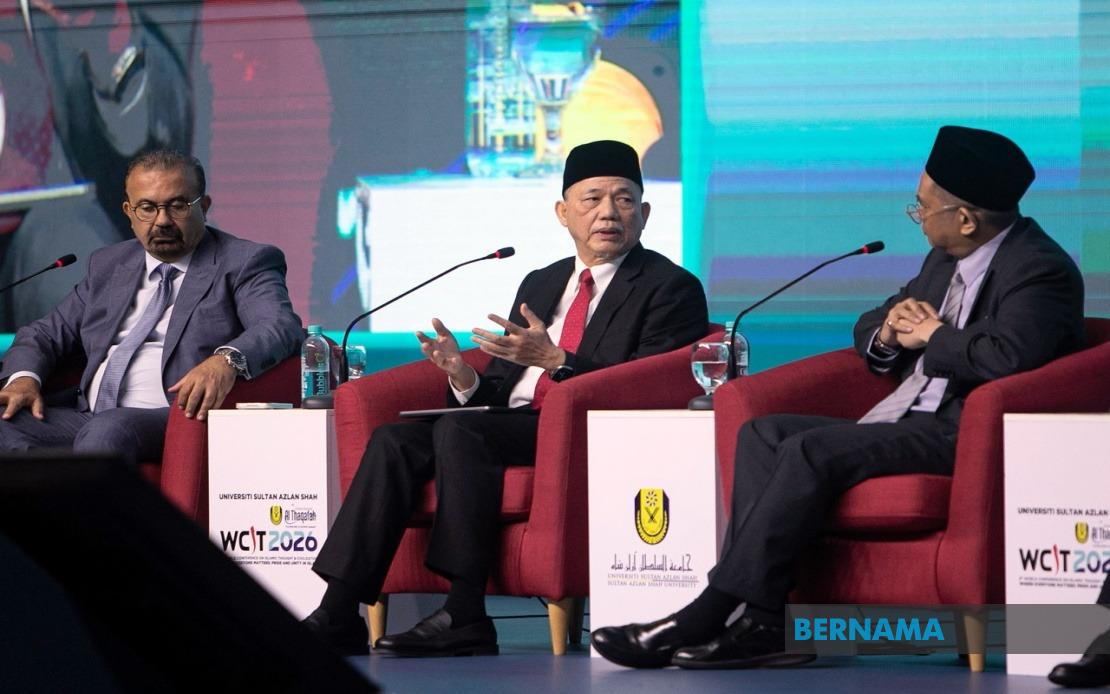
Deputy Prime Minister Datuk Seri Fadillah Yusof has issued a stark assessment of how modern geopolitical upheaval transcends traditional sectoral boundaries, arguing that energy and maritime security have become inseparable challenges with cascading consequences for nations and ordinary citizens alike. Speaking during the 8th World Conference on Islamic Thought and Civilisation (WCIT) in Ipoh on July 21, Fadillah — who also holds the portfolio of Energy Transition and Water Transformation Minister — contended that the intensifying confrontation between the United States and Iran exemplifies this troubling convergence.
The Deputy Prime Minister's remarks underscore a fundamental shift in how security threats propagate through interconnected global systems. Where once policymakers could compartmentalise energy markets and shipping routes as separate domains requiring distinct policy responses, events unfolding thousands of kilometres away now ripple through supply chains, financial markets, and household budgets within weeks. The observation reflects a reality that Southeast Asian economies, heavily dependent on uninterrupted resource flows and predictable trade corridors, cannot afford to ignore.
Fadillah elaborated on the concrete manifestations of this interconnectedness during his remarks at the distinguished royal session with Sultan of Perak Sultan Nazrin Shah. He noted that recent developments in the Strait of Hormuz — the chokepoint through which roughly one-fifth of the world's petroleum transits — have created pressure points extending far beyond the immediate geography. Electricity tariffs, fuel availability, and the cost of imported goods all become hostage to tensions occurring in waters thousands of kilometres from Malaysian shores.
The cascading economic effects warrant serious attention from regional policymakers and business leaders. When geopolitical tensions threaten maritime routes, insurance premiums for commercial shipping spike upward rapidly, embedding additional costs throughout supply chains. Energy prices tend to become more volatile, reflecting market anxiety over potential supply disruptions. These increased expenses ultimately materialise in the prices Malaysian consumers and businesses pay for electricity, petrol, and manufactured goods dependent on imported components or raw materials.
For Malaysia specifically, the stakes feel particularly acute given the nation's geographical positioning and economic structure. Straddling one of the world's most strategically vital waterways in the Strait of Melaka, Malaysia sits at the intersection of multiple overlapping security challenges. The country's prosperity has historically rested upon maintaining an open, stable, and rules-based international trading system — a foundation that becomes increasingly fragile when conflicts destabilise the very maritime corridors upon which that system depends. Any disruption to shipping through the Strait of Melaka threatens not only Malaysia's imports and exports but potentially the entire regional economy.
Fadillah's emphasis on Malaysia's diplomatic approach to these developments appears calibrated to reassure both domestic audiences and international partners. Rather than adopting confrontational postures, he suggested that Malaysia would navigate these turbulent waters through careful diplomacy and measured engagement. This reflects a long-standing foreign policy principle: maintaining friendships with multiple poles of the international system while avoiding entrapment in great power rivalries.
The minister's analysis also carries implicit recognition that Southeast Asia occupies a precarious position in the contemporary geopolitical landscape. The region's prosperity depends fundamentally on freedom of navigation, stable energy supplies, and predictable access to international markets. When tensions between major powers threaten these conditions, smaller nations become collateral damage regardless of their own preferences or alignment. Malaysia's commitment to a rules-based international order, therefore, represents not merely idealistic aspiration but rather a pragmatic calculation about the conditions necessary for regional stability and national wellbeing.
The intersection of energy security and maritime security raises important questions about how Malaysia should structure its own strategic planning and investments. Policymakers must increasingly consider how energy transitions affect shipping routes, how maritime security arrangements influence fuel prices, and how both dimensions interact with broader supply chain vulnerabilities. The Deputy Prime Minister's portfolio encompassing energy transition suggests awareness that moving toward renewable energy sources might offer some insulation from the volatility of global oil markets, though maritime security challenges would persist regardless.
For Malaysia and other Southeast Asian nations, the emerging challenge involves building resilience against shocks originating beyond their control while maintaining the openness necessary for economic prosperity. This requires simultaneous investment in energy diversification, strategic reserves, regional cooperation on maritime security, and diplomatic channels capable of mediating international tensions before they metastasise into crises. Fadillah's remarks at the WCIT gathering signal that Malaysia recognises these imperatives and intends to position itself as a stabilising voice advocating for dialogue, rules-based order, and mutual respect among nations.

