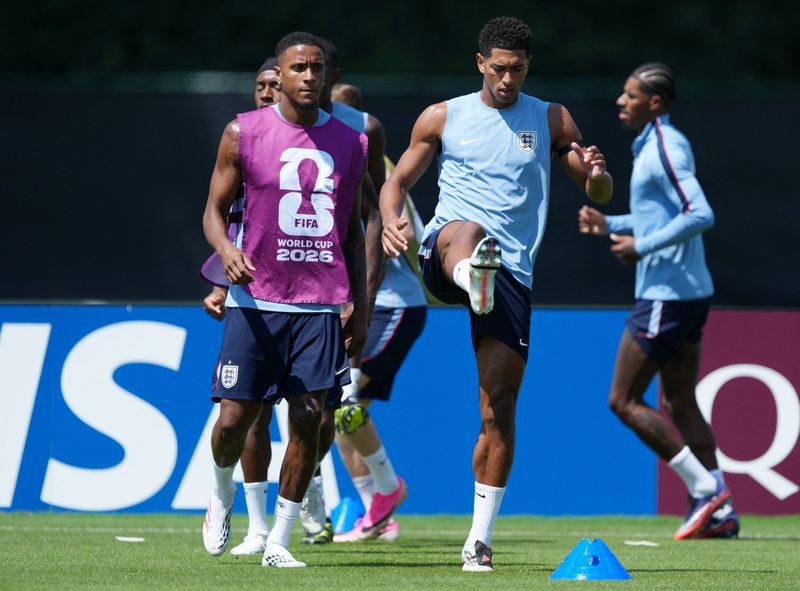
England's players have made a conscious effort to draw a line under the media storm that followed their dramatic quarter-final win, presenting a unified front as they prepare for Wednesday's World Cup semi-final clash against Argentina in Atlanta. The squad's apparent cohesion stands in contrast to the public disagreement that surfaced between manager Thomas Tuchel and midfielder Jude Bellingham in the immediate aftermath of England's 2-1 extra-time victory over Norway, signalling that internal tensions have been resolved and the team is moving forward with shared purpose.
Defender Ezri Konsa acknowledged that media speculation has long been part of the fabric of international football, particularly for a squad carrying the expectations of an entire nation. However, he stressed that the current England team possesses the maturity and experience necessary to filter out external noise and concentrate solely on performance. The ability to compartmentalise distractions has become a critical skill for modern professional footballers, and Konsa's comments suggest that Tuchel's management philosophy emphasises psychological resilience alongside tactical preparation.
The tensions that emerged during England's quarter-final victory highlighted a philosophical difference between the manager and his star midfielder. Tuchel expressed dissatisfaction with his team's overall display against Norway, while Bellingham, who scored both goals in the dramatic extra-time win, pushed back against the criticism by questioning whether the coach fully appreciated the physical and mental demands of performing at such an elevated level against world-class opposition. Such disagreements, while potentially destabilising, have apparently been resolved through dialogue and mutual respect.
Marc Guehi, England's other starting defender, offered effusive praise for Tuchel's leadership, crediting the German tactician with establishing an environment characterised by genuine camaraderie and collective belief. Guehi's assessment suggests that Tuchel has successfully transmitted his philosophy throughout the squad, creating a culture where individual ambitions are subsumed within the broader team objective. The defender went further, claiming that the intensity of the quarter-final experience had actually strengthened rather than fractured group dynamics, with the dramatic nature of the victory binding players more tightly together.
Tuchel, when informed of his players' endorsements during his own press conference, expanded on his fundamental coaching philosophy. The manager articulated a worldview in which football remains fundamentally a collective endeavour, despite the prevalence of superstar individual talents at the highest level. His observation that the entire World Cup tournament has demonstrated how elite players commit themselves to team principles rather than pursuing personal glorification suggests a broader shift in mentality at international level, where the romance of representing one's nation has reasserted itself over individual agendas.
The German's comments carried an implicit critique of football culture that prizes individual brilliance above collective sacrifice. By emphasising the extraordinary mentality demonstrated by his squad—particularly the work conducted away from public scrutiny—Tuchel sought to reframe the narrative around England's campaign. Rather than focusing on controversial tactical decisions or personality clashes, he positioned his team as exemplars of a more enlightened approach to international football, one where determination and unwillingness to surrender have become defining characteristics.
If England successfully navigate their semi-final against Argentina, they will face Spain in a repeat of the Euro 2024 final, a match the Spanish won decisively. The prospect of another encounter with Spain adds an additional layer of motivation for the English squad, offering a chance for redemption and the opportunity to claim a trophy that eluded them in European competition. Spain's own passage through the tournament, demonstrated by their 2-0 demolition of France in Tuesday's semi-final, confirms that Luis de la Fuente's team remains the tournament's most accomplished side.
The logistical demands of international football, while often overlooked, have their own psychological impact on squad dynamics. Guehi's candid admission that he slept through Spain's semi-final while travelling from Kansas to Atlanta served as a reminder that even elite athletes must manage fatigue alongside competitive pressure. The schedule that sees England headquartered in Kansas but playing knock-out matches in Atlanta necessitates regular long-distance travel, a factor that compounds the physical and mental toll of tournament football.
Tuchel's ability to maintain squad unity despite the inevitable pressures and distractions of tournament football will be tested most severely against Argentina, a team with its own aura of invincibility stemming from its Copa América success and the presence of world-class talent throughout its ranks. The semi-final represents a juncture where squad cohesion, tactical discipline, and individual brilliance must converge, and England's apparent harmony could prove the crucial intangible that determines the outcome. For Malaysian and Southeast Asian observers, England's journey offers broader lessons about how professional teams navigate external pressure while maintaining internal coherence, principles applicable across sport and beyond.

