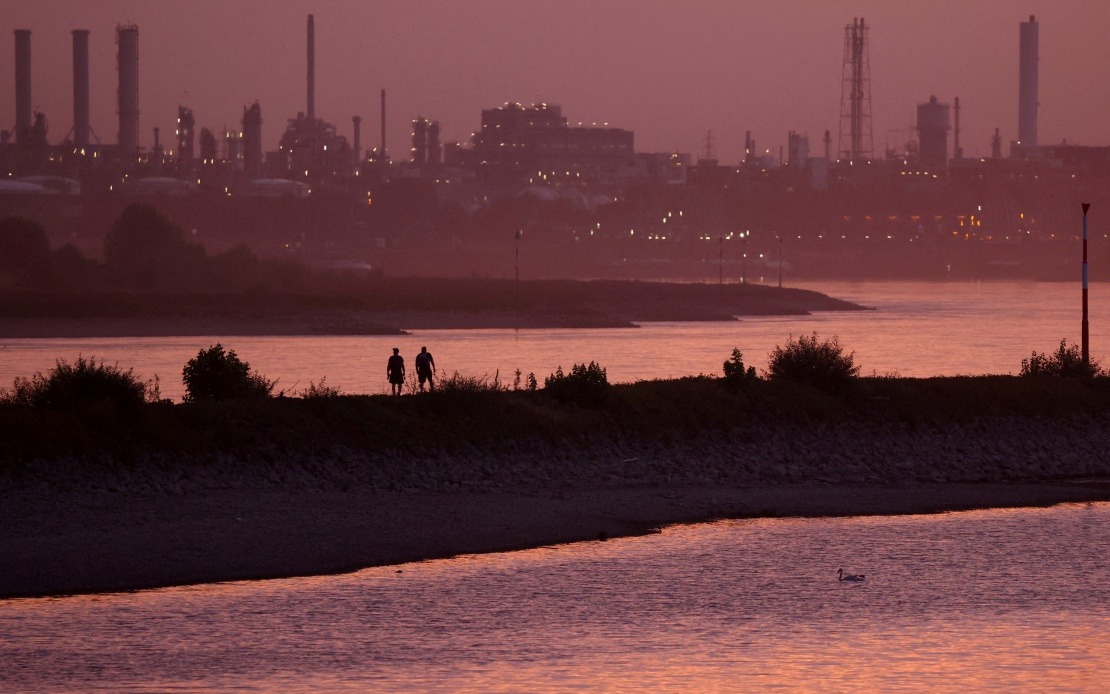
German explosives experts were mobilised on Thursday to safely disarm a substantial Second World War-era bomb that resurfaced in the Rhine river near Cologne as the waterway receded to historically unprecedented levels. The discovery underscores how Europe's devastating summer drought has exposed submerged remnants of the 1939-1945 conflict, transforming the continent's busiest inland shipping corridor into an archaeological site of sorts. The 500-kilogramme American aerial ordnance, identified as originating from United States bombing campaigns over Nazi-occupied Germany, was first spotted on Wednesday evening adjacent to Cologne's Rheinpark district.
The German Press Agency reported that authorities implemented a precautionary evacuation zone encompassing a 400-metre perimeter around the bomb's location. Approximately 360 individuals residing or employed in the affected area—including residents of a retirement facility and personnel working at nearby RTL television studios—were instructed to leave their premises pending the completion of defusing operations. German municipal officials declined to publicly announce the precise timing of the defusal procedure, citing standard security protocols for such sensitive operations involving unstable ordnance.
The Rhine's water gauge plummeted to just 67 centimetres on Thursday in Cologne, matching a historical low reached merely days beforehand and illustrating the severity of the ongoing hydrological crisis. Meteorological projections indicated further deterioration, with forecasters predicting levels could sink to 66 centimetres by evening. Such measurements are exceptionally rare and underscore the exceptional nature of current climatic conditions affecting Central Europe. The sustained drought following weeks of intense heat has fundamentally altered the physical landscape of one of the continent's most vital economic arteries.
The discovery of this particular bomb is far from an isolated incident. As water levels fell dramatically across the Rhine basin, other wartime artefacts and debris—some hazardous, others merely historical curiosities—have emerged from decades of submersion. Each exposure raises fresh concerns for local authorities and emergency services, who must allocate resources to identify, secure, and neutralise potentially explosive devices. The frequency of such discoveries has prompted German officials to intensify monitoring efforts along vulnerable river stretches.
Beyond the immediate security implications, the extreme low water conditions have severely compromised commercial navigation on the Rhine, traditionally Europe's most economically significant inland waterway. Shipping operators have been compelled to dramatically reduce cargo loads, effectively lowering the volume of goods transported per voyage. For manufacturers, petrochemical refineries, and agricultural producers dependent on Rhine logistics, this translates into escalating transportation costs, supply chain delays, and ultimately higher consumer prices. Some heavy-load barge operators have suspended operations altogether, unable to operate profitably under current depth constraints.
Hydrological specialists and water resource managers offer a sobering assessment of the immediate outlook. Rather than anticipating a swift recovery as might typically occur following weather patterns normalisation, official forecasters warn that Rhine levels will rise only marginally in coming days. The absence of substantial precipitation across the catchment basin—encompassing France, Switzerland, Germany, and numerous Alpine regions—means that groundwater aquifers remain depleted and tributary flows remain severely diminished. This suggests the crisis will persist well into autumn unless weather patterns shift dramatically.
The situation echoes similar crises experienced in 2018, when severe drought across Central Europe similarly forced shipping restrictions and exposed wartime ordnance. However, environmental scientists increasingly attribute the growing frequency and severity of such episodes to long-term climate change patterns. Rising temperatures accelerate evaporation rates, while shifting precipitation distributions mean that traditional wet seasons arrive later or remain abnormally dry. For Southeast Asian observers, these European developments carry cautionary implications regarding future freshwater security and climate resilience planning.
The discovery near Cologne also highlights an often-overlooked legacy of the Second World War. Across Germany and other heavily bombed nations, thousands of unexploded ordnance remain buried in soil, rivers, and urban areas. Cologne itself endured some of the war's heaviest Allied bombing campaigns, with the city repeatedly targeted for its railway infrastructure and industrial capacity. The Rhine, serving as a natural boundary and shipping route, received considerable tonnage of ordnance, much of which failed to detonate upon impact.
For Germany's emergency services and bomb disposal specialists, such discoveries represent routine occupational hazards. Annually, technicians defuse hundreds of explosive devices across the nation, and the infrastructure and expertise to handle such operations remains well-developed. Nevertheless, each operation carries inherent risks, and the coordination required to evacuate civilian populations remains a complex logistical challenge, particularly in densely populated urban areas like Cologne.
The convergence of climate crisis and historical hazard in this instance demonstrates how environmental changes interact with existing vulnerabilities. As global temperatures continue rising and precipitation patterns grow increasingly erratic, similar scenarios will likely recur with greater frequency across Europe and potentially other regions where the legacy of twentieth-century warfare remains physically embedded in the landscape. For policymakers and emergency planners worldwide, including those in Southeast Asia preparing for anticipated climate impacts, the Cologne episode offers a instructive case study in adaptive resilience and risk management.

