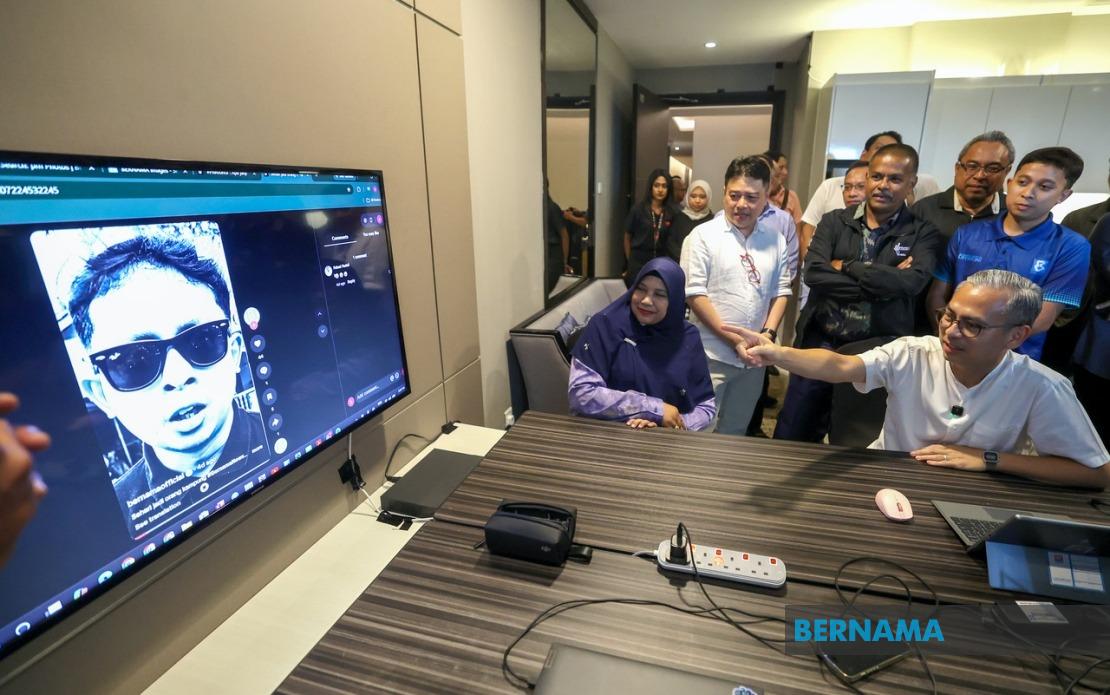
Communications Minister Datuk Fahmi Fadzil paid tribute to the Malaysian National News Agency's (Bernama) professional commitment during the Johor state election, underscoring the critical role national media plays in delivering impartial political coverage. His visit to Bernama's Johor operations centre on July 7 reflected the government's recognition that reliable election reporting underpins democratic processes and public confidence in institutional integrity.
Fahmi's inspection of the operations centre revealed a well-resourced newsroom deployed to capture developments across Johor's 56 contested seats. The minister observed that 44 Bernama personnel—comprising journalists, cameramen, and photographers—had been strategically positioned to provide geographic coverage spanning the entire state. This deployment stretched from the southern reaches of Endau through to Tanjung Surat and extended into Johor's northern districts, demonstrating the logistical complexity of managing statewide election reporting during a compressed polling period.
The minister's remarks highlighted the significance of Bernama's infrastructure and technical capabilities in enabling comprehensive election coverage. During his tour, which lasted more than an hour, Fahmi examined the operations centre's facilities, staffing arrangements, and editorial setup. His positive assessment of working conditions suggested that adequate investment in newsroom resources—from editing stations to broadcast facilities—had been prioritised to support journalists operating under the pressure of election deadlines.
Acknowledging Bernama's leadership structure, Fahmi specifically commended chief executive officer Datin Paduka Nur-ul Afida Kamaludin and editor-in-chief Arul Rajoo Durar Raj for their organisational preparations. The minister characterised their coordination efforts as exemplary, noting that editorial personnel had received satisfactory levels of institutional support. This recognition reflected broader ministerial confidence in state media's ability to function as a reliable information channel during politically sensitive periods.
For Malaysian observers, the visit underscored ongoing debates about media independence and state involvement in election reporting. While Bernama operates as a national news wire serving both public and private broadcasters across Malaysia, its role in providing official election data and centralised coverage remains institutionally significant. The minister's public endorsement sought to reinforce public perceptions of institutional neutrality and professional journalism standards.
The Johor contest represented a substantial electoral undertaking, with 172 candidates competing across the 56 state assembly seats—an average of more than three candidates per seat reflecting fractionalised party competition. Fahmi's remarks implied that Bernama's coverage framework was proportionate to this competitive intensity and the informational needs of Johor's electorate. Early voting had commenced on the same day as the ministerial visit, with the main polling day scheduled for July 11.
From a Southeast Asian perspective, Malaysia's institutional approach to election coverage reflects regional patterns where state news agencies maintain a formal presence in political reporting, often alongside independent outlets. Bernama's dual role—serving as a commercial news wire provider while maintaining public interest responsibilities—mirrors similar arrangements in neighbouring jurisdictions where media market structures blend public and private services.
The minister's commendation also addressed the logistical demands of modern election journalism. Managing a 44-person team across a geographically dispersed state requires sophisticated coordination, real-time editorial judgments, and technical infrastructure supporting simultaneous multi-platform publication. Fahmi's satisfaction with operational arrangements suggested Bernama's systems had proven adequate to these technical requirements.
For media practitioners and journalism observers, the visit symbolised governmental recognition that election coverage quality matters for democratic legitimacy. By publicly inspecting the newsroom and acknowledging staff contributions, the minister signalled that professional news gathering deserves institutional support and political acknowledgment. This framing positioned election reporting not as a neutral administrative function but as an activity warranting ministerial engagement.
The specific geographic references—Endau to Tanjung Surat, encompassing northern districts—illustrated how Bernama's deployment strategy balanced coverage intensity with resource efficiency. Rather than concentrating reporters in urban centres, the news agency had distributed personnel to ensure that outlying constituencies received equivalent journalistic attention, supporting informed voting across diverse regions.

