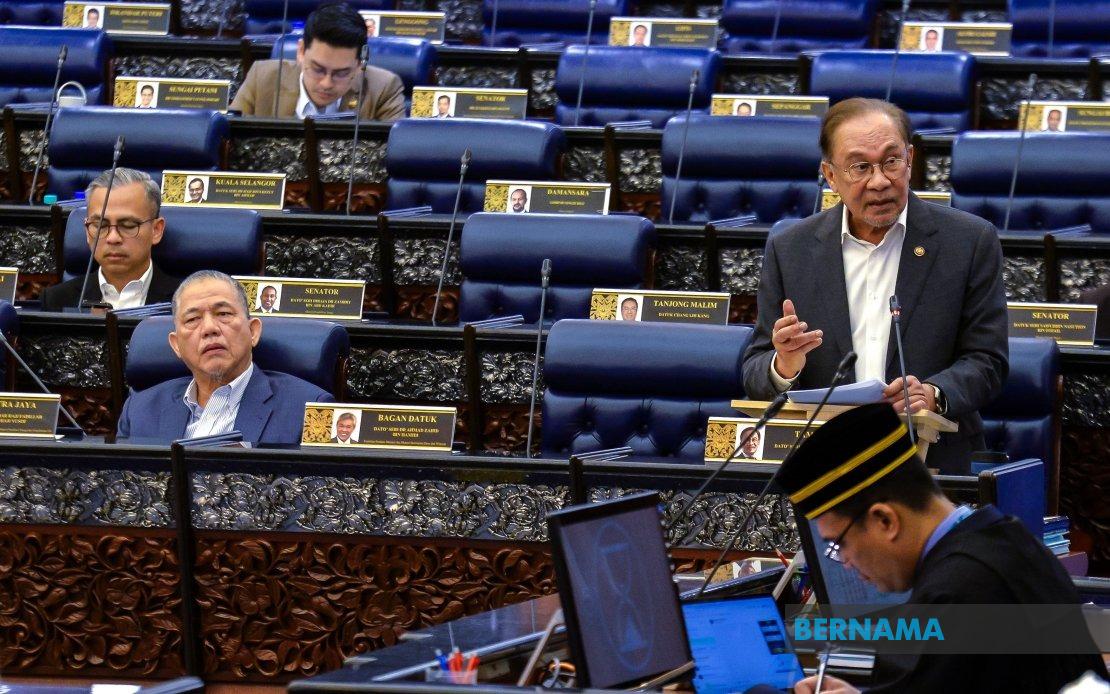
Prime Minister Datuk Seri Anwar Ibrahim has clarified that the federal government's approach to allocating funds to states prioritises meeting their specific development needs over their relative contributions to national tax revenues. Speaking during parliamentary proceedings, he noted that nearly every state receives more from Putrajaya than it generates in taxes, with only Selangor and Penang consistently collecting more revenue than they receive in federal support. This distinction is crucial for understanding Malaysia's fiscal federalism model, which explicitly recognises that wealthier, more developed states require less redistributive support than those facing greater infrastructure and social challenges.
The Prime Minister's remarks came in response to parliamentary questions about whether the current distribution framework treats all states fairly and whether the MADANI Government has made meaningful adjustments to allocation mechanisms. His response underscores a fundamental principle that has guided federal budgeting across Malaysian administrations: that public resources should flow toward urgent developmental priorities rather than simply reflecting economic output patterns. This philosophy reflects the constitutional framework that enables the federal government to redistribute national wealth in pursuit of balanced regional development.
Anwar itemised several categories of expenditure that inform federal allocation decisions, providing insight into how Putrajaya weighs competing demands across the country. These include comprehensive flood mitigation and disaster resilience programmes, which have become increasingly critical as climate-related weather events intensify across Malaysia. Infrastructure projects such as the Pan Borneo highway represent major strategic investments that generate employment and economic activity beyond their immediate regions. Additionally, the federal budget addresses fundamental gaps in basic services including water supply networks, drainage systems, educational facilities, and poverty-targeted initiatives. This multi-dimensional approach reflects the complexity of equitable governance in a federation where developmental disparities remain significant.
The MADANI Government's track record on state allocations has become a touchstone in federal-state relations and intra-party political discourse. Anwar specifically highlighted increased funding flows to traditionally less-developed northern and east coast states including Kedah, Terengganu, and Kelantan. This emphasis carries both substantive and political weight, suggesting that the current administration has recalibrated priorities compared to its predecessors. For observers tracking the government's commitment to inclusive development, such comparisons serve as measurable indicators of policy shifts, though comprehensive analysis would require detailed budget figures across multiple fiscal years for proper assessment.
The distinction between Selangor and Penang merits particular attention given their roles as economic powerhouses within Malaysia's federal structure. Both states have developed substantial internal revenue bases through industrialisation, commerce, and services sectors, rendering them net contributors to federal coffers. Consequently, their allocations operate under different logics than states where tax collection capacity remains constrained by less developed private sectors. This creates inherent tensions within federal systems where wealthy regions may feel their economic contributions are not fully reflected in public investments, while less wealthy regions argue they require proportionally greater support to close infrastructure and services gaps.
The Malaysian context presents distinctive challenges compared to other federations. The country's geographical dispersion across Peninsular Malaysia and East Malaysia (Sabah and Sarawak) means that allocation decisions carry implications for territorial integration and national cohesion. Sabah and Sarawak benefit from constitutional provisions recognising their special status, while Peninsular states operate within different frameworks. The Pan Borneo highway exemplifies how federal allocation decisions pursue objectives beyond simple need-based redistribution, instead reflecting strategic national infrastructure ambitions that connect regions and promote integration.
Poverty eradication remains a persistent challenge that allocation formulas attempt to address. While Malaysia has achieved middle-income status, pockets of significant deprivation persist, particularly in rural areas and among indigenous communities in Peninsular Malaysia and East Malaysia. Federal allocations targeting poverty reduction implicitly recognise that tax revenue collection correlates imperfectly with need; areas with the poorest populations often generate minimal tax revenue, yet present the greatest claims on public resources for welfare, basic services, and capability development.
Water infrastructure represents another allocation priority with acute urgency across multiple states. Malaysia's experience with water crises has demonstrated the critical importance of investing in supply systems, treatment facilities, and distribution networks. Federal allocations for water-related projects address both immediate scarcity challenges and long-term sustainability concerns as climate change alters precipitation patterns. The inclusion of water systems in federal allocation rationales illustrates how needs-based distribution accommodates infrastructure categories that transcend simple economic productivity metrics.
The educational dimension of federal allocations connects resource distribution to human capital development and social mobility. Schools require consistent federal support to ensure equitable access regardless of state tax-raising capacity. This principle reflects the recognition that educational quality influences long-term economic competitiveness and social cohesion, justifying allocations that may exceed some states' tax contributions. Similarly, healthcare infrastructure and other public services operate under this needs-based rather than contribution-based logic.
The political dimensions of this allocation debate extend beyond technocratic budgeting concerns. State governments, particularly those controlled by opposition parties, have periodically contested federal allocation formulas, characterising them as punitive or inadequate. The MADANI Government's emphasis on increased allocations to specific states carries implicit messaging about fairness and inclusivity, particularly relevant given Malaysia's coalition politics where federal and state governance may operate under different partisan umbrellas. Anwar's parliamentary defence thus addresses both substantive policy concerns and political legitimacy questions.
Moving forward, the sustainability of needs-based allocation approaches depends on maintaining fiscal capacity at the federal level while managing states' expectations for infrastructure investment. Economic growth, tax base expansion, and effective revenue collection all influence federal resources available for distribution. Conversely, demographic shifts, climate impacts, and development pressures continuously reshape which states present the most pressing needs. The allocation framework therefore requires periodic reassessment to remain responsive to evolving circumstances.
For Malaysian citizens and policymakers, understanding these allocation principles illuminates broader questions about federalism, equity, and national resource management. The distinction between contribution-based and needs-based distribution reflects competing values within democratic governance. Anwar's defence of current practices suggests the current administration prioritises developmental equity over pure fiscal reciprocity, though the outcomes and long-term effects of this approach merit ongoing scrutiny and evaluation.

