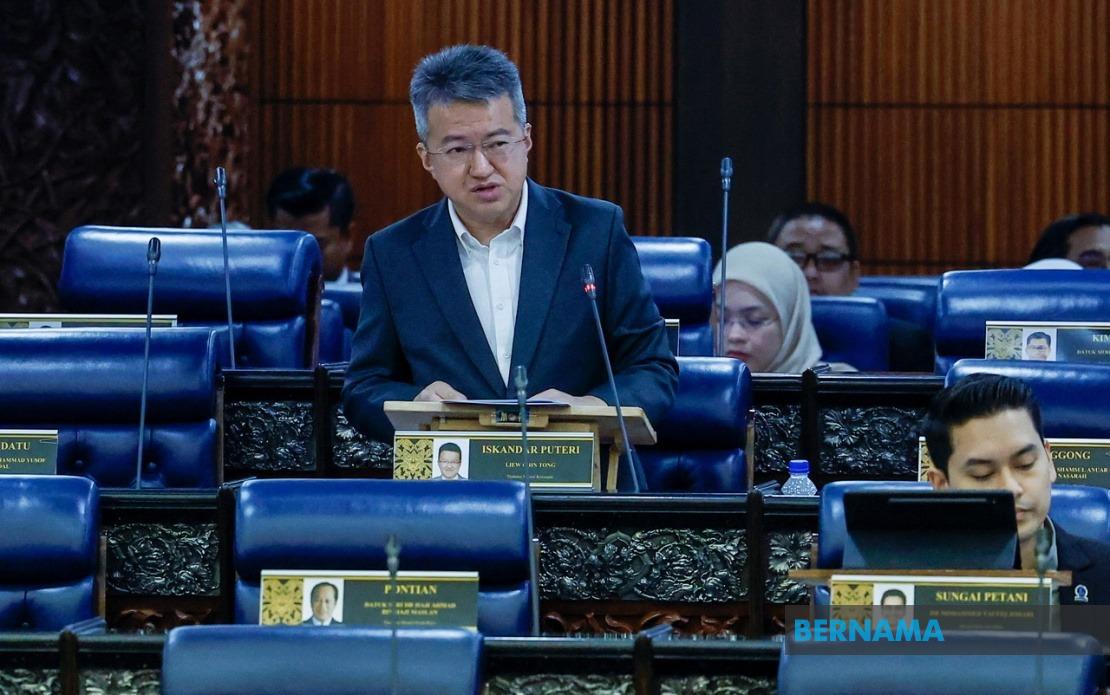
The federal government has moved to clarify concerns that a RM1.5 billion increase in Sabah's interim special grant will not compromise the state's existing development and operating allocations for the year. Deputy Finance Minister Liew Chin Tong made this assurance during parliamentary proceedings, responding to questions about the funding boost that Prime Minister Datuk Seri Anwar Ibrahim had announced in May. The clarification comes at a time when discussions around federal-state fiscal arrangements remain sensitive given Sabah's unique constitutional position within the Malaysian federation.
The distinction between the special grant and regular development allocations is crucial to understanding the government's position. Liew emphasized that the two funding streams operate independently within the federal budget framework, meaning the additional RM1.5 billion allocated through the special grant mechanism would not trigger corresponding reductions in the development ceiling that Sabah receives annually. This technical clarification was important because critics and concerned stakeholders had questioned whether the federal government might use the special grant as a replacement for, rather than a supplement to, existing development funds.
Sabah's development allocation has experienced year-on-year growth under this fiscal arrangement. The state's development budget has expanded from RM6.7 billion to RM6.9 billion in the current year, reflecting the government's stated commitment to infrastructure parity between East Malaysia and Peninsular Malaysia. This expansion encompasses substantial projects that define the state's economic and social infrastructure landscape, including the Pan Borneo Highway—a transformational regional connectivity project—alongside more localized investments in rural road networks, electrification schemes, and water supply initiatives that directly affect daily lives in remote communities.
Healthcare and education infrastructure has received particular attention in Sabah's development budget. The allocation encompasses construction and upgrading programmes for hospitals and clinics, addressing long-standing medical service gaps in the state, as well as rehabilitation of aging school buildings and police stations. These facility upgrades represent investments in human capital and institutional capacity that extend beyond mere budgetary figures, contributing to service delivery improvements that have practical significance for Sabah's residents across sectors.
Utility subsidies constitute another critical element of federal support to Sabah, reflecting the state's unique economic circumstances. Despite transferring regulatory control of electricity supply to the Sabah state government in 2024—a significant devolution of power—the federal government has committed to maintaining subsidy coverage for the utility sector. The subsidy allocation for 2026 is projected to reach RM880 million, providing continued price stability for consumers in a state where electricity costs represent a substantial household expense. This continuation demonstrates federal acknowledgment that economic stability in Sabah requires ongoing support beyond regulatory frameworks.
Rural water supply has become an area of increased investment focus. Funding for this essential service has grown substantially, increasing from RM103.5 million in 2025 to RM143 million in the current year. This 38 percent increase reflects recognition that water security remains a development priority in regions where infrastructure gaps persist. Access to reliable piped water supply remains uneven across Sabah's geography, and increased allocation signals intent to accelerate coverage expansion beyond major urban centers.
Cost-of-living assistance programmes represent a substantial portion of federal support that directly reaches Sabah residents. The Sumbangan Tunai Rahmah and Sumbangan Asas Rahmah schemes collectively channel an estimated RM1.2 billion into Sabah's economy through targeted cash transfers. These social safety net programmes address inflation pressures and provide cushioning for lower-income households, complementing broader infrastructure investments with direct household support mechanisms.
The constitutional framework governing Sabah's special grants carries historical and political significance. Article 112C of the Federal Constitution enshrines the principle that special grants should be paid to Sabah, establishing a constitutional obligation rather than mere discretionary federal largesse. The procedural requirements detailed in Article 112D establish specific mechanisms for how such grants must be processed and transferred. Liew's emphasis on following these constitutional procedures—referencing established practice from 2022, 2023, and 2025—underscores that the government treats special grant administration as a constitutional matter bound by formal processes rather than ad-hoc political decisions.
The government's legal position remains nuanced regarding interpretation of these constitutional provisions. While the federal government has filed an appeal against aspects of the Kota Kinabalu High Court's ruling on special grants, Liew's statement reaffirms commitment to the constitutional principle underlying these grants. This apparent tension between litigation and principled respect reflects the complexity of constitutional interpretation in Malaysia's federal system, where courts, federal government, and state governments navigate competing interpretations of foundational constitutional texts.
Ongoing negotiations between federal and state authorities aim to establish a durable mechanism for determining future special grant amounts. Rather than addressing each grant payment through ad-hoc political negotiation or court proceedings, the government seeks to develop a formula-based system consistent with Articles 112C and 112D. Such mechanistic approaches offer potential advantages in terms of predictability and reducing political friction over annual negotiations, though substantive disagreement may persist regarding what such formulas should entail.
The larger context involves Malaysia's ongoing project of equitable development between Peninsular Malaysia and East Malaysia. Federal commitments to Sabah's infrastructure and social welfare must be understood within this broader imperative, though resource constraints and competing priorities across all states create perpetual tension over allocation decisions. The RM1.5 billion special grant, coupled with expanded development allocations and subsidy commitments, represents substantial federal investment in Sabah's development trajectory.
For Sabah's constituents and policymakers, these assurances matter significantly. The distinction between additional grants and protected development allocations affects the state government's planning capacity and confidence in multi-year project timelines. Malaysian observers monitoring federal-state relations will note whether actual disbursement matches stated commitments and whether the negotiated mechanisms for future grants function as intended. The test of these assurances will ultimately lie in implementation and the trajectory of development outcomes in Sabah's communities.

