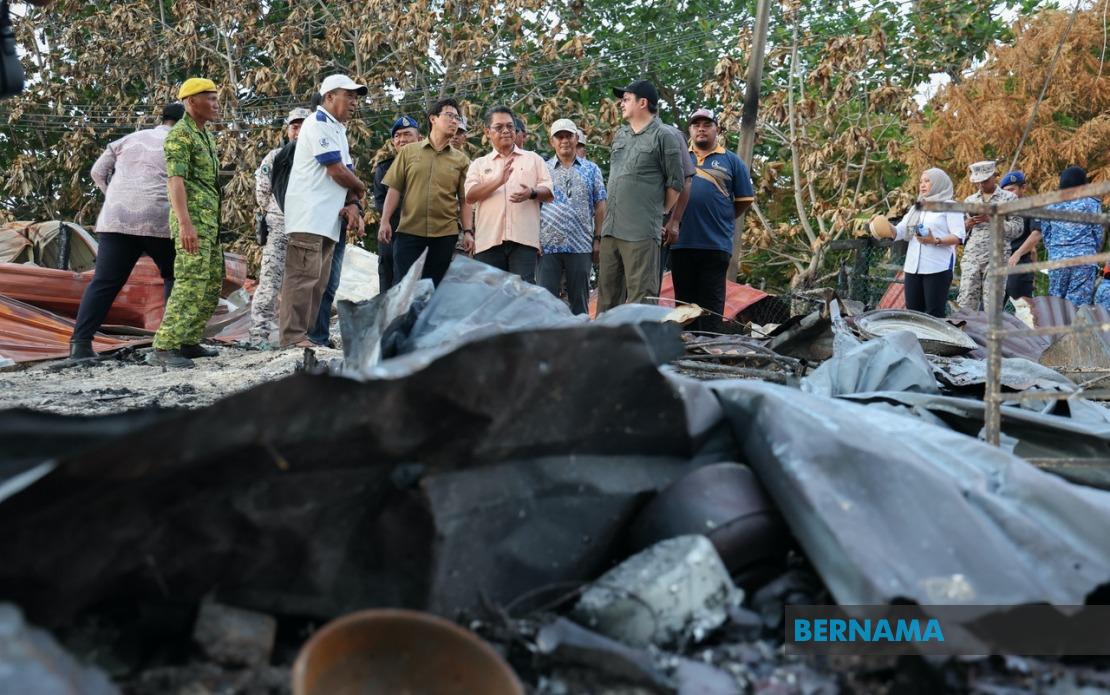
A significant displacement crisis unfolded in Sandakan when a fire swept through Kampung Nunuyan Laut early yesterday morning, destroying 28 residential structures and leaving more than 100 residents homeless. The Federal Government has now moved swiftly to provide immediate relief, with the Prime Minister's Department distributing assistance to 29 heads of households affected by the disaster. Minister in the Prime Minister's Department (Sabah and Sarawak) Datuk Mustapha Sakmud spearheaded the relief efforts, visiting the fire site alongside Sandakan Municipal Council President Datuk Walter Kenson to assess the scale of damage and coordinate response measures.
The Implementation Coordination Unit within the Prime Minister's Department took rapid action to address the most pressing needs of affected residents, extending support beyond basic monetary relief. Among the immediate interventions was the provision of wheelchairs for elderly community members unable to manage without mobility assistance, reflecting government recognition that disaster recovery involves attending to vulnerable populations with specific requirements. This targeted approach signals an understanding that uniform aid packages often overlook the needs of those with disabilities or age-related challenges, a consideration frequently absent in emergency responses across the region.
Datak Mustapha outlined a coordinated approach involving multiple government bodies working in tandem to comprehensively assess victim requirements. The Sandakan Municipal Council and relevant governmental agencies have been tasked with conducting thorough needs assessments to ensure aid allocation addresses actual gaps rather than assumed priorities. The minister also highlighted the disruption to essential services, particularly emphasising the damage to the jetty that serves as a critical transportation link for schoolchildren commuting daily. The government has made clear that preventing educational interruption represents a priority, with the Implementation Coordination Unit directed to fast-track repairs to this vital infrastructure through MPS submissions.
A complexities layer to the recovery process emerged through revelations about land tenure arrangements in the affected area. Datuk Walter disclosed that residents of Kampung Nunuyan Laut were living on privately owned land comprising two separate land titles, creating additional obstacles to reconstruction planning. This situation is not uncommon across Malaysia's coastal settlements, where informal settlements often develop on private property with varying degrees of formal arrangement. The involvement of private landowners introduces negotiation and coordination requirements that extend beyond standard disaster management protocols, potentially complicating the pace of permanent relocation solutions.
The Rural Development Department will assume responsibility for determining optimal relocation pathways, with planning discussions expected to encompass village reserve land as potential settlement sites. These deliberations will necessarily involve engaging the two private landowners whose property currently houses displaced residents, adding layers of complexity to what might otherwise be straightforward resettlement. The department's role reflects the reality that disaster recovery in Malaysia frequently requires balancing community needs against private property rights, a tension that administrative bodies must navigate with sensitivity and legal precision.
Beyond immediate shelter concerns, authorities have committed to establishing comprehensive support systems ensuring affected residents achieve sustainable recovery rather than temporary survival. The planned infrastructure improvements include reliable electricity supply, clean water systems, and functional maritime access, recognising that temporary camps often devolve into prolonged humanitarian situations without adequate utility provision. The deliberate inclusion of jetty construction in relocation plans acknowledges that waterfront communities depend on maritime transport for economic survival, and reconstruction efforts must restore not merely housing but viable livelihoods.
The Sandakan fire represents a significant disaster for Sabah's eastern coastal communities, affecting over 100 individuals who lost homes, possessions, and immediate security overnight. The speed of government response, visible through ministerial site visits and coordinated agency mobilisation, demonstrates institutional capacity to react to crises affecting Malaysian citizens. However, the underlying complexities around land ownership and relocation logistics suggest that sustainable resolution may extend considerably beyond initial emergency phases, potentially testing government commitment to comprehensive recovery support.
For Malaysian policymakers and observers, the Pulau Nunuyan incident illustrates persistent challenges surrounding informal settlements in resource-rich regions. Coastal communities throughout Southeast Asia frequently develop without formal land title certainty, creating vulnerability to rapid displacement when disasters strike. The Sandakan case demonstrates how disaster recovery becomes entangled with broader questions of land governance, property rights, and infrastructure development—issues demanding integrated solutions rather than emergency patches.
The federal government's intervention through the Prime Minister's Department signals recognition that East Malaysian crises warrant high-level political attention and resource commitment. Datuk Mustapha's direct involvement and public statements about infrastructure priorities reflect political investment in demonstrating governmental efficacy in regional disaster response. For affected residents, this visibility may translate into accelerated bureaucratic processing and prioritised resource allocation, advantages not automatically available to disaster victims in all circumstances.

