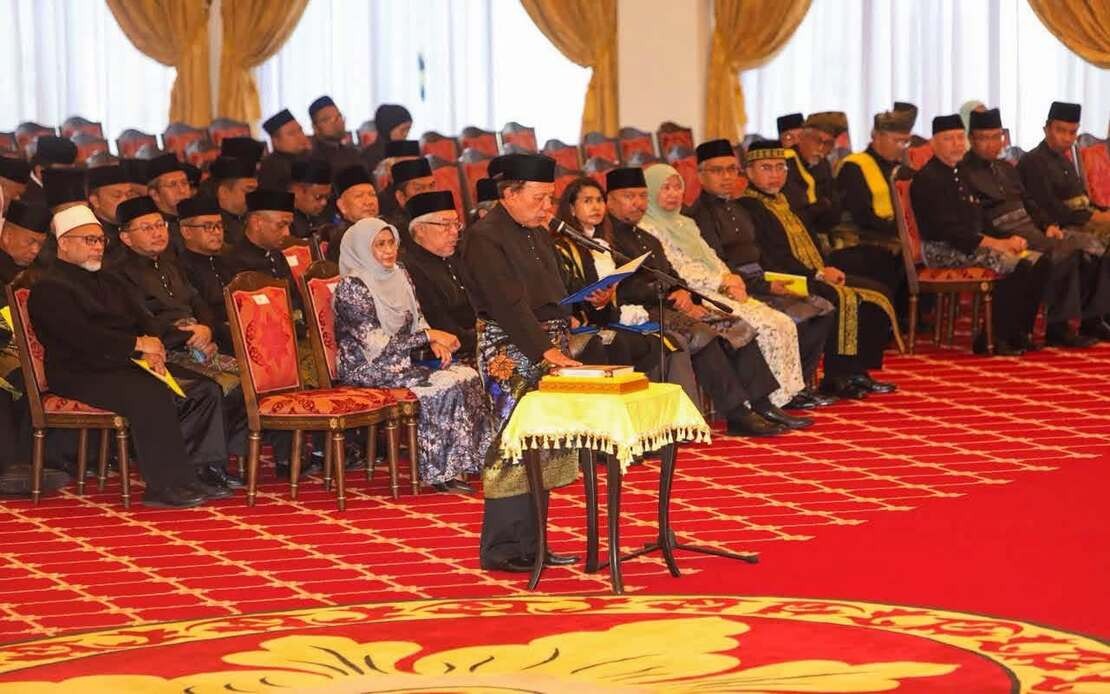
Datuk Ismail Lasim has assumed office as Negeri Sembilan's Menteri Besar following his formal swearing-in before the Yang Dipertuan Besar of Negeri Sembilan, Tuanku Muhriz Tuanku Munawir, at the Balairong Seri of Istana Besar Seri Menanti on August 2. The transition marks a significant development in the state's political leadership, with federal officials moving swiftly to acknowledge the appointment through public expressions of support and confidence in the new chief minister's ability to steer the state's administration.
Deputy Prime Minister Datuk Seri Dr Ahmad Zahid Hamidi, who concurrently serves as Rural and Regional Development Minister, conveyed formal congratulations via social media, emphasizing that the responsibility entrusted to Ismail represents both an honour and a substantial challenge. In his statement, Zahid expressed confidence that the incoming leader would discharge his duties effectively, prioritizing the welfare of Negeri Sembilan's residents and advancing the state's development agenda. The explicit invocation of collective effort and shared purpose in his message underscores the federal government's intention to position itself as a supportive partner in Negeri Sembilan's governance during this transitional period.
Defence Minister Datuk Seri Mohamed Khaled Nordin similarly offered congratulations, framing the appointment within the broader context of developmental continuity. Mohamed Khaled characterized the public's confidence in Ismail as a mandate to perpetuate existing momentum in the state's progress, stressing the importance of maintaining stability alongside achieving further economic and social advancement. His remarks reflected an understanding that state leadership changes often invite scrutiny regarding whether incoming administrations will preserve or redirect developmental trajectories, particularly in matters of state infrastructure, employment generation, and public services delivery.
Plantation and Commodities Minister Datuk Seri Dr Noraini Ahmad joined her federal colleagues in recognizing the appointment as a watershed moment for Negeri Sembilan's governance structure. Noraini's contribution to the broader congratulatory message highlighted the symbolic significance of leadership transitions within Malaysia's constitutional monarchy framework, where formal investiture ceremonies affirm both constitutional proprieties and the legitimacy of elected representatives' mandates. Her reference to a "new phase" suggests acknowledgment that Ismail's administration may chart adjustments in policy priorities or implementation approaches within the state government.
Ismail brings substantial accumulated experience to his new role, having maintained a continuous presence in Negeri Sembilan's political arena since his initial election to the state assembly in 1999. His political trajectory spanning nearly three decades provides him with deep institutional knowledge of the state's administrative structures, policy frameworks, and constituent demographics. This longevity in electoral politics distinguishes him from leaders who transition abruptly into chief ministerial positions without prior exposure to state-level governance complexities.
Throughout his previous tenure in the state executive council, which encompassed three consecutive terms until 2018, Ismail maintained responsibility for the education portfolio. His involvement in developing and implementing human capital development policies positioned him at the intersection of demographic planning and workforce preparation, two critical areas for Negeri Sembilan's long-term competitiveness. The emphasis on educational policy during his earlier role suggests he understands the correlation between institutional investment in schooling and the state's ability to attract skilled employment and foreign direct investment.
At 67 years of age, Ismail represents a generation of Malaysian politicians who have witnessed multiple cycles of electoral competition and administrative reform. His prior experience holding executive council positions demonstrates familiarity with cabinet-style collective decision-making and the negotiation processes required when multiple state representatives must reach consensus on budgetary allocations and policy direction. This background may facilitate his navigation of contemporary governance challenges, including pandemic-related economic disruption, revenue volatility, and escalating public service demands.
The immediate circulation of congratulatory messages from prominent federal office-holders signals intentional coordination in messaging and suggests the federal government views Ismail's appointment as consistent with broader national governance priorities. The explicitly religious invocations embedded in each statement—references to divine guidance and blessing—reflect the integration of Islamic moral frameworks within Malaysia's political communication conventions, reinforcing values alignment between state and federal leadership structures. This rhetorical consistency across ministerial statements demonstrates sophisticated management of Malaysia's complex federal-state power relationships.
For Negeri Sembilan specifically, Ismail's appointment occurs within a political context where state governments across Malaysia have increasingly assumed prominence in public discourse regarding developmental outcomes, fiscal management, and constituent service delivery. Unlike the federal sphere, state administrations directly interface with residents on localized concerns including land management, small-scale infrastructure, and licensing procedures. Ismail's long familiarity with state-level issues positions him to address these immediate governance concerns alongside longer-term strategic planning for the state's economic diversification and regional integration within the Klang Valley metropolitan sphere.
The swearing-in ceremony itself, conducted according to constitutional protocols before the state's hereditary ruler, affirms the enduring institutional significance of Malaysia's constitutional monarchy in legitimizing elected representatives' assumption of executive authority. This formal ceremonial dimension distinguishes Malaysian state transitions from purely administrative changeovers, embedding political succession within frameworks that balance democratic representation with constitutional monarchy traditions. The involvement of Tuanku Muhriz as witness to Ismail's oath underscores that state governance operates within established constitutional parameters rather than through arbitrary executive determination.
Moving forward, Ismail's effectiveness as Menteri Besar will likely be evaluated against benchmarks including fiscal discipline in state budgeting, timely resolution of constituent grievances through state government mechanisms, and tangible advancement in areas where state-level action significantly affects residents' quality of life. His educational background and previous portfolio assignments suggest he may prioritize initiatives intersecting education, workforce development, and economic opportunity creation. The breadth of congratulatory messages from federal leaders implies the central government anticipates cooperative working relationships with Negeri Sembilan's administration on matters of shared federal-state jurisdiction.

