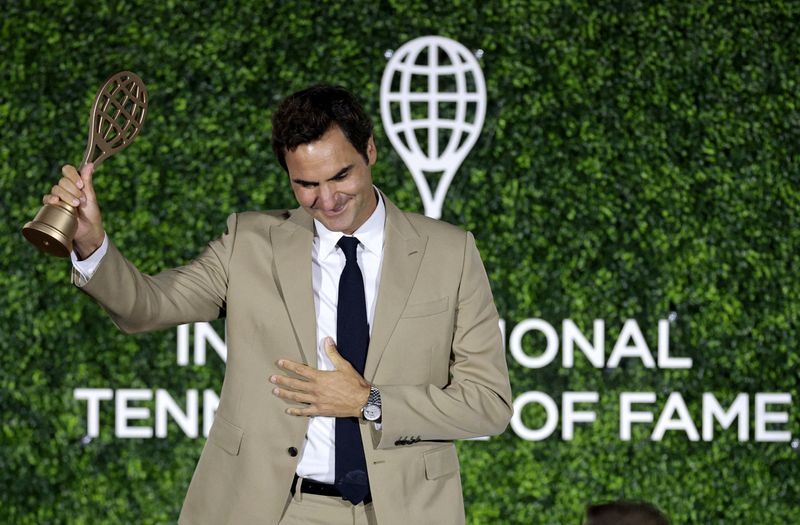
Roger Federer's induction into the International Tennis Hall of Fame on Saturday marked a watershed moment for one of sport's greatest athletes, with the 20-time Grand Slam champion delivering a deeply personal address that transcended the typical accolades of such ceremonies. Speaking at the event in Newport, Rhode Island, the 45-year-old Swiss icon openly acknowledged his emotions while discussing a career that fundamentally reshaped modern tennis, emphasizing that his accomplishments were never about pursuing fame but rather about pursuing excellence in a sport that shaped his entire life.
Federer's Hall of Fame journey came alongside broadcaster and journalist Mary Carillo, whose parallel recognition underscored the event's significance within tennis circles. The induction itself represents the culmination of an unprecedented run of dominance that spanned multiple decades and three separate centuries of professional competition. Beyond the statistics—which themselves are staggering—Federer's admission to this exclusive institution recognizes his singular impact on how tennis is played, perceived, and celebrated globally, particularly across Europe and Asia where his elegant style and sportsmanship earned him a devoted following that extended far beyond traditional tennis audiences.
The record Federer compiled during his playing career remains virtually untouched in its scope. His eight Wimbledon titles represent an all-time men's record at the grass-court Grand Slam, while his 310 weeks at world number one reflect an era of consistency that modern tennis has struggled to replicate. Beyond these marquee achievements, Federer secured six Australian Open crowns, five U.S. Open titles, and a French Open championship, combining for 103 ATP Tour victories before his retirement in 2022. For Southeast Asian tennis enthusiasts, Federer's career represented proof that sustained excellence across different surfaces and court conditions was possible, challenging the notion that specialization was necessary for success at the highest levels.
What distinguished Federer's acceptance speech was his candid rejection of fame as a motivating force. Instead, he articulated a philosophy centered on the intrinsic satisfaction of spending a lifetime engaged in work that genuinely consumed his passion. This perspective resonates particularly with younger athletes across Malaysia and the region, as it offers a counternarrative to the contemporary emphasis on celebrity and commercial success. Federer's insistence that his primary goal was to work alongside people equally devoted to excellence suggests that institutional and cultural factors—how tennis is coached, how players are developed, how peer communities are formed—mattered as much to his achievements as innate talent or work ethic.
Beyond the trophy cabinet, Federer's presentation style became integral to his identity and commercial appeal. The Swiss famously wore more than 5,000 custom headbands throughout his career, a seemingly trivial detail that Federer himself laughed about during his address, yet which encapsulated his approach to the sport. This attention to aesthetic detail, combined with his willingness to wear two pairs of socks simultaneously and adopt eccentric on-court tactics like the SABR—his deliberate sneak-attack return technique—demonstrated that excellence need not come at the expense of personality. For Malaysian audiences accustomed to viewing tennis primarily through media representations, Federer's innovation on court illustrated how individual expression and tactical creativity could coexist with competitive success.
The emotional core of Federer's speech emerged when he expressed gratitude toward those who had sustained his career. His acknowledgment of coaches, medical staff, and particularly his wife Mirka suggested that behind every statistical achievement stood a network of support structures often invisible to spectators. Mirka's own public praise for Federer's character beyond the court—his conduct as a husband, father, and friend—reframed the Hall of Fame induction as recognition not merely of tennis prowess but of integrated human excellence. This holistic framing carries implications for how Southeast Asian societies evaluate sporting achievement, suggesting that character and relationship management deserve equal weight with victory counts.
Federer's reflection on his childhood in Basel, specifically his memories as a 13-year-old ball boy watching professional tennis, created a narrative arc that extended his Hall of Fame moment beyond mere historical documentation. By returning conceptually to that young spectator's perspective, he articulated how his entire career represented an extended embodiment of that youthful wonder and enthusiasm. For Malaysian tennis development, this narrative underscores the importance of cultivating grassroots exposure and allowing young people to witness excellence firsthand, as such experiences can germinate motivations that sustain decades-long commitment to the sport.
Crucially, Federer positioned his Hall of Fame induction not as a conclusion but as a transition point within an ongoing relationship with tennis. His metaphor of still writing his love letter to the sport acknowledged that retirement from professional play did not mean departure from meaningful engagement with tennis as a whole. This distinction matters for understanding legacy construction in sport: Federer's Hall of Fame status grants him platforms and authority to shape tennis's future direction as a commentator, mentor, and custodian of the sport's values. Such influence extends to how tennis is promoted and developed across Asia, where Federer's endorsements and participation in exhibition events significantly impact public interest and participation rates.
Federer's commentary on having competed across multiple generations—from Andre Agassi and Lleyton Hewitt through to Rafael Nadal and Novak Djokovic—highlighted his unique position as a bridge figure in tennis history. His career spanned transitions in equipment technology, training methodology, and global geographical distribution of playing talent. This intergenerational perspective positioned him as uniquely qualified to assess tennis's evolution and to advocate for continuity in values that might otherwise be lost amid rapid modernization. For regional tennis administrators and coaches, Federer's voice carries particular weight in discussions about how Southeast Asian talent development aligns with contemporary global standards.
The message Federer conveyed about tennis's future emphasized balance between innovation and preservation of core values. His explicit hope that the sport would maintain its amateur spirit and camaraderie among competitors while embracing increased pace and globalization identified a central tension in modern professional tennis. As professional tennis becomes ever more commercialized and geographically distributed, with increasing participation from Asian players and markets, Federer's Hall of Fame platform allows him to articulate principles that might otherwise be overlooked. His encouragement for players to take risks, pursue authenticity, and avoid complacency suggests ongoing relevance for his perspective even after competitive retirement.
Federer's call for players to do things never before attempted in tennis directly invoked his own legacy of innovation. The SABR, unreturnable serves, aggressive net play, and other tactical experimentation had defined his approach to the sport, and his Hall of Fame speech doubled down on this philosophy as something the sport should actively cultivate rather than resist. For emerging players across Southeast Asia developing their games, this validation of creative experimentation provides permission to deviate from conventional training methodologies and to trust their instincts about tactical adaptation. The implicit message—that greatness emerges through authentic expression rather than pure imitation of established methods—carries implications for how tennis is taught and coached throughout the region.
The significance of Federer's induction extends beyond personal vindication to encompass the moment tennis finds itself in globally. As Asian nations increasingly dominate participation statistics and produce world-ranked players at accelerating rates, Federer's Hall of Fame status and his continued engagement with the sport's evolution positions him as a crucial voice in determining what values persist as tennis becomes increasingly Asian. His emphasis on keeping the sport young at heart, maintaining authentic self-expression, and never ceasing to ask fundamental questions about how tennis should be played suggests that even as tennis's demographic center of gravity shifts eastward, certain principles about excellence, creativity, and character transcend geography and era. Federer's farewell, framed as not a goodbye but rather a transformation into a new relationship with the sport, affirms that his influence on global tennis will persist for decades, shaping how the game develops in regions like Southeast Asia where his artistry and sportsmanship inspired countless younger players to pursue the sport.

