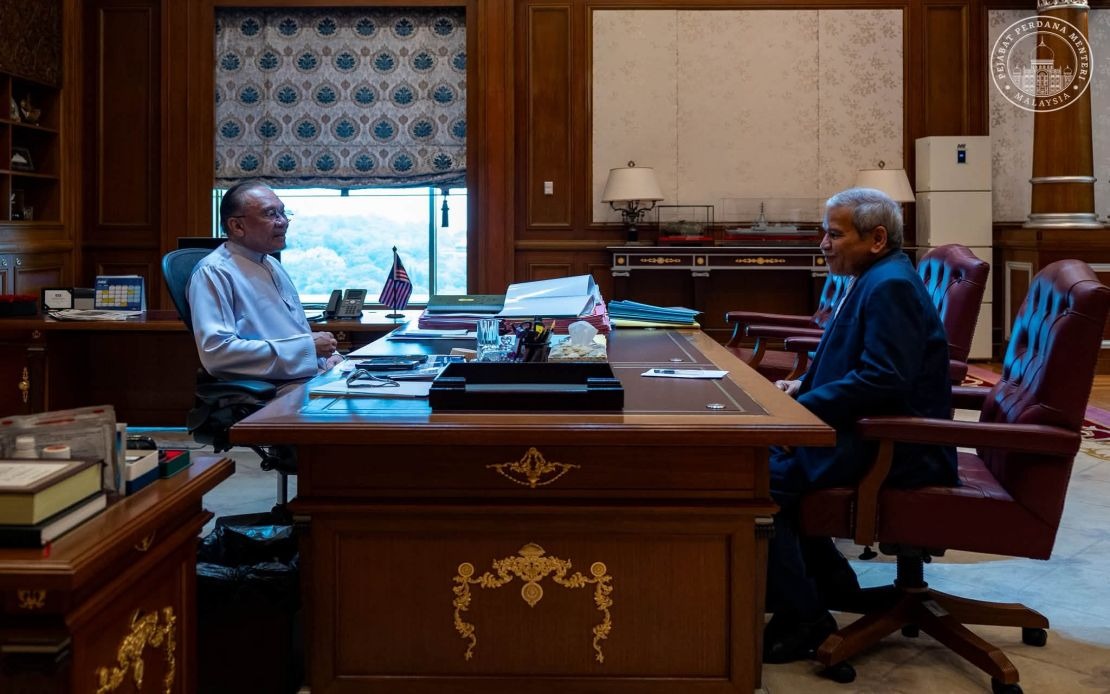
Prime Minister Datuk Seri Anwar Ibrahim has reiterated the government's commitment to fortifying the Federal Land Development Authority as a cornerstone institution designed to enhance the livelihoods and social standing of settler communities across the nation. Speaking following a meeting with newly appointed FELDA chairman Tan Sri Ahmad Badri Mohd Zahir in Putrajaya, Anwar underscored the dual imperative of preserving settler welfare while simultaneously modernising the organisation's economic footprint.
The leadership transition at FELDA marks a significant moment for the authority, which has historically served as a vehicle for rural development and poverty alleviation in Malaysia. Tan Sri Ahmad Badri assumed the chairmanship on July 15, succeeding Datuk Seri Ahmad Shabery Cheek, whose tenure concluded on June 30. This changeover occurs amid broader discussions about the organisation's relevance and operational efficiency in the contemporary economic landscape.
As both Prime Minister and Finance Minister, Anwar has positioned FELDA's revitalisation as a priority within the MADANI Government's broader agenda. His remarks emphasise that strengthening the institution is not merely about preserving tradition but about ensuring it remains functional and competitive in supporting successive generations of beneficiaries. This framing suggests recognition that FELDA faces modernisation pressures requiring strategic intervention.
A critical dimension of Anwar's message centres on generational considerations. The Prime Minister specifically highlighted the need to address challenges confronting younger settlers who have inherited schemes established decades ago. Many second and third-generation FELDA members face different economic realities than their parents, including pressures from globalised commodity markets, changing agricultural practices, and alternative livelihood expectations. Anwar's acknowledgment of these evolving concerns indicates awareness that one-size-fits-all approaches may inadequately serve contemporary settler populations.
The welfare component remains foundational to FELDA's mandate, yet the organisation must simultaneously compete economically to justify continued government investment and maintain its institutional viability. This balancing act has grown more complex as commodity prices fluctuate, land productivity varies, and economic diversification becomes increasingly necessary. Anwar's dual emphasis reflects understanding that settler dignity depends on both direct support and access to sustainable economic opportunities.
The incoming chairman faces expectations that extend beyond routine administration. Ahmad Badri's appointment signals the government's intent to pursue active leadership that can navigate FELDA through simultaneous objectives: preserving its social welfare functions, enhancing operational efficiency, and positioning the institution for relevance in changing times. The confidence Anwar expressed in Ahmad Badri's capacity suggests the Prime Minister views this leadership transition as an inflection point for broader institutional renewal.
FELDA's historical significance in Malaysia's development narrative cannot be understated. Since its establishment, the authority has settled hundreds of thousands of families on land development schemes, contributing substantially to poverty reduction and rural development. However, the organisation has periodically faced scrutiny regarding financial performance, scheme sustainability, and settler satisfaction. Recent administrations have undertaken various restructuring exercises, though long-term sustainability questions persist.
The government's commitment to ongoing support carries financial and policy implications. Strengthening FELDA may require investment in infrastructure modernisation, productivity enhancement programmes, and youth engagement initiatives. It could also entail policy adjustments regarding land utilisation, commodity diversification, and market access arrangements. The precise mechanisms through which support will materialise remain to be detailed, but Anwar's statement establishes a platform for anticipated announcements or initiatives.
For Malaysian settlers and their families, particularly those in longstanding schemes, this emphasis represents official acknowledgment that their circumstances warrant sustained institutional attention. However, delivery mechanisms will ultimately determine whether renewed commitment translates into tangible improvements in income, services, and economic prospects. The coming months under Ahmad Badri's leadership will likely reveal the administration's practical approach to translating these strategic statements into operational changes.
Regionally, FELDA's trajectory holds broader significance as other Southeast Asian nations grapple with agricultural development, rural welfare, and settler prosperity challenges. Malaysia's approaches and outcomes may inform regional discussions about effective institutional frameworks for supporting farming communities and managing land development programmes in developing economies.
The emphasis on institutional strengthening rather than fundamental restructuring suggests continuity in approach, with refinement of existing mechanisms rather than radical transformation. This conservative stance reflects both the institution's deep social roots and political sensitivity surrounding settler communities. Whether such measured approaches prove sufficient for addressing contemporary challenges remains a central question as Ahmad Badri commences his tenure and the government pursues its stated commitment to FELDA's renewal.

