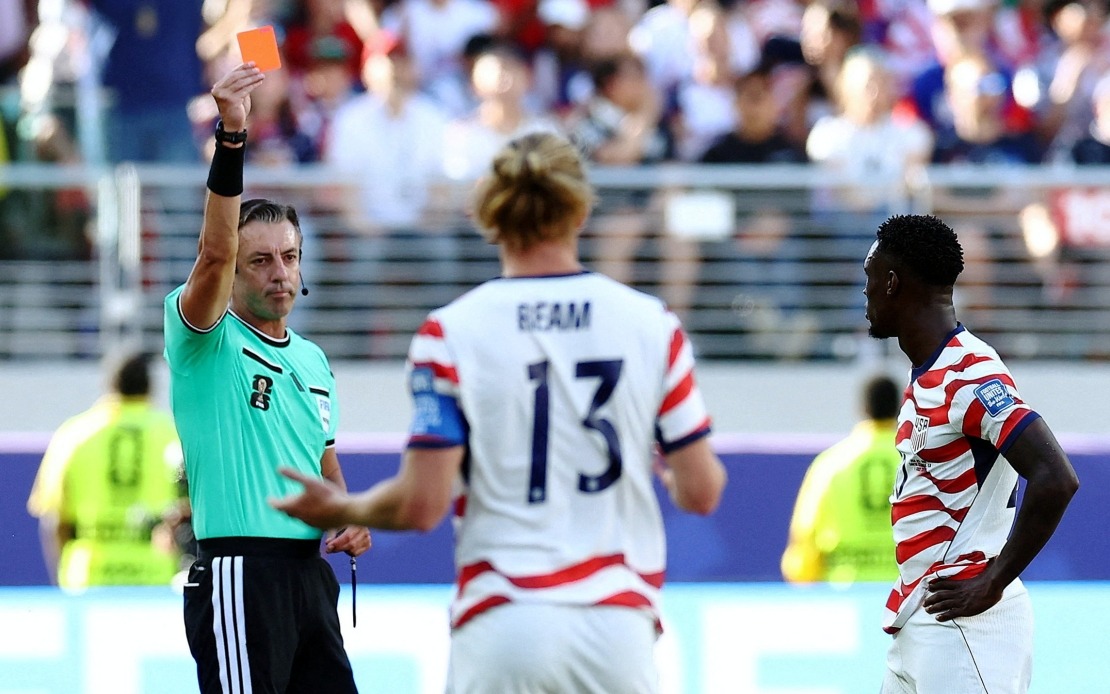
FIFA's decision to suspend rather than enforce a match ban on American striker Folarin Balogun has ignited a dispute between the global football governing body and the Belgian Football Association, raising questions about the consistency of disciplinary procedures during major tournaments. The suspension, announced on Sunday ahead of a crucial round-of-16 encounter in Seattle, grants Balogun eligibility to face Belgium on Monday despite receiving a red card in the United States' 2-0 group-stage victory over Bosnia and Herzegovina on July 1.
Balogun, who has emerged as a potent attacking force at the tournament with three goals, was dismissed for stamping on Bosnia and Herzegovina defender Tarik Muharemovic during that earlier match. The FIFA Disciplinary Committee subsequently determined that the incident violated Articles 14 and 66 of the FIFA Disciplinary Code, warranting a one-match suspension. However, invoking Article 27 of the same code, the committee suspended the implementation of this ban for a probationary period spanning one year, effectively allowing the striker to participate in the Belgium fixture.
The technicality that enabled Balogun's participation centres on FIFA's authority to suspend enforcement of sanctions under specific circumstances. According to FIFA's official statement, should Balogun commit another infringement of comparable nature and severity during the probationary year, the suspended suspension would automatically activate without affecting potential additional penalties for any new transgression. This conditional approach represents FIFA's interpretation of its disciplinary framework's flexibility, though the decision has proven contentious among competing federations concerned about tournament equity.
Belgium's response to FIFA's ruling has been characterised by formal disapproval and legal scrutiny. The Royal Belgian Football Association issued a statement expressing "astonishment" at the determination and indicated it was evaluating all available remedies to protect its competitive interests. The Belgian federation's objection rests on a fundamentally different reading of FIFA's own regulations, specifically Article 66.4, which the RBFA contends establishes an automatic suspension mechanism for players receiving direct red cards. This automatic suspension, the federation argues, should apply to the team's immediately subsequent match without exception or discretion.
The Belgian protest gains additional weight when considered against precedent established earlier in the same tournament. The RBFA emphasises that every other red card issued during the competition had resulted in the affected player sitting out their team's next fixture, establishing a consistent enforcement pattern that Balogun's case now appears to contradict. This inconsistency, from Belgium's perspective, undermines the principle of equal treatment that ought to govern international competition and raises concerns about whether subjective judgements regarding "similar nature and seriousness" could be applied inconsistently depending on a player's perceived importance or his team's tournament trajectory.
Further strengthening Belgium's legal argument are provisions within the FIFA World Cup 2026 Competition Regulations, specifically Article 10.5, which stipulates that players or team officials dismissed through either direct red card or accumulated cautions "will automatically be suspended from their team's subsequent match." The RBFA notes that this automatic suspension language mirrors the approach that has governed multiple World Cup tournaments and was explicitly reaffirmed through FIFA World Cup 2026 Circular No. 16, distributed to all participating member associations on May 12. Tournament coordinators also reiterated this rule during official coordination meetings and workshop sessions held before matches, according to the Belgian federation's account.
The timing and significance of this dispute cannot be divorced from the high stakes involved. The United States, competing as co-host, is pursuing its first quarterfinal appearance since 2002, and Balogun's presence represents a considerable advantage given his tournament-leading goal tally. Belgium, conversely, faces a full-strength American squad in what amounts to a sudden-death encounter for both nations' World Cup aspirations. The disparity in preparation—Belgium's likely lack of tactical adjustment for Balogun's confirmed availability—exemplifies how disciplinary decisions at tournament peaks can tangibly affect competitive balance.
Belgium's investigation into "all potential options" to safeguard its rights suggests the federation may pursue formal appeals or diplomatic channels within FIFA's governance structure, though the immediate practical effect remains clear: Balogun will line up against them in Seattle. The federation's emphasis on protecting "fundamental principles of fair play" and ensuring consistency "at this FIFA World Cup and at future editions" indicates Belgium views this not merely as a single match controversy but as a precedent with systemic implications for tournament governance and the credibility of FIFA's disciplinary framework.
The divergence between Article 66.4's seemingly unambiguous automatic suspension language and Article 27's discretionary suspension authority reveals an internal inconsistency within FIFA's Disciplinary Code that the committee has now weaponised to produce an outcome that favours Balogun and, by extension, the United States. Whether this reflects an intentional interpretation or an accidental oversight, the effect is identical: a rule that multiple federations understood to be mandatory has been treated as permissive. For Malaysian and Southeast Asian observers of global football governance, this episode illustrates how even supposedly objective regulatory frameworks can harbour discretionary space that powerful federations and prominent players may exploit, sometimes at the expense of smaller or less resourced associations who accept such rulings as final.
The ramifications extend beyond the immediate match. If Balogun scores decisive goals against Belgium and the United States advances, questions will inevitably surface regarding whether the suspended ban materially altered the tournament's trajectory. Conversely, should Belgium prevail despite Balogun's participation, the controversy may fade from immediate discourse, though Belgium's formal objection will remain lodged within FIFA's records. Either outcome underscores the tension between FIFA's stated commitment to standardised disciplinary application and its institutional capacity to override that consistency through selective interpretation of its own regulations.

