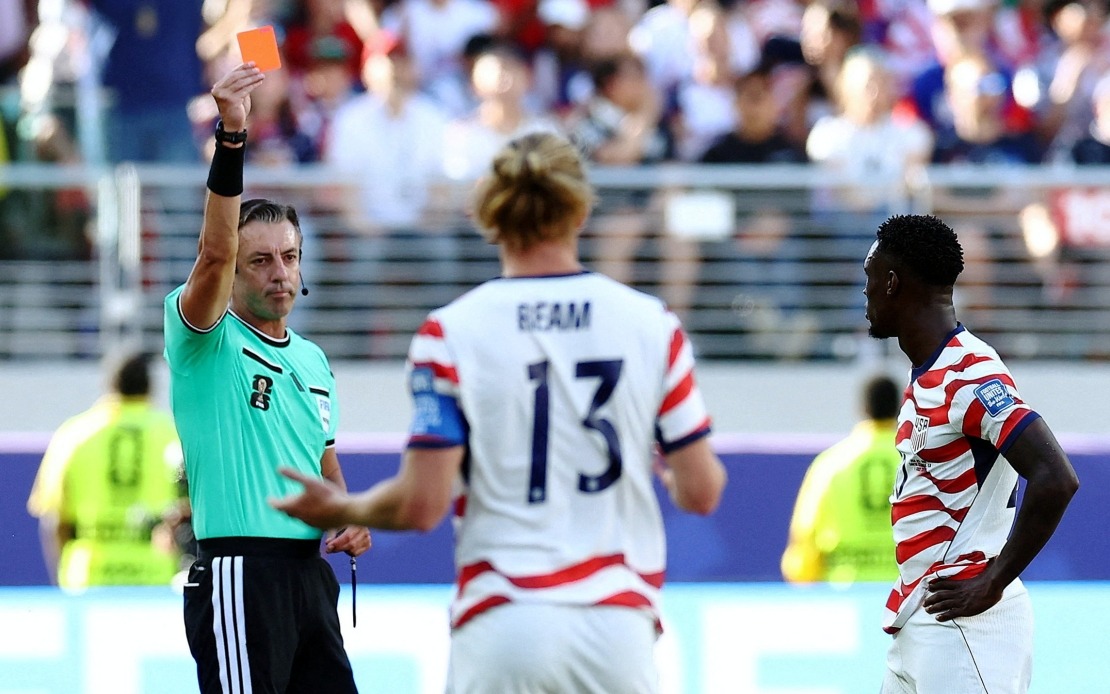
FIFA's referees' chief Pierluigi Collina has publicly endorsed Brazilian match official Raphael Claus following scathing criticism from United States President Donald Trump, who labeled the referee's decision-making as "suspect" in a high-profile World Cup incident. The intervention by soccer's global governing body underscores the mounting pressure faced by officials when their calls draw scrutiny from world leaders, while also highlighting FIFA's determination to shield its match officials from political interference.
Trump's complaints centered on Claus's handling of the last-32 encounter between the United States and Bosnia and Herzegovina, where American striker Folarin Balogun received a red card following a VAR review. The dismissal, which came during a critical knockout-stage match, prompted immediate backlash from the US president, who viewed the ruling as unjust and indicative of potential bias. The incident gained further prominence after Balogun's suspension was controversially overturned the following day, enabling the player to participate in the subsequent last-16 fixture against Belgium—a match the Americans ultimately lost 4-1 in Seattle.
In a carefully worded statement, FIFA positioned Claus as one of the tournament's most accomplished officials, describing him as "one of the world's leading professional referees and a valued member of Team One" at the World Cup. The organization emphasized that throughout his career, Claus has "consistently demonstrated the highest standards of professionalism and integrity," framing the defense in terms that deflect from the specific incident while reaffirming the referee's overall track record and credibility. This strategic response illustrates how international sports bodies manage reputational crises involving their personnel when faced with public censure from powerful figures.
Collina's personal endorsement carried particular weight, given his role overseeing referee operations and his own legendary status as one of soccer's greatest match officials during his playing era. The Italian confirmed that Claus is appearing at his second FIFA World Cup, having previously worked during the Qatar tournament in 2022, and stressed that FIFA maintains "full confidence in him as a trusted match official." By invoking Claus's experience and previous selection for major tournaments, Collina attempted to establish that the Brazilian's credentials had withstood rigorous vetting processes and international scrutiny.
The controversy raises questions about how referee decisions intersect with political power and media narratives, particularly when matches involve teams from countries with influential leaders. Trump's direct criticism and his reported personal request to FIFA president Gianni Infantino to "review" the Balogun red card decision marked an unusual instance of executive-level intervention in sporting matters. Such pressure, whether explicitly or implicitly, risks undermining the independence that match officials require to make impartial calls based solely on the rules of play.
Infantino himself issued a broader statement defending the referee corps without specifically naming Claus, instead offering a general tribute to "Team One" and reiterating that officials had been "selected through a rigorous process which considered their skills, consistency, and quality over a sustained period." The FIFA president's strategy appeared designed to defuse tension while signaling that the organization would not allow external political pressure to dictate its personnel decisions or override established protocols. His assertion that "we must respect the referees and respect the rules that govern our game" served as an implicit pushback against Trump's criticism.
Crucially, Claus has not been sidelined following the controversy—instead, speculation has emerged that he could potentially be selected to referee the tournament's final match, a position typically reserved for elite officials. Brazil's exit from the competition at the last-16 stage eliminates any perception of bias based on national interest, theoretically clearing a path for Claus's appointment to the sport's most prestigious annual match. Such a selection would constitute a powerful statement from FIFA that the organization stands behind its officials despite external criticism.
For Malaysian and Southeast Asian readers, this episode carries implications beyond the immediate World Cup context. Referees across regional tournaments routinely face similar pressures from political figures, national football associations, and passionate supporters when controversial decisions are made. The principle that FIFA is defending—the independence and authority of match officials—remains fundamental to sporting integrity throughout the region. When officials know their decisions may be subject to political review or public rebuke from world leaders, the incentive structure shifts in ways that potentially compromise the sport itself.
The incident also underscores how major international sporting events have become extensions of diplomatic and political relationships between nations. When a US president feels compelled to weigh in on a refereeing decision involving his country's team, it reflects broader expectations among stakeholders that their influence should translate into favorable outcomes on the field. FIFA's defense of Claus, therefore, represents a necessary assertion that sporting outcomes cannot and should not be determined by who exercises greater political leverage.
Looking ahead, the handling of this situation may establish precedent for how FIFA addresses future controversies involving high-profile figures and controversial match decisions. Should the organization have yielded to Trump's pressure, it would have signaled that political intervention could sway disciplinary matters, thereby weakening referee authority globally. Instead, by standing firm—yet remaining diplomatic in its public communications—FIFA has attempted to preserve the principle that officials answer to the sport's governing bodies, not to external political demands, however influential the source.

