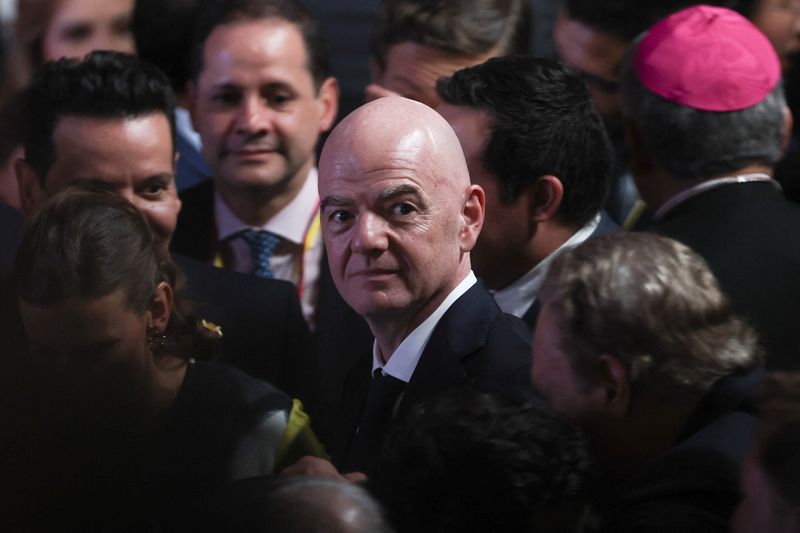
FIFA has moved to shield President Gianni Infantino from escalating criticism by issuing a formal warning against what it characterizes as a systematic effort to destabilize his tenure. The statement, released on Saturday, represents an unusually forceful show of institutional backing for the embattled leader as he faces mounting pressure from several quarters within international football's governance structure. The FIFA leadership has invoked the organization's constitutional framework to delegitimize challenges to Infantino's authority, suggesting that opposition must operate through established democratic channels rather than public campaigns.
The crisis roiling FIFA stems fundamentally from the catastrophic failure of Infantino's ambitious proposal to monetize World Cup broadcasting and commercial rights by selling a stake in the tournament's future earnings—a plan designed to generate approximately $4.2 billion. The initiative collapsed amid fierce backlash from multiple constituencies within world football, exposing deep fractures in the support that Infantino had cultivated since assuming the presidency. The European football confederation UEFA, which represents some of the sport's most powerful national associations, has publicly withdrawn its confidence in the FIFA leader. Meanwhile, prominent individual federation officials, including Norwegian Football Federation President Lise Klaveness, have called explicitly for his resignation, arguing that Infantino has forfeited the institutional legitimacy required to lead a global governing body.
Without naming specific adversaries or identifying which publications and reports FIFA considers problematic, the organization's statement rejects what it terms "unsubstantiated assertions and demonstrably false claims" about Infantino and FIFA itself. The comment appears directed toward recent investigative reporting by The Daily Telegraph, which has detailed payments UEFA made to a former employee during Infantino's tenure as the European body's general secretary. Infantino has categorically denied any wrongdoing related to these transactions, and FIFA has similarly dismissed the allegations as baseless. The defensive posture suggests that FIFA's leadership perceives the media narrative as threatening to Infantino's political survival within the organization.
The organization has promised to contest inaccurate or misleading reporting with vigorous counterclaims, signaling an intention to manage public perceptions aggressively during this turbulent period. FIFA has also reiterated its commitment to ensuring that any future presidential election proceeds exclusively through its established statutory mechanisms and democratic processes. The statement emphasizes that Infantino was elected by member associations and retains their mandate, a claim that becomes increasingly problematic as prominent confederations and individual federations withdraw their support. This rhetorical assertion of democratic legitimacy contrasts sharply with the reality of splintering support across football's major regional blocs.
A critical turning point in this power struggle emerged during a crisis meeting convened in Morocco on Wednesday, where FIFA's leadership formally apologized to its 211 member associations for mishandling the commercial rights proposal. The gathering simultaneously served to reaffirm full institutional backing for Infantino, suggesting that core FIFA leadership remains committed to preserving his presidency despite the public controversy. This crisis convocation underscores how rapidly the situation has deteriorated—the organization felt compelled to stage a show of unity precisely because unity was visibly fracturing. The Morocco meeting revealed that FIFA's internal power structure, particularly among senior officials and continental confederations outside Europe, remains substantially aligned with Infantino's continued leadership.
The political geography of support and opposition has crystallized in revealing patterns. Africa's football confederation CAF provided unanimous backing for Infantino on Thursday, reflecting his considerable popularity across the African continent. South America's CONMEBOL confederation similarly rejected any effort to remove him that bypassed a full member vote, effectively protecting his position by insisting on procedural correctness. Mexico's football federation has also backed the FIFA president, even as its regional confederation CONCACAF called for a comprehensive reckoning with his record. These divisions within and between confederations illustrate how deeply fragmented international football governance has become, with Infantino's tenure exposing structural tensions between regional power bases and between different generations of football administrators.
Infantino's bid for a fourth consecutive term at the FIFA Congress scheduled for Morocco in March represents the critical test of his political viability. No credible challenger has yet emerged to contest the presidency, despite the public calls for his removal from UEFA and various national associations. This vacuum reflects both the difficulty of mobilizing unified opposition within FIFA's unwieldy 211-member structure and the genuine support that Infantino maintains among many confederations. The March Congress will reveal whether the growing vocal criticism from Europe and individual federations translates into actual voting strength, or whether Infantino's continental coalition, particularly in Africa and South America, remains sufficiently cohesive to secure reelection.
The underlying struggle encompasses not merely personality or individual competence, but fundamental questions about FIFA's governance model and its relationship to commercial exploitation of world football's premier competitions. The failed World Cup monetization scheme reflected Infantino's vision for FIFA's financial future, and its rejection signals resistance to his strategic direction. Yet the organizational and procedural weapons available to his opponents remain limited, constrained by FIFA's statutes and by the reality that opposition to Infantino's reelection must be constructed from confederations with conflicting interests and competing regional agendas. The organization's defensive posture suggests that FIFA's leadership hierarchy recognizes the severity of the legitimacy crisis while believing that procedural fortifications can contain the political damage.
For Southeast Asian football administrators and national associations, the developments carry subtle but significant implications. These federations, while lacking the political weight of European or South American confederations, will ultimately participate in the March Congress vote. The crisis also raises fundamental questions about FIFA's capacity to manage complex financial arrangements and to maintain confidence among its constituent members. A Infantino reelection would validate his leadership model despite the controversy, while his defeat would signal that even a sitting president lacks sufficient support to overcome institutional resistance to his agenda. The outcome will likely shape FIFA's governance approach for years to come, influencing how future presidents can pursue ambitious financial or organizational initiatives.

