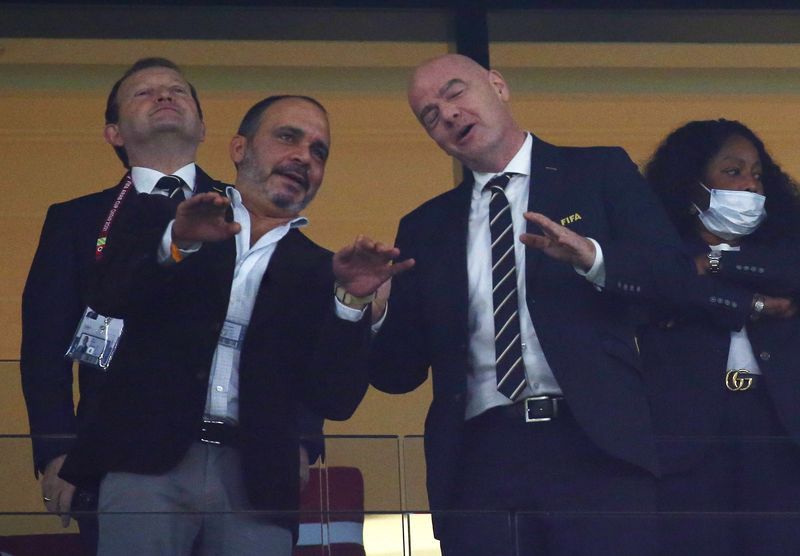
The Jordan Football Association has finally received outstanding prize payments for its national team's participation in December's Arab Cup tournament in Qatar, with the funds arriving just days after the federation's president levelled serious allegations of quid pro quo dealings at world football's governing body. Prince Ali bin Hussein, who chairs the JFA, confirmed the payment on Thursday, marking an abrupt resolution to what had become a high-profile diplomatic friction point between a regional federation and FIFA's central administration ahead of critical leadership elections.
The eight-month delay in disbursing money owed to Jordan's players and coaching staff for reaching the Arab Cup final represented only one facet of a broader grievance. Prince Ali had publicly accused FIFA of employing what amounts to coercive negotiation tactics, specifically claiming that the governing body had offered assistance with the association's various challenges in exchange for his personal endorsement of FIFA President Gianni Infantino. The accusation emerged as Infantino faced mounting pressure from confederations and member associations over his abandoned proposal to monetize World Cup commercial rights, a plan that triggered significant backlash across global football.
The Jordan federation chief alleged that during discussions at the World Cup, FIFA officials had conveyed to him that backing Infantino's leadership "would go a long way to helping our FA out." This framing transforms what might otherwise appear as bureaucratic delay into something far more troubling—a suggestion that financial benefits owed under tournament rules could be contingent on political loyalty. The timing of the payment, occurring within forty-eight hours of these public accusations, lends credence to the perception that FIFA moved only once the issue was thrust into the international spotlight.
Prince Ali's position within Middle Eastern and broader Asian football circles carries particular significance for FIFA's current institutional moment. As a member of the AFC and a respected figure across multiple continental confederations, his withdrawal of support—or explicit opposition to Infantino—carries real political weight as the organisation heads toward its next presidential election cycle. His stated refusal to endorse or vote for the incumbent sends a clear signal that the incident has damaged FIFA's standing among at least some significant regional powerbrokers, particularly those with leverage in Asian and African voting blocs.
The timing of FIFA's conciliatory payment also reflects the organisation's broader credibility crisis. Just days earlier, following a crisis meeting in Morocco, FIFA's leadership acknowledged making mistakes with the commercial rights proposal while simultaneously reaffirming its confidence in Infantino. The swift payment to Jordan appears designed to contain a growing perception that FIFA operates transactionally rather than according to transparent rules. By resolving the outstanding obligation quickly after public complaint, the organisation sought to prevent Prince Ali's accusations from gaining further traction among other federation leaders who might harbour similar grievances about delayed payments or conditional assistance.
For Southeast Asian football observers and administrators, the Jordan situation illustrates systemic vulnerabilities within FIFA's governance architecture. The eight-month delay itself raises questions about administrative competence, but the more disturbing implication is whether financial incentives routinely become intertwined with political demands across FIFA's broader operations. Smaller confederations and developing football associations may feel particular vulnerability to such dynamics, given their dependence on FIFA funding and tournament revenue. Malaysia and other regional football bodies operate within this same ecosystem and face decisions about their positions on FIFA leadership matters during voting periods.
Prince Ali's explicit distinction between welcoming the payment and maintaining his opposition to Infantino's leadership demonstrates sophisticated political calculation. By accepting the funds while refusing to alter his voting position, he prevents FIFA from claiming that the resolution settled the underlying dispute. Instead, he has framed the payment as belated acknowledgement of an obligation, not as compensation that should purchase political loyalty. This stance preserves his credibility with other federation leaders who may have felt similarly aggrieved but who lacked Prince Ali's profile to voice concerns publicly.
The broader context involves FIFA's troubled governance during Infantino's tenure. The abandoned World Cup commercialisation proposal emerged from an attempt to expand FIFA's revenue streams, but it provoked a coalescence of opposition from confederations concerned about accountability and the distribution of football revenues. This episode revealed that significant sections of FIFA's membership harbour doubts about the current administration's direction. Prince Ali's accusations transform what could have remained an internal administrative matter into a public allegation about FIFA's ethical decision-making processes.
FIFA's decision to offer no substantive response to the blackmail allegations—requesting no comment from the governing body—suggests institutional defensiveness. A more confident leadership might have either firmly rejected the characterisation or provided detailed explanation of the payment delay. The silence permits multiple interpretations, none favourable to FIFA's public standing. International football governance already faces scrutiny regarding corruption, financial irregularities, and political interference; incidents like this reinforce perceptions that informal arrangements and conditionality influence how FIFA distributes resources and handles federation relationships.
Moving forward, the incident establishes a precedent whereby federation leaders facing unexplained delays in prize money disbursements or tournament funding can point to the Jordan example as evidence that public criticism generates rapid administrative attention. This dynamic threatens to make FIFA's financial systems appear reactive and politically motivated rather than governed by consistent policy. For Malaysian football stakeholders and administrators across Asia-Pacific, the case underscores the importance of strong governance frameworks within the AFC and independent accountability mechanisms that might insulate regional football from pressure tied to FIFA's internal leadership competitions.

