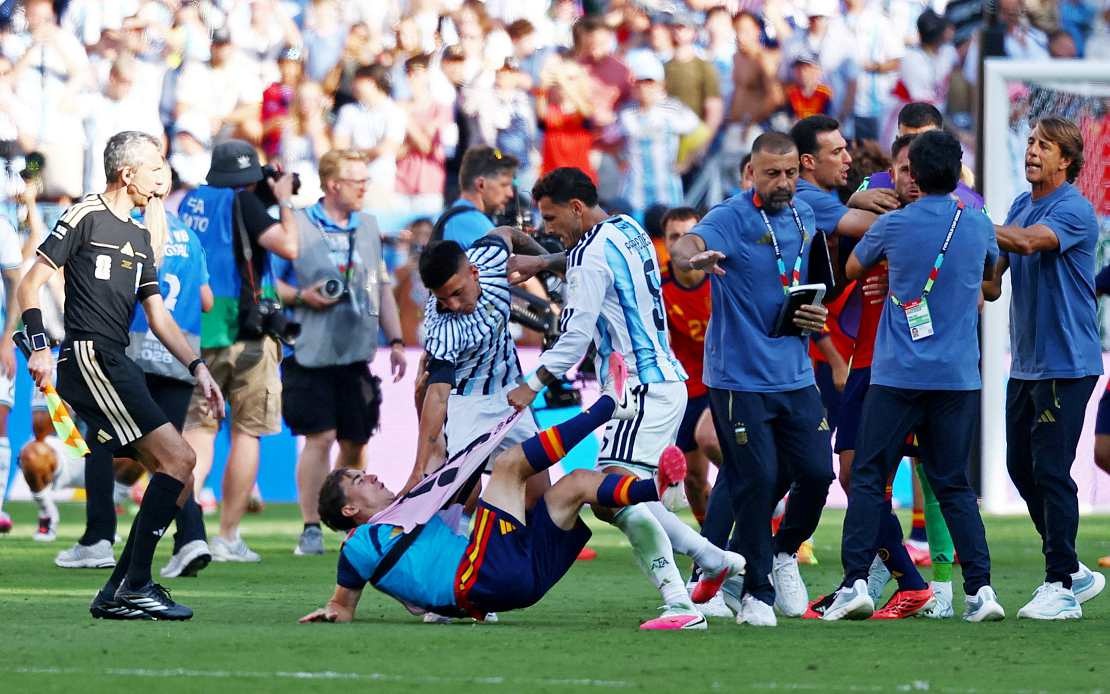
Football's governing body FIFA has initiated formal disciplinary proceedings against Argentina following their World Cup final defeat to Spain, assigning a dedicated prosecutor to examine alleged breaches of tournament conduct regulations. The decision came after FIFA reviewed detailed match commissioner reports documenting incidents that occurred both during and immediately after the final whistle in New Jersey. Argentina midfielder Leandro Paredes was observed appearing to throw punches at Spanish players as they celebrated their victory, an act that prompted the disciplinary committee to invoke Article 36 of the FIFA disciplinary code and launch a comprehensive investigation into potential rule violations.
The investigation represents part of a broader pattern of scrutiny surrounding Argentina's physical style of play throughout the tournament. During their semi-final clash against England, Argentina drew criticism for their combative approach, with midfielder Enzo Fernandez receiving a red card following two bookable offences. This aggressive tactical approach, while effective in securing victories, has become a focal point for disciplinary concerns among match officials and FIFA observers monitoring player conduct standards across the competition.
FIFA's formal statement confirmed that the Disciplinary and Ethics Prosecutor will thoroughly examine all potential breaches of the disciplinary code related to post-match incidents. The investigating body pledged to communicate additional details once the prosecutor completes their comprehensive report and presents findings to the disciplinary committee. This methodical approach reflects FIFA's established protocol for handling complex disciplinary matters that may involve multiple players and require detailed analysis of match footage and eyewitness accounts.
Beyond the immediate post-match incidents, uncertainty remains regarding whether FIFA intends to investigate Argentina's actions following their victory over England, specifically the hoisting of a banner asserting Argentine sovereignty over the Falkland Islands. Such a display would constitute a direct violation of Article 34.3 of the tournament regulations, which prohibits political messaging at World Cup matches. The AFA previously incurred financial penalties for an identical action during a 2014 friendly encounter with Slovenia, establishing precedent for treating such conduct as a disciplinary matter.
FIFA's approach to political gestures has historically been stringent and uncompromising. The English Football Association faced explicit warnings that captain Harry Kane would encounter sporting sanctions, beginning with a mandatory yellow card, if he wore the 'OneLove' rainbow-coloured armband at the 2022 World Cup in Qatar, a nation where homosexuality remains legally criminalised. This position underscores FIFA's general stance prioritising sport over broader social and political messaging, regardless of the cause's humanitarian intent or international support.
The contrast with UEFA's recent enforcement illustrates varying interpretations across football's governance structure. Following Euro 2024, UEFA imposed one-match suspension bans on Spanish players Rodri and Alvaro Morata after they engaged in chanting celebrating Spain's territorial claims to Gibraltar. This considerably harsher penalty compared to FIFA's historical financial fines suggests that UEFA applies more severe consequences to political expression during its competitions, potentially creating inconsistent enforcement standards within international football.
For Malaysian and Southeast Asian football followers, the investigation signals that FIFA maintains vigilant oversight of player conduct regardless of a nation's profile or tournament success. The incident underscores how international sports governance intersects with geopolitical sensitivities, with teams navigating complex regulations surrounding acceptable behaviour. Argentina's situation demonstrates that reaching the World Cup final provides no exemption from disciplinary accountability, a principle that applies uniformly across all participating nations.
The outcome of FIFA's investigation carries implications extending beyond Argentina's immediate squad. Potential sanctions could influence how other nations approach celebrating victories and expressing national sentiment during future tournaments. Should FIFA impose meaningful penalties against Argentina players, it would reinforce the organisation's commitment to enforcing conduct standards, though critics might argue such enforcement lacks consistency when compared to UEFA's parallel actions or FIFA's selective application of political expression rules.
Argentina faces the prospect of individual player suspensions, team-level penalties, or financial fines depending on the prosecutor's findings and the disciplinary committee's judgment. The severity of any sanction remains uncertain pending completion of the investigation, though precedent suggests FIFA may combine multiple penalty types rather than relying on singular disciplinary measures. The AFA will likely mount a detailed defense articulating contextual factors surrounding the alleged incidents while emphasizing their commitment to maintaining sportsmanship standards.
As FIFA proceeds with its investigation, the football world awaits clarity on how the organisation intends to balance enforcing conduct codes against respecting cultural expressions and national pride. The case illustrates enduring tensions between sport's aspiration toward political neutrality and the reality that athletes represent nations carrying deep historical, territorial, and geopolitical dimensions. Argentina's disciplinary proceedings will establish or reaffirm precedent for handling similar situations in forthcoming tournaments, potentially shaping how teams approach celebration protocols and national expression at future World Cups.

