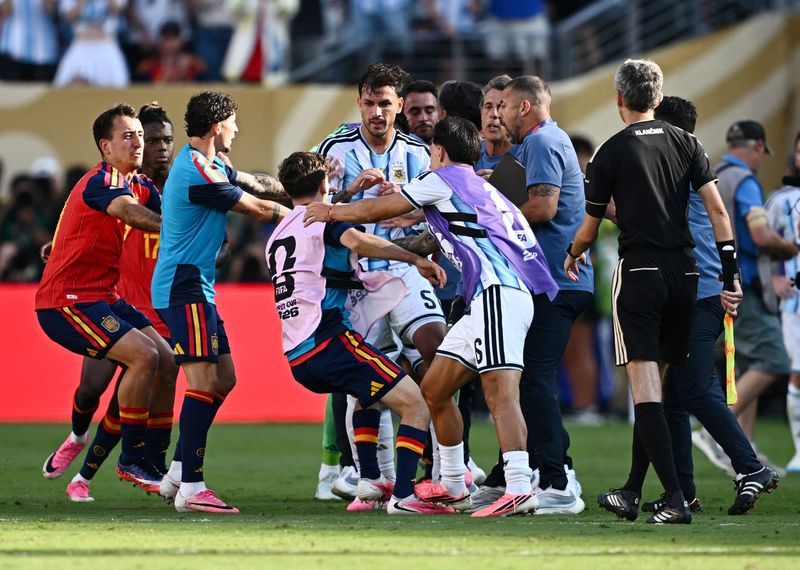
Football's international governing body FIFA has formally initiated a disciplinary inquiry into the violent confrontation that broke out immediately after Spain's 1-0 victory over Argentina in an emotionally charged World Cup final. The decision to launch the investigation underscores how seriously the sport's administrators view the incident, which marred what should have been a celebration of Spain's second world championship. A dedicated disciplinary and ethics prosecutor has been assigned to examine the circumstances surrounding the clash and determine whether further sanctions are warranted against the players involved.
Spain secured their tournament-winning goal through winger Ferran Torres in the extra-time period, denying Argentina a chance to claim their third World Cup title. However, the match had already grown tense after Argentina midfielder Enzo Fernandez received a red card in the 93rd minute of regular play for accumulating two yellow cards, leaving the South American side with ten players on the pitch for the final portion of the encounter. This numerical disadvantage intensified the frustration among the Argentine squad as the match progressed toward its conclusion.
When the final whistle sounded, the long-simmering tensions between the two teams exploded into open conflict. Argentine midfielder Leandro Paredes initiated the confrontation by engaging several Spanish players in physical altercations, with Spanish defender Eric Garcia and midfielder Gavi among those directly involved in the initial clash. What began as a localized dispute rapidly escalated into a broader melee, as players from both benches rushed onto the field, resulting in multiple simultaneous confrontations between teammates of opposing nations.
The scale and intensity of the brawl required intervention from multiple officials and coaching staff. Both squads engaged in pushing, shoving, and aggressive physical contact that extended well beyond typical post-match handshake protocols. Argentina's head coach Lionel Scaloni made efforts to restore calm among his players and de-escalate the volatile situation, aware that the incident was unfolding before a global audience and risking severe disciplinary consequences for his team.
For Malaysian and Southeast Asian football fans, this incident carries particular significance given the region's passionate engagement with international football. The controversy highlights how heightened emotions in major tournaments can override the professional standards expected of elite athletes, a concern that extends to domestic leagues across the region. The investigation will likely set precedents for how FIFA handles similar incidents in future competitions, potentially influencing disciplinary standards that affect teams from Asia-Pacific nations competing in global tournaments.
The formal appointment of a dedicated prosecutor signals that FIFA considers the matter serious enough to warrant a thorough, independent examination rather than a cursory review. This approach demonstrates a commitment to maintaining standards of player conduct, though it also reflects concerns that allowing such incidents to pass without proper scrutiny could normalize aggressive behaviour in high-stakes matches. The complexity of determining which players were primarily responsible, versus those caught up in the broader melee, will likely complicate the investigator's task.
Historically, FIFA has faced criticism for inconsistent disciplinary responses to similar incidents, with observers frequently noting that penalties appear disproportionate or politically influenced. The involvement of a dedicated ethics prosecutor in this case suggests an attempt to establish clearer accountability mechanisms, though the lack of a specified timeline for concluding the investigation leaves considerable uncertainty about when outcomes will be announced. This delay could itself become controversial, particularly if affected players face uncertainty regarding their availability for upcoming club matches or international competitions.
The incident also raises broader questions about tournament intensity and player welfare. When matches reach elimination stages with reduced player counts due to red cards, the psychological and physical strain on remaining players intensifies significantly. Argentina's numerical disadvantage in the final minutes may have contributed to elevated frustration levels, though this does not excuse the physical confrontations that followed. Understanding these contextual factors will be essential for FIFA's investigator in determining appropriate sanctions.
For Spanish and Argentine football communities, the investigation outcome will carry deep symbolic weight beyond mere disciplinary consequences. Both nations have storied World Cup histories and passionate supporter bases, and how their players are treated in the investigation may influence public perception of FIFA's neutrality and fairness. The organisation faces pressure to demonstrate that large football nations receive equivalent treatment to smaller footballing nations when violations occur.
The brawl stands as a sobering reminder that even at sport's highest levels, maintaining professionalism under extreme pressure remains challenging. Players who have trained their entire lives to excel in these moments must also manage their emotional responses when outcomes hang in the balance. FIFA's investigation will ultimately determine whether suspensions, fines, or other penalties are warranted, setting important expectations for future tournaments hosted across Asia, Europe, and beyond.

