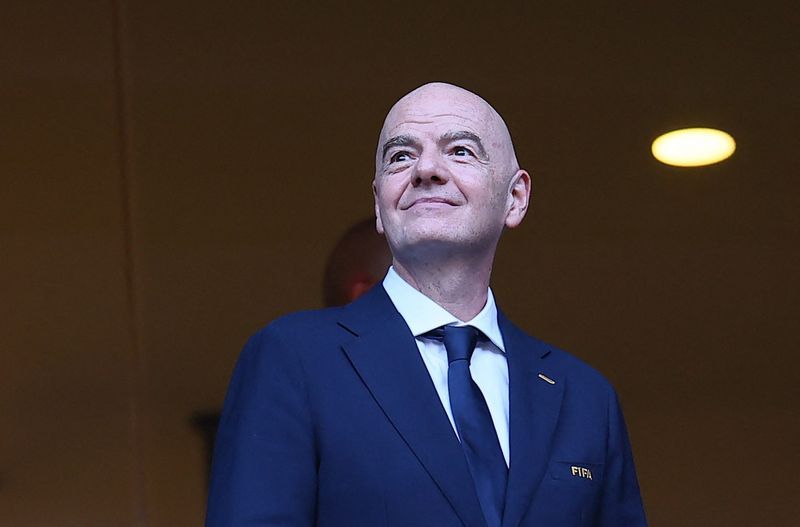
FIFA President Gianni Infantino's grip on power has been severely weakened following the dramatic collapse of his plan to raise $4.2 billion through the sale of World Cup commercial rights to private investors. The 56-year-old Swiss-Italian administrator abandoned the proposal late Friday after three days of unprecedented turmoil within global football's governing body, but the fallout has proven far more damaging than a simple withdrawal. According to reports in the Times of London on Monday, three major regional confederations—UEFA (Europe), CONCACAF (North and Central America and the Caribbean), and the AFC (Asia)—have privately united with the explicit aim of forcing Infantino from office before his term expires in 2031.
The immediate shock to Infantino's position stems from his catastrophic failure to consult major stakeholders before unveiling the scheme. The proposal would have represented the first time private capital entered World Cup financing, fundamentally altering the tournament's ownership structure. UEFA and CONCACAF issued scathing statements on Saturday expressing lost confidence in his leadership, while the AFC—traditionally more aligned with FIFA's power structure—stopped short of direct condemnation but called the lack of consultation "totally unacceptable" and demanded institutional reforms. This coordinated criticism from three confederations controlling the majority of global football infrastructure signals a coordinated challenge to Infantino's authority that his predecessors rarely faced.
The formal positions declared so far remain limited in scope. Five European national associations including England's FA have formally withdrawn their support for Infantino's reelection scheduled for the FIFA Congress in Morocco in March, while Denmark indicated it would never have voted for him regardless. Conversely, the football associations of Morocco, Qatar, Kuwait, Lebanon and Sri Lanka have publicly pledged continued backing. With 211 national federations holding voting rights at Congress, these declarations represent only a fraction of total voting power. However, the sudden shift in confederation-level support carries disproportionate weight, as these organisations command considerable influence over their member states' voting decisions.
Infantino's immediate tactical priority centres on preventing the convening of an Extraordinary Congress. Should 43 or more FIFA member associations formally petition for such a session, procedures would be triggered that could accelerate his removal or force a confidence vote outside the scheduled March election. This threshold creates both vulnerability and opportunity: the diverse interests within the 211 national federations mean achieving sufficient signatures for an extraordinary session requires substantial coordination, yet the damage to Infantino's credibility has already created an opening for opposition forces to mobilise. He has seven months to repair fractured relationships and consolidate support among wavering confederations and their member states.
The strategic foundation of Infantino's political survival has historically relied on cultivating powerful allies among less prosperous football nations outside Europe, who depend heavily on FIFA financial distributions to maintain domestic operations. Unlike his predecessors Joao Havelange and Sepp Blatter, Infantino recognised that European associations, while influential, represented only one segment of global football's political economy. His failed World Cup privatisation scheme was specifically calibrated to appeal to these financial dependencies, with promises of dividends between $20 million and $40 million annually for each supporting nation beginning in 2025. By pitching the plan directly to these associations without consulting UEFA, CONCACAF or AFC leadership, Infantino miscalculated the tolerance of confederation leaders for unilateral decision-making affecting their members' interests.
The institutional damage extends beyond personnel politics. UEFA has sent FIFA a formal "document preservation letter" demanding retention of all materials related to Infantino's proposal, signalling that European confederation remains prepared to pursue legal proceedings. This threat of litigation over governance and procedural failures introduces a second front in the broader challenge to Infantino's position, one that extends beyond the electoral arena into court systems. The preservation letter essentially locks FIFA's records and prevents document destruction that might obscure decision-making processes or communications that could later prove embarrassing or incriminating.
Opponents seeking to replace Infantino face a November 18 deadline for nominations and must identify a candidate capable of bridging the conflicting interests now openly dividing global football. The opposition candidate must simultaneously appeal to less wealthy associations dependent on FIFA distribution systems while maintaining credibility with prosperous European confederations that value governance reform and transparency. This dual requirement eliminates many obvious candidates and explains why, despite clear dissatisfaction with Infantino, no credible replacement figure has yet emerged publicly. The compressed timeline between now and the nomination deadline severely constrains the opposition's ability to coalesce around a unified alternative.
For Southeast Asian football, particularly Malaysia and the AFC region, the unfolding crisis carries important implications for FIFA's financial governance and distribution mechanisms. The AFC's carefully calibrated criticism—neither fully supporting nor condemning Infantino—reflects the confederation's strategic position as a bridge between European powers and smaller nations dependent on FIFA funding. Should Infantino survive to March or be replaced by a new president, the AFC's moderating role throughout this crisis positions it to extract concessions regarding financial transparency and consultation protocols affecting its 47 member associations. The confederations' threat to establish alternative competitions should Infantino refuse to step down represents an existential challenge that could fracture global football's regulatory unity.
The peculiar vulnerability of Infantino's position stems partly from his own success in centralising FIFA authority. His predecessors operated within more distributed power structures where confederation leaders maintained greater autonomy. Infantino's personalised approach to governance—reflected in unilateral decision-making on commercial rights—left him exposed when major stakeholders felt excluded from consequential decisions affecting their interests. The attempted privatisation scheme, which would have dramatically enriched FIFA while offering selected nations temporary bonuses, exposed the philosophical tension between FIFA's role as administrator of international football and as a vehicle for extracting commercial value from the sport's most prestigious competition.
Ahead of the March Congress, Infantino must also manage the symbolic dimensions of his retreat. His apology for how the proposal "divided the game" acknowledges responsibility while avoiding admission of strategic error. Yet this carefully calibrated messaging may prove insufficient to convince confederations that his governance approach has fundamentally changed. The three confederations' reported coordination suggests they are prepared to sustain pressure throughout the remaining months, potentially coordinating their member associations' positions and preventing Infantino from individually negotiating his way out of the crisis. Should momentum toward his removal continue building, the confederation unity could prove decisive in determining global football's leadership for the next electoral cycle.

