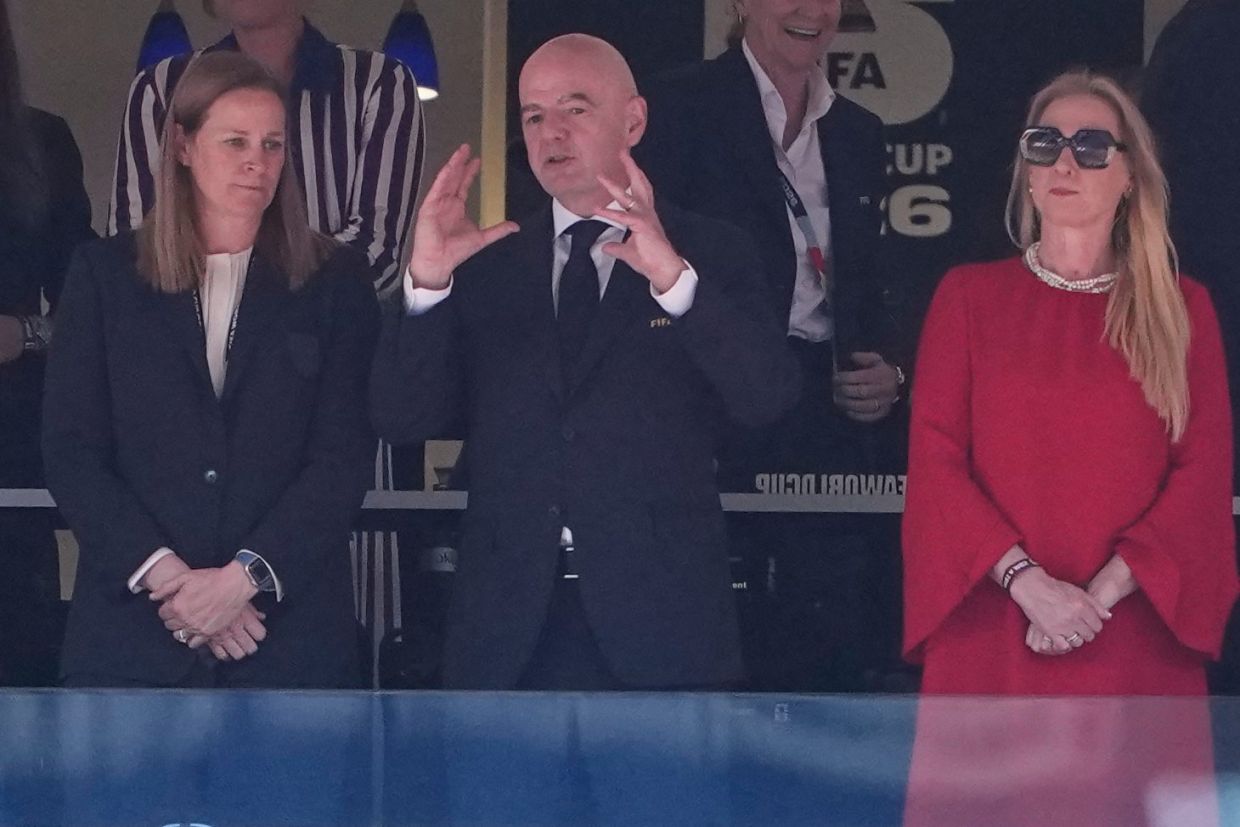
Beneath the swirl of recriminations and allegations surrounding the 2026 World Cup, one inescapable reality has crystallized: FIFA is wealthier and more politically resilient than ever before. The tournament has been buffeted by criticism from nearly every direction—exorbitant ticket pricing, the controversial treatment of the Iranian delegation, the rejection of a Somali referee, and a dubious peace prize awarded to an American political figure—yet the organisation's leadership, under administrator Gianni Infantino, has emerged substantially strengthened rather than weakened by these tribulations.
The latest flashpoint illuminated FIFA's capacity to weather storms that would typically threaten institutional credibility. After intense diplomatic pressure, FIFA permitted a suspended American player to compete, triggering outrage internationally from those who viewed the decision as a capitulation to political coercion. Sports law expert Nick De Marco crystallized the deeper anxiety: the incident transcended the narrow question of whether the original dismissal was correct, instead exposing whether FIFA has fundamentally compromised the World Cup's legitimacy and its own regulatory authority over global football.
Yet such objections evaporate with remarkable speed once competitive action concludes. The furore surrounding the American player's participation dissipated almost immediately following a decisive Belgian victory, demonstrating how sporting spectacle overwhelms institutional critique. Infantino has demonstrated singular focus on FIFA's paramount mission: maximising revenue across all tournaments and related activities. The numbers tell a compelling story of commercial triumph: the 2026 World Cup is projected to generate approximately $9 billion in direct income for FIFA, representing a $2 billion increase compared to Qatar 2022. This financial acceleration occurs precisely as questions about governance, integrity, and political independence intensify.
The expanded tournament format—mushrooming from 32 to 48 participating nations—has proved a masterstroke of revenue generation. Prize distributions have doubled to an unprecedented $871 million total, guaranteeing every participating nation a minimum $12.5 million participation fee. Smaller football associations, particularly from the developing world, have found these payouts transformative for their operations. Cape Verde's remarkable tournament performance generated over $21 million, equivalent to roughly 0.75% of the island nation's entire gross domestic product. For football federations across Africa, Asia, and South America, FIFA's enlarged financial commitments have become indispensable to their institutional functioning.
The profit cascade extends far beyond FIFA itself. Venue food and beverage operators have recorded extraordinary earnings, with individual spectators spending up to $100 per match—nearly double typical National Football League outlays. Mandatory hydration breaks, implemented ostensibly for player welfare but conveniently aligned with advertising intervals, have transformed the traditional match structure into an American-style format with four distinct commercial breaks rather than two halves. Broadcasters and corporate sponsors have benefited substantially from these incorporated pauses. Host cities initially expressing budgetary anxieties have witnessed unexpected economic gains, with Bank of America analysis revealing year-on-year credit and debit card expenditure increases of 6.3% in World Cup host cities during mid-June, while spending by non-resident visitors surged 16.7%.
Infantino's accumulation of authority proceeds largely unimpeded by institutional checks. The FIFA administrator faces an election scheduled for early 2027 at the 77th FIFA Congress in Rabat, Morocco—itself a 2026 World Cup host nation. Each of FIFA's 211 member associations controls one vote, and Infantino is running unopposed, a status reflecting near-universal backing from federations across Asia, South America, and Africa. This will constitute his third consecutive term, having initially assumed office following Sepp Blatter's 2015 resignation amid the corruption scandal that almost destroyed the organisation's international standing. His path to re-election appears essentially predetermined.
When Infantino initially assumed FIFA's leadership, the organization emerged from profound reputational devastation. United States prosecutors had pursued extensive corruption investigations resulting in numerous arrests and prosecutions among FIFA officials. Infantino's tenure has involved implementing modest transparency reforms and incrementally enhanced governance procedures, yet he has simultaneously concentrated power within executive structures while dramatically expanding FIFA's portfolio of commercial tournaments. This paradoxical trajectory—simultaneous reform and centralisation—has reconstructed FIFA's image without fundamentally redistributing decision-making authority.
The latest controversy involving alleged political intervention demonstrates this tension vividly. After an unnamed American official reportedly contacted Infantino regarding the suspended player's eligibility, political figures from Belgium and the United Kingdom demanded his resignation. Jürgen Klopp, the renowned former Liverpool manager, expressed the underlying frustration with particular clarity: "This is our sport, not theirs. If Donald Trump and Gianni Infantino really sorted this out between themselves, it is madness. It calls everything into question." Such objections, however forcefully articulated by prominent football figures and elected officials, lack institutional mechanisms for enforcement against FIFA leadership.
Conversely, FIFA's core constituent bodies—the continental football confederations and national associations whose votes determine Infantino's political future—have demonstrated consistent resolve in supporting his administration. Sheikh Salman, president of the Asian Football Confederation, declared that "FIFA is in its best position ever." The Royal Moroccan Football Federation praised "the great work carried out by Mr. Gianni Infantino and his team to develop African and world football." These endorsements reflect not merely personal loyalty but rather the substantial financial interest that national federations and continental bodies possess in FIFA's continued expansion of revenue-generating tournaments.
The 2026 World Cup, viewed comprehensively, presents FIFA with an opportunity to characterize the tournament as an unqualified triumph despite evident governance challenges. Stadiums have operated at or near capacity despite ticket controversy. Footballing talent has performed at exceptional levels. The expanded format enabled nine African nations to advance through knockout stages, exceeding historical participation rates. The tournament has benefited from the hospitality and organisational capacity of its host countries, contrasting favourably with the recent editions held in Russia and Qatar, which endured widespread criticism regarding human rights concerns.
FIFA's institutional independence from political accountability mechanisms remains FIFA's defining characteristic. The organisation answers principally to its member federations, whose financial dependence on FIFA revenues creates structural incentives aligned with expanding rather than constraining executive authority. When Infantino eventually stands for re-election in Rabat, the outcome will reflect the preferences of football associations seeking continued access to FIFA's increasingly generous financial distributions. The political pressure exerted by individual governments or prominent figures, however morally justified their criticism, operates outside FIFA's formal decision-making structures and possesses limited capacity to alter outcomes determined by votes within FIFA's congress. As the 2026 World Cup concludes, FIFA departs considerably wealthier, its leadership democratically unchallenged among its constituent members, and its hold over global football seemingly more secure than ever before.

