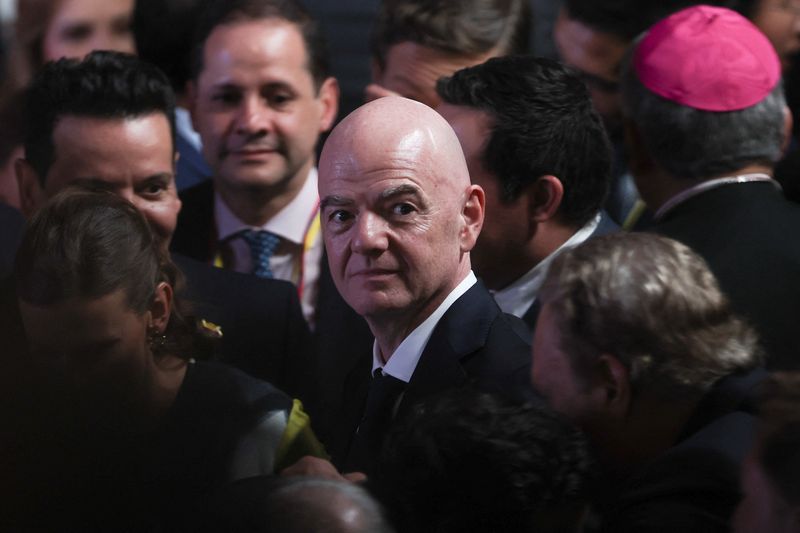
Football's three most powerful continental confederations—UEFA, the Asian Football Confederation and CONCACAF—are actively exploring whether to trigger a no-confidence vote against FIFA President Gianni Infantino, according to senior officials involved in the discussions. The move would be extraordinary in FIFA's 122-year history, as no sitting president has ever faced such a challenge from member associations. The proposal emerged in response to Infantino's controversial attempt to sell a minority stake in a new FIFA commercial entity to private investors, which would have controlled lucrative World Cup rights, triggering a governance crisis within world football's governing body.
The three confederations represent Europe, Asia, and North and Central America respectively, collectively commanding substantial voting power within FIFA's 211-member structure. According to those familiar with deliberations, Infantino faces a stark choice: withdraw from the March 2027 presidential election voluntarily, or confront removal through formal congressional procedures. A source close to the matter told Reuters that supporters of the no-confidence route believe it signals serious intent, though questions persist about whether such a vote could actually succeed given Infantino's existing support among African and other FIFA member associations.
FIFA's governing statutes provide the procedural framework for such action. The FIFA Council possesses authority to convene an Extraordinary Congress at any point, whilst the organisation must call one if at least one-fifth of FIFA's member associations submit a formal written request specifying agenda items. Once convened, this Extraordinary Congress must occur within three months, with each attending association casting a single vote. Notably, FIFA's statutes contain no explicit provision addressing no-confidence procedures against a sitting president, creating uncertain legal territory.
Infantino retains significant backing within FIFA's membership, particularly from Africa's confederation CAF, whose president Patrice Motsepe publicly reaffirmed continental support last week. FIFA's revenue for the 2023-2026 cycle is forecast to exceed $15 billion, with the bulk concentrated in this World Cup year, giving Infantino substantial resources and institutional leverage. Moreover, no credible challenger has publicly declared candidacy ahead of the November 18 nomination deadline, leaving potential reformers without an obvious alternative candidate. Some observers worry that launching an unsuccessful no-confidence challenge could paradoxically strengthen Infantino by demonstrating his electoral resilience.
The investment proposal itself promised substantial benefits to FIFA's membership. Member associations would have accessed up to $20 million in one-off capital for infrastructure development, coaching programmes, national team operations, competition support, grassroots initiatives and women's football expansion. The commercial entity would have generated revenue streams while insulating World Cup operations from traditional FIFA funding mechanisms. However, UEFA, AFC and CONCACAF uniformly opposed the initiative, citing fundamental failures in transparency, stakeholder consultation and governance transparency—criticisms that escalated dramatically this month when FIFA's Chief Operating Officer Kevin Lamour departed amid complaints that staff had been misled about the project's scope and that it represented one individual's personal agenda rather than institutional policy.
Lamour's departure marked a turning point, prompting FIFA Vice President Sandor Csanyi to publicly withdraw support for Infantino, characterising the operational chief's exit as a "final straw" in an accumulating governance crisis. UEFA issued statements calling for "thorough and fundamental" leadership review with "no option off the table," whilst CONCACAF and AFC released a joint statement accusing FIFA's leadership of fundamental trust breaches. Yet despite intense pressure from these confederations, FIFA's leadership has publicly reaffirmed complete support for Infantino, with six Arab football associations, including Qatar and Morocco—co-hosts of the 2030 World Cup—publicly backing the president last week.
For Malaysia and Southeast Asian football stakeholders, this crisis carries significant implications for AFC governance and World Cup qualification processes. The AFC's participation in no-confidence discussions signals serious institutional dissatisfaction, potentially indicating divergence between Asian football's commercial interests and FIFA's centralised control over lucrative tournament rights. Were a no-confidence vote to succeed, it would fundamentally reshape FIFA governance and likely affect how continental confederations negotiate their relationship with the world body regarding revenue sharing, tournament scheduling and player welfare standards—issues directly affecting Southeast Asian national teams and club competitions.
The challenge facing Infantino's opponents extends beyond formal voting procedures. Smaller FIFA member associations, particularly from developing nations, may prioritise immediate financial benefits and FIFA investment commitments over governance reforms advocated by wealthier confederations. Football Association of Malawi President Fleetwood Haiya encapsulated this position when challenging potential challengers to articulate concrete benefits: "Tell us what you are going to bring to Malawi." This reflects genuine concerns among smaller associations that governance reform, however necessary, pales against immediate resource scarcity and infrastructure needs.
Beyond FIFA's formal voting structure, pressure emanates from commercial stakeholders without formal congressional representation. The European Football Clubs organisation, chaired by Paris St Germain president Nasser Al-Khelaifi and representing more than 800 clubs, has aligned with UEFA and reform advocates, threatening club non-participation in future men's and women's Club World Cups unless governance and stakeholder relationship concerns receive serious attention. Though clubs lack FIFA voting rights, they command substantial sporting and commercial leverage capable of disrupting FIFA's prestigious international tournament schedule, creating additional pressure on Infantino's position.
Michael Payne, former International Olympic Committee marketing chief, offered perspective on the broader governance challenge: even if Infantino secured electoral victory through majority support from smaller nations, governing FIFA whilst facing opposition from all major football superpowers would prove substantively difficult. Payne observed that sponsors express bewilderment at FIFA's capacity to execute a successful World Cup commercially whilst simultaneously generating internal governance crises, questioning whether the organisation can effectively manage global football operations amid such institutional fracture.
The no-confidence vote scenario represents only one trajectory among several possibilities. Infantino could withdraw voluntarily before the nomination deadline, effectively removing the issue. Alternatively, formal voting could proceed at the March 2027 Congress, where Infantino's demonstrated support among smaller associations might secure reelection despite major confederations' opposition. What remains clear is that world football's governance structure faces fundamental strain, with no rapid resolution apparent. For Southeast Asian readers, this uncertainty affects AFC's institutional voice within FIFA's hierarchy and, consequently, the confederations' capacity to advocate for regional interests regarding World Cup expansion, qualification formats and financial distributions affecting Southeast Asian national teams and domestic competitions.

