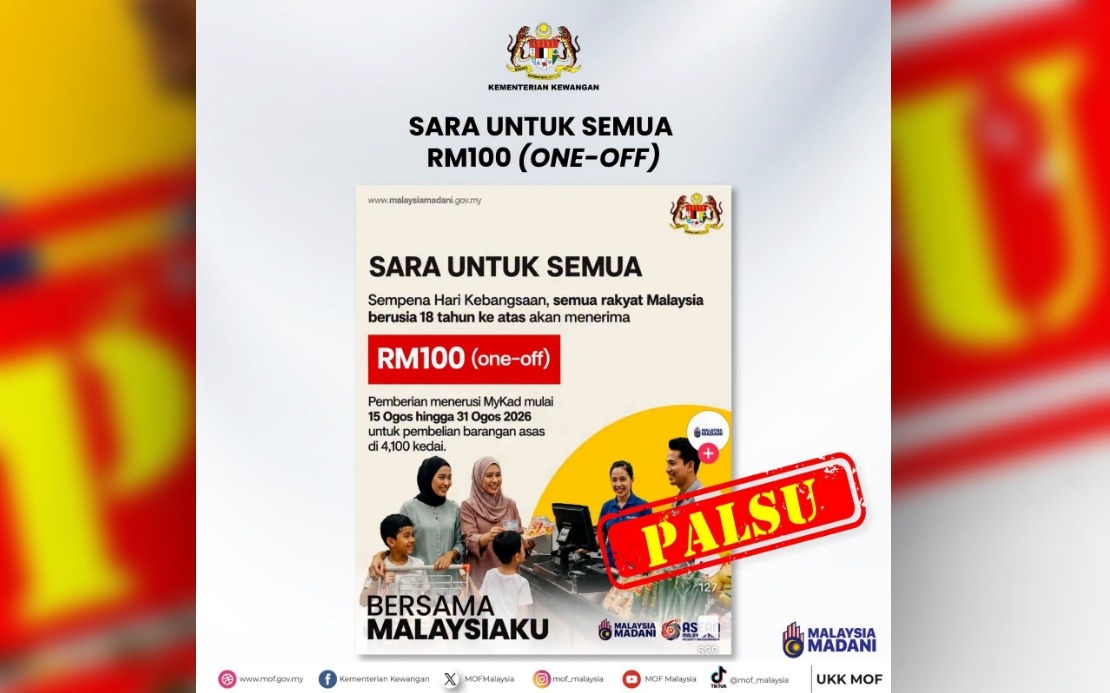
The Ministry of Finance has moved swiftly to debunk widespread misinformation circulating on social media claiming that every Malaysian aged 18 and above will receive a one-time RM100 Sumbangan Asas Rahmah (SARA) payment coinciding with the nation's National Day celebrations. In an official statement released on August 5, the ministry categorically denied the authenticity of the poster being shared across various platforms, emphasising that no such announcement has been authorised or made through proper government channels.
The viral claim, which has gained traction particularly on social media platforms popular among Malaysian users, represents another instance of misinformation that exploits national occasions and public sentiment to spread false narratives about government welfare initiatives. The poster's timing—arriving just before National Day festivities—appears deliberately crafted to lend credibility by associating the alleged payment with patriotic celebrations, a tactic commonly used in disinformation campaigns targeting economically vulnerable segments of the population.
The MOF's response highlights the ministry's ongoing struggle against the proliferation of false financial claims that frequently circulate during peak seasons and national celebrations. These types of fabricated announcements can undermine public confidence in legitimate government assistance programmes and create confusion about actual welfare schemes available to citizens. The ministry explicitly cautioned the public against further dissemination of such materials, recognising the exponential speed at which misinformation spreads through social networks where verification mechanisms remain weak.
This incident underscores the critical importance of media literacy and institutional credibility in Malaysia's digital information landscape. The ministry's guidance directing citizens to access verified information solely through official government channels reflects growing concern about the sophistication of online disinformation. As Malaysia continues to develop its digital infrastructure and online engagement, distinguishing between authentic government communications and fabricated claims has become increasingly challenging for ordinary citizens lacking technical verification skills.
The denial also serves as a reminder that legitimate government financial assistance programmes—including existing SARA initiatives and other targeted subsidies—have specific eligibility criteria, predetermined timelines, and formal announcement procedures that are publicised through established official communication networks. Citizens receiving sudden claims about unexpected payments should exercise healthy scepticism and cross-reference information against official ministry websites, government press releases, and credible news organisations before sharing such claims with others.
From a broader perspective, the prevalence of such fabricated payment claims reflects deeper economic anxieties within Malaysian society. During periods of inflationary pressure and cost-of-living pressures, citizens become increasingly susceptible to messages promising direct financial relief. This vulnerability has been exploited by those creating and spreading misinformation, who understand the appeal of unexpected government handouts and the public's desire to believe in relief measures, particularly when economic conditions feel restrictive.
The Ministry of Finance's proactive approach to addressing this claim demonstrates the government's commitment to protecting citizens from exploitation through false financial promises. However, this reactive stance also points to the need for more robust preventative measures, including enhanced digital literacy programmes and stronger cooperation between government agencies and social media platforms to identify and limit the spread of fabricated official announcements before they achieve viral status.
The timing of this misinformation—surfacing around a major national occasion—is particularly significant in Malaysia's political and cultural context. National Day carries profound symbolic importance, making it an ideal occasion for leveraging patriotic sentiment to increase the persuasive power of false claims. The public's emotional connection to national celebrations can inadvertently lower their critical evaluation of information circulating during these periods, making such occasions prime targets for coordinated disinformation campaigns.
Moving forward, the ministry's emphasis on citizens obtaining information exclusively through official channels is reasonable, yet raises questions about accessibility and digital equity. Many Malaysians, particularly elderly populations and those with limited internet literacy, may struggle to navigate official government websites or differentiate between authentic social media accounts and impersonators. This gap in digital accessibility remains an ongoing challenge that authorities must address through complementary public education initiatives and improved digital infrastructure.
The incident also carries implications for how Malaysia manages public discourse around genuine welfare assistance programmes. When false claims proliferate without sufficient counter-information from government sources, they risk contaminating public perception of actual assistance schemes, potentially reducing uptake among eligible citizens who become confused or sceptical about the legitimacy of government programmes. Clear, proactive communication about real assistance initiatives becomes essential for maintaining public trust and ensuring effective targeting of welfare resources to those genuinely in need.

